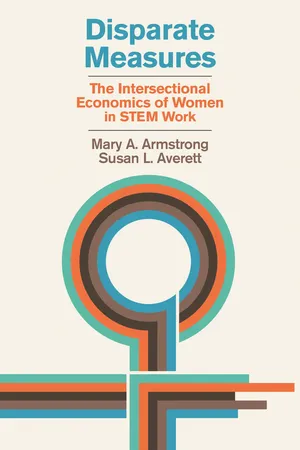
Seen as part economic driver, part social remedy, STEM work is commonly understood to benefit both the US economy and people—particularly women—from underrepresented groups. But what do diverse women find when they work in US STEM occupations? What do STEM jobs really deliver—and for whom? In Disparate Measures, Mary Armstrong and Susan Averett challenge the conventional wisdom that a diverse US STEM workforce will bring about economic abundance for the women who participate in it. Combining intersectionality theory and critical data theory with a feminist economic analysis, the authors explore how different groups of diverse women truly fare in US STEM professions.
Disparate Measures is centered on eight unique, in-depth case studies, each of which provides an intersectional economic analysis (a term coined by the authors) of diverse women working in STEM occupations. Four case studies prioritize women of color and examine the STEM participation and earnings of Black women, American Indian and Alaska Native women, Asian and Pacific Islander women, and Hispanic women/Latinas; four additional case studies illuminate intersections that are frequently neglected by the STEM inclusivity literature: foreign-born women, women with disabilities, Queer women, and mothers. What the authors find in their groundbreaking, detailed analysis is that the promises of STEM are only partly true: when compared to women not working in STEM, most women are indeed economically elevated by STEM occupations—yet when compared to white men in the same STEM occupations, women's second-class status is usually reaffirmed. The authors conclude by offering seven "big-picture" recommendations for rethinking STEM equity, showing just how we can successfully confront the entrenched patterns of economic disadvantage faced by diverse women in STEM jobs.
eBook - ePub
Disparate Measures
The Intersectional Economics of Women in STEM Work
- English
- ePUB (mobile friendly)
- Available on iOS & Android
eBook - ePub
Disparate Measures
The Intersectional Economics of Women in STEM Work
About this book
Trusted by 375,005 students
Access to over 1.5 million titles for a fair monthly price.
Study more efficiently using our study tools.
Information
Subtopic
Women in BusinessIndex
BusinessTable of contents
- Cover
- Contents
- Acknowledgments
- Introduction: True Lies—The Narratives of STEM Diversity
- 1 Intersectional Economic Analysis: Theory and Praxis
- 2 Gender and STEM Work: A Particular Economy
- 3 Black Women in STEM
- 4 American Indian and Alaska Native Women in STEM
- 5 Asian and Pacific Islander Women in STEM
- 6 Hispanic Women/Latinas in STEM
- 7 Foreign-Born Women in STEM
- 8 Women with Disabilities in STEM
- 9 Lesbians, Bisexual Women, Trans Women, and Gender-Nonbinary Individuals in STEM
- 10 Mothers in STEM
- 11 Realities and Possibilities: Rethinking the Economics of Women in STEM Work
- Appendix A: STEM Occupational Categories: American Community Survey and Current Population Survey
- Appendix B: STEM-Related Occupational Categories: American Community Survey and Current Population Survey
- Appendix C: STEM and STEM-Related Occupational Categories: National Health Interview Survey
- References
- Index
Frequently asked questions
Yes, you can cancel anytime from the Subscription tab in your account settings on the Perlego website. Your subscription will stay active until the end of your current billing period. Learn how to cancel your subscription
No, books cannot be downloaded as external files, such as PDFs, for use outside of Perlego. However, you can download books within the Perlego app for offline reading on mobile or tablet. Learn how to download books offline
Perlego offers two plans: Essential and Complete
- Essential is ideal for learners and professionals who enjoy exploring a wide range of subjects. Access the Essential Library with 800,000+ trusted titles and best-sellers across business, personal growth, and the humanities. Includes unlimited reading time and Standard Read Aloud voice.
- Complete: Perfect for advanced learners and researchers needing full, unrestricted access. Unlock 1.5M+ books across hundreds of subjects, including academic and specialized titles. The Complete Plan also includes advanced features like Premium Read Aloud and Research Assistant.
We are an online textbook subscription service, where you can get access to an entire online library for less than the price of a single book per month. With over 1.5 million books across 990+ topics, we’ve got you covered! Learn about our mission
Look out for the read-aloud symbol on your next book to see if you can listen to it. The read-aloud tool reads text aloud for you, highlighting the text as it is being read. You can pause it, speed it up and slow it down. Learn more about Read Aloud
Yes! You can use the Perlego app on both iOS and Android devices to read anytime, anywhere — even offline. Perfect for commutes or when you’re on the go.
Please note we cannot support devices running on iOS 13 and Android 7 or earlier. Learn more about using the app
Please note we cannot support devices running on iOS 13 and Android 7 or earlier. Learn more about using the app
Yes, you can access Disparate Measures by Mary A. Armstrong,Susan L. Averett in PDF and/or ePUB format, as well as other popular books in Business & Women in Business. We have over 1.5 million books available in our catalogue for you to explore.