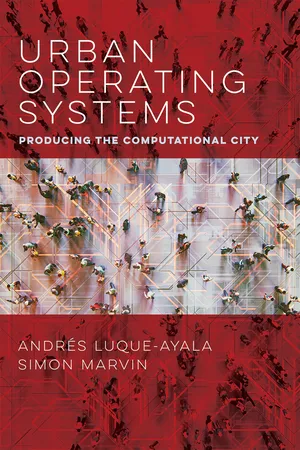
A new wave of enthusiasm for smart cities, urban data, and the Internet of Things has created the impression that computation can solve almost any urban problem. Subjecting this claim to critical scrutiny, in this book, Andrés Luque-Ayala and Simon Marvin examine the cultural, historical, and contemporary contexts in which urban computational logics have emerged. They consider the rationalities and techniques that constitute emerging computational forms of urbanization, including work on digital urbanism, smart cities, and, more recently, platform urbanism. They explore the modest potentials and serious contradictions of reconfiguring urban life, city services, and urban-networked infrastructure through computational operating systems—an urban OS.
Luque-Ayala and Marvin argue that in order to understand how digital technologies transform and shape the city, it is necessary to analyze the underlying computational logics themselves. Drawing on fieldwork that stretches across eleven cities in American, European, and Asian contexts, they investigate how digital products, services, and ecosystems are reshaping the ways in which the city is imagined, known, and governed. They discuss the reconstitution of the contemporary city through digital technologies, practices, and techniques, including data-driven governance, predictive analytics, digital mapping, urban sensing, digitally enabled control rooms, civic hacking, and open data narratives. Focusing on the relationship between the emerging operating systems of the city and their traditional infrastructures, they shed light on the political implications of using computer technologies to understand and generate new urban spaces and flows.
The open access edition of this book was made possible by generous funding from Arcadia – a charitable fund of Lisbet Rausing and Peter Baldwin.
eBook - ePub
Urban Operating Systems
Producing the Computational City
- English
- ePUB (mobile friendly)
- Available on iOS & Android
eBook - ePub
Urban Operating Systems
Producing the Computational City
About this book
Trusted by 375,005 students
Access to over 1.5 million titles for a fair monthly price.
Study more efficiently using our study tools.
Information
Table of contents
- Cover
- Contents
- Acknowledgments
- Chapter Credits
- 1 Introduction: Producing the Computational City
- 2 Operationalization: Diagramming the City through the Urban OS
- 3 Datafication: The Making of Data-as-Infrastructure
- 4 Sensing: Commodification through Hyperfragmentation
- 5 Mapping: The Computational Production of Territory
- 6 Prediction: The City as a Calculative Machine
- 7 Circulation: Maintaining Urban Flows under Turbulence
- 8 Resistance? Civic Hacking and an Operating System for Urban Occupation
- 9 Conclusion: The Urban OS as a Political Technology
- Notes
- References
- Index
Frequently asked questions
Yes, you can cancel anytime from the Subscription tab in your account settings on the Perlego website. Your subscription will stay active until the end of your current billing period. Learn how to cancel your subscription
No, books cannot be downloaded as external files, such as PDFs, for use outside of Perlego. However, you can download books within the Perlego app for offline reading on mobile or tablet. Learn how to download books offline
Perlego offers two plans: Essential and Complete
- Essential is ideal for learners and professionals who enjoy exploring a wide range of subjects. Access the Essential Library with 800,000+ trusted titles and best-sellers across business, personal growth, and the humanities. Includes unlimited reading time and Standard Read Aloud voice.
- Complete: Perfect for advanced learners and researchers needing full, unrestricted access. Unlock 1.5M+ books across hundreds of subjects, including academic and specialized titles. The Complete Plan also includes advanced features like Premium Read Aloud and Research Assistant.
We are an online textbook subscription service, where you can get access to an entire online library for less than the price of a single book per month. With over 1.5 million books across 990+ topics, we’ve got you covered! Learn about our mission
Look out for the read-aloud symbol on your next book to see if you can listen to it. The read-aloud tool reads text aloud for you, highlighting the text as it is being read. You can pause it, speed it up and slow it down. Learn more about Read Aloud
Yes! You can use the Perlego app on both iOS and Android devices to read anytime, anywhere — even offline. Perfect for commutes or when you’re on the go.
Please note we cannot support devices running on iOS 13 and Android 7 or earlier. Learn more about using the app
Please note we cannot support devices running on iOS 13 and Android 7 or earlier. Learn more about using the app
Yes, you can access Urban Operating Systems by Andrés Luque-Ayala,Simon Marvin, Janet Vertesi,Paul N. Edwards in PDF and/or ePUB format, as well as other popular books in Politics & International Relations & Artificial Intelligence (AI) & Semantics. We have over 1.5 million books available in our catalogue for you to explore.