Algorithms, data extraction, digital marketers monetizing "eyeballs": these all seem like such recent features of our lives. And yet, Lee McGuigan tells us in this eye-opening book, digital advertising was well underway before the widespread use of the Internet. Explaining how marketers have brandished the tools of automation and management science to exploit new profit opportunities, Selling the American People traces data-driven surveillance all the way back to the 1950s, when the computerization of the advertising business began to blend science, technology, and calculative cultures in an ideology of optimization. With that ideology came adtech, a major infrastructure of digital capitalism.
To help make sense of today's attention merchants and choice architects, McGuigan explores a few key questions: How did technical experts working at the intersection of data processing and management sciences come to command the center of gravity in the advertising and media industries? How did their ambition to remake marketing through mathematical optimization shape and reflect developments in digital technology? In short, where did adtech come from, and how did data-driven marketing come to mediate the daily encounters of people, products, and public spheres? His answers show how the advertising industry's efforts to bend information technologies toward its dream of efficiency and rational management helped to make "surveillance capitalism" one of the defining experiences of public life.
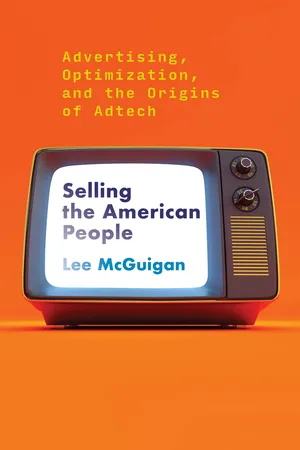
eBook - ePub
Selling the American People
Advertising, Optimization, and the Origins of Adtech
- English
- ePUB (mobile friendly)
- Available on iOS & Android
eBook - ePub
Selling the American People
Advertising, Optimization, and the Origins of Adtech
About this book
Trusted by 375,005 students
Access to over 1.5 million titles for a fair monthly price.
Study more efficiently using our study tools.
Information
Subtopic
Digital MarketingTable of contents
- Cover
- Series Page
- Title Page
- Copyright
- Contents
- Acknowledgments
- I: Dreams and Designs to Optimize Advertising
- II: An Archaeology of Affordances
- Conclusion
- Index
Frequently asked questions
Yes, you can cancel anytime from the Subscription tab in your account settings on the Perlego website. Your subscription will stay active until the end of your current billing period. Learn how to cancel your subscription
No, books cannot be downloaded as external files, such as PDFs, for use outside of Perlego. However, you can download books within the Perlego app for offline reading on mobile or tablet. Learn how to download books offline
Perlego offers two plans: Essential and Complete
- Essential is ideal for learners and professionals who enjoy exploring a wide range of subjects. Access the Essential Library with 800,000+ trusted titles and best-sellers across business, personal growth, and the humanities. Includes unlimited reading time and Standard Read Aloud voice.
- Complete: Perfect for advanced learners and researchers needing full, unrestricted access. Unlock 1.5M+ books across hundreds of subjects, including academic and specialized titles. The Complete Plan also includes advanced features like Premium Read Aloud and Research Assistant.
We are an online textbook subscription service, where you can get access to an entire online library for less than the price of a single book per month. With over 1.5 million books across 990+ topics, we’ve got you covered! Learn about our mission
Look out for the read-aloud symbol on your next book to see if you can listen to it. The read-aloud tool reads text aloud for you, highlighting the text as it is being read. You can pause it, speed it up and slow it down. Learn more about Read Aloud
Yes! You can use the Perlego app on both iOS and Android devices to read anytime, anywhere — even offline. Perfect for commutes or when you’re on the go.
Please note we cannot support devices running on iOS 13 and Android 7 or earlier. Learn more about using the app
Please note we cannot support devices running on iOS 13 and Android 7 or earlier. Learn more about using the app
Yes, you can access Selling the American People by Lee McGuigan, Joshua Braun,Ramon Lobato in PDF and/or ePUB format, as well as other popular books in Technology & Engineering & Digital Marketing. We have over 1.5 million books available in our catalogue for you to explore.