Silence is not absence. It may be perceived as meaningless, or it may not be perceived at all, but it takes up space. In Dissonant Records, Tanya Clement makes the case for spoken word audio recordings within the archives. She explains why we tend to not use these audio recordings in research, what silences exist in the cultural record, and what difference it makes when we start to listen. From recordings of the survivors of the 1921 Tulsa Massacre to Anne Sexton's recorded therapy sessions, Clement illustrates the myriad ways in which our current use of archives precludes the use of invaluable recorded texts.
Whom, what, and how are we not studying in our cultural histories? Why, Clement asks, do audio recordings typically garner little interest? This book dissects the institutional and disciplinary blockades that discourage the use of spoken word audio recordings in research and teaching while interrogating how institutions and researchers can be selectively biased in favor of print and against the seemingly more ephemeral, time-based objects of our archives. History making is a messy, sociotechnical process, the author explains, and our understanding of culture can only be made better when we listen more closely to the noise.
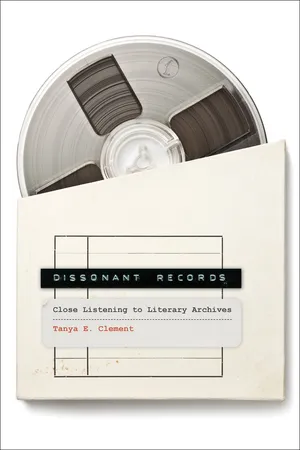
eBook - ePub
Dissonant Records
Close Listening to Literary Archives
- English
- ePUB (mobile friendly)
- Available on iOS & Android
eBook - ePub
Dissonant Records
Close Listening to Literary Archives
About this book
Trusted by 375,005 students
Access to over 1.5 million titles for a fair monthly price.
Study more efficiently using our study tools.
Information
Subtopic
Library & Information ScienceIndex
Social SciencesTable of contents
- Cover
- Series Page
- Title Page
- Copyright
- Dedication
- Contents
- Series Foreword
- Preface
- Introduction: Records and Resonance in the Archives
- 1. Amplify: Close Listening to Silencing and the 1921 Tulsa Race Massacre
- 2. Distortion: Authority, Authenticity, and Agency in Recordings of Zora Neale Hurston’s Black Folk
- 3. Interference: Silence and the Ideal Listener in Ralph Ellison’s American Novel
- 4. Compression: The Entelechy of Records in Anne Sexton’s Poem “For the Year of the Insane”
- 5. Reception: Conocimiento in Gloria Anzaldúa’s Spirituality Tapes
- Coda: Distant Listening and Resonance
- References
- Index
Frequently asked questions
Yes, you can cancel anytime from the Subscription tab in your account settings on the Perlego website. Your subscription will stay active until the end of your current billing period. Learn how to cancel your subscription
No, books cannot be downloaded as external files, such as PDFs, for use outside of Perlego. However, you can download books within the Perlego app for offline reading on mobile or tablet. Learn how to download books offline
We are an online textbook subscription service, where you can get access to an entire online library for less than the price of a single book per month. With over 1.5 million books across 990+ topics, we’ve got you covered! Learn about our mission
Look out for the read-aloud symbol on your next book to see if you can listen to it. The read-aloud tool reads text aloud for you, highlighting the text as it is being read. You can pause it, speed it up and slow it down. Learn more about Read Aloud
Yes! You can use the Perlego app on both iOS and Android devices to read anytime, anywhere — even offline. Perfect for commutes or when you’re on the go.
Please note we cannot support devices running on iOS 13 and Android 7 or earlier. Learn more about using the app
Please note we cannot support devices running on iOS 13 and Android 7 or earlier. Learn more about using the app
Yes, you can access Dissonant Records by Tanya E Clement, Elizabeth Losh,Jacqueline Wernimont in PDF and/or ePUB format, as well as other popular books in Social Sciences & Library & Information Science. We have over 1.5 million books available in our catalogue for you to explore.