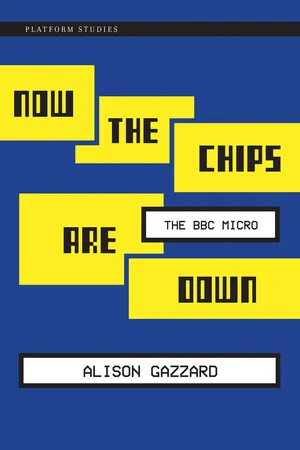
In 1982, the British Broadcasting Corporation launched its Computer Literacy Project, intended "to introduce interested adults to the world of computers and computing." The BBC accompanied this initiative with television programs, courses, books, and software—an early experiment in multi-platform education. The BBC, along with Acorn Computers, also introduced the BBC Microcomputer, which would be at the forefront of the campaign. The BBC Micro was designed to meet the needs of users in homes and schools, to demystify computing, and to counter the general pessimism among the media in Britain about technology. In this book, Alison Gazzard looks at the BBC Micro, examining the early capabilities of multi-platform content generation and consumption and the multiple literacies this approach enabled—not only in programming and software creation, but also in accessing information across a range of media, and in "do-it-yourself" computing. She links many of these early developments to current new-media practices.
Gazzard looks at games developed for the BBC Micro, including Granny's Garden, an educational game for primary schools, and Elite, the seminal space-trading game. She considers the shift in focus from hardware to peripherals, describing the Teletext Adapter as an early model for software distribution and the Domesday Project (which combined texts, video, and still photographs) as a hypermedia-like experience.
Gazzard's account shows the BBC Micro not only as a vehicle for various literacies but also as a user-oriented machine that pushed the boundaries of what could be achieved in order to produce something completely new.
- English
- ePUB (mobile friendly)
- Available on iOS & Android
eBook - ePub
About this book
Information
Subtopic
Computer Science GeneralIndex
Computer ScienceTable of contents
- Cover
- Series page
- Title page
- Copyright page
- Contents
- Series Foreword
- Acknowledgments
- Introduction
- I Hardware and Software Literacies
- II Making and Playing Games
- III Extending the Platform
- Index
Trusted by 375,005 students
Access to over 1.5 million titles for a fair monthly price.
Study more efficiently using our study tools.
Frequently asked questions
Yes, you can cancel anytime from the Subscription tab in your account settings on the Perlego website. Your subscription will stay active until the end of your current billing period. Learn how to cancel your subscription
No, books cannot be downloaded as external files, such as PDFs, for use outside of Perlego. However, you can download books within the Perlego app for offline reading on mobile or tablet. Learn how to download books offline
Perlego offers two plans: Essential and Complete
- Essential is ideal for learners and professionals who enjoy exploring a wide range of subjects. Access the Essential Library with 800,000+ trusted titles and best-sellers across business, personal growth, and the humanities. Includes unlimited reading time and Standard Read Aloud voice.
- Complete: Perfect for advanced learners and researchers needing full, unrestricted access. Unlock 1.5M+ books across hundreds of subjects, including academic and specialized titles. The Complete Plan also includes advanced features like Premium Read Aloud and Research Assistant.
We are an online textbook subscription service, where you can get access to an entire online library for less than the price of a single book per month. With over 1.5 million books across 990+ topics, we’ve got you covered! Learn about our mission
Look out for the read-aloud symbol on your next book to see if you can listen to it. The read-aloud tool reads text aloud for you, highlighting the text as it is being read. You can pause it, speed it up and slow it down. Learn more about Read Aloud
Yes! You can use the Perlego app on both iOS and Android devices to read anytime, anywhere — even offline. Perfect for commutes or when you’re on the go.
Please note we cannot support devices running on iOS 13 and Android 7 or earlier. Learn more about using the app
Please note we cannot support devices running on iOS 13 and Android 7 or earlier. Learn more about using the app
Yes, you can access Now the Chips Are Down by Alison Gazzard, Ian Bogost,Nick Montfort in PDF and/or ePUB format, as well as other popular books in Computer Science & Computer Science General. We have over 1.5 million books available in our catalogue for you to explore.