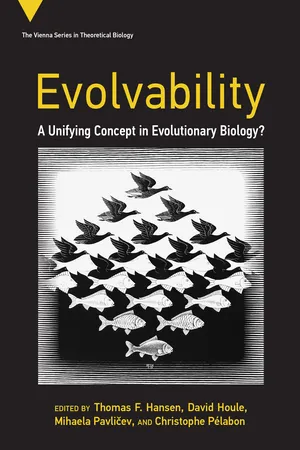
Evolvability—the capability of organisms to evolve—wasn't recognized as a fundamental concept in evolutionary theory until 1990. Though there is still some debate as to whether it represents a truly new concept, the essays in this volume emphasize its value in enabling new research programs and facilitating communication among the major disciplines in evolutionary biology. The contributors, many of whom were instrumental in the development of the concept of evolvability, synthesize what we have learned about it over the past thirty years. They focus on the historical and philosophical contexts that influenced the emergence of the concept and suggest ways to develop a common language and theory to drive further evolvability research.
The essays, drawn from a workshop on evolvability hosted in 2019–2020 by the Center of Advanced Study at the Norwegian Academy of Science and Letters, in Oslo, provide scientific and historical background on evolvability. The contributors represent different disciplines of evolutionary biology, including quantitative and population genetics, evolutionary developmental biology, systems biology, and macroevolution, as well as the philosophy of science. This plurality of approaches allows researchers in disciplines as diverse as developmental biology, molecular biology, and systems biology to communicate with those working in mainstream evolutionary biology. The contributors also discuss key questions at the forefront of research on evolvability.
Contributors:
J. David Aponte, W. Scott Armbruster, Geir H. Bolstad, Salomé Bourg, Ingo Brigandt, Anne Calof, James M. Cheverud, Josselin Clo, Frietson Galis, Mark Grabowski, Rebecca Green, Benedikt Hallgrímsson, Thomas F. Hansen, Agnes Holstad, David Houle, David Jablonski, Arthur Lander, Arnaud LeRouzic, Alan C. Love, Ralph Marcucio, Michael B. Morrissey, Laura Nuño de la Rosa, Øystein H. Opedal, Mihaela Pavličev, Christophe Pélabon, Jane M. Reid, Heather Richbourg, Jacqueline L. Sztepanacz, Masahito Tsuboi, Cristina Villegas, Marta Vidal-García, Kjetil L. Voje, Andreas Wagner, Günter P. Wagner, Nathan M. Young
eBook - ePub
Evolvability
A Unifying Concept in Evolutionary Biology?
- English
- ePUB (mobile friendly)
- Available on iOS & Android
eBook - ePub
Evolvability
A Unifying Concept in Evolutionary Biology?
About this book
Information
Subtopic
BiologyIndex
Biological SciencesTable of contents
- Cover
- Series Page
- Title Page
- Copyright
- Table of Contents
- Series Foreword
- 1. Introduction: Evolvability
- 2. A History of Evolvability: Reconstructing and Explaining the Origination of a Research Agenda
- 3. Conceptual Roles of Evolvability across Evolutionary Biology: Between Diversity and Unification
- 4. Evolvability as a Disposition: Philosophical Distinctions, Scientific Implications
- 5. Variation, Inheritance, and Evolution: A Primer on Evolutionary Quantitative Genetics
- 6. Measuring Evolvability
- 7. The Evolution of Evolvability
- 8. The Genotype-Phenotype Map Structure and Its Role in Evolvability
- 9. The Developmental Basis for Evolvability
- 10. Models of Contingent Evolvability Suggest Dynamical Instabilities in Body Shape Evolution
- 11. Mutational Robustness and Evolvability
- 12. Evolvability, Sexual Selection, and Mating Strategies
- 13. Can We Explain Variation in Evolvability on Ecological Timescales?
- 14. Does Lack of Evolvability Constrain Adaptation? If So, on What Timescales?
- 15. Evolvability of Flowers: Macroevolutionary Indicators of Adaptive Paths of Least Resistance
- 16. Evolvability of Body Plans: On Phylotypic Stages, Developmental Modularity, and an Ancient Metazoan Constraint
- 17. Evolvability and Macroevolution
- 18. Conclusion: Is Evolvability a New and Unifying Concept?
- Contributors
- Index
Trusted by 375,005 students
Access to over 1.5 million titles for a fair monthly price.
Study more efficiently using our study tools.
Frequently asked questions
Yes, you can cancel anytime from the Subscription tab in your account settings on the Perlego website. Your subscription will stay active until the end of your current billing period. Learn how to cancel your subscription
No, books cannot be downloaded as external files, such as PDFs, for use outside of Perlego. However, you can download books within the Perlego app for offline reading on mobile or tablet. Learn how to download books offline
Perlego offers two plans: Essential and Complete
- Essential is ideal for learners and professionals who enjoy exploring a wide range of subjects. Access the Essential Library with 800,000+ trusted titles and best-sellers across business, personal growth, and the humanities. Includes unlimited reading time and Standard Read Aloud voice.
- Complete: Perfect for advanced learners and researchers needing full, unrestricted access. Unlock 1.5M+ books across hundreds of subjects, including academic and specialized titles. The Complete Plan also includes advanced features like Premium Read Aloud and Research Assistant.
We are an online textbook subscription service, where you can get access to an entire online library for less than the price of a single book per month. With over 1.5 million books across 990+ topics, we’ve got you covered! Learn about our mission
Look out for the read-aloud symbol on your next book to see if you can listen to it. The read-aloud tool reads text aloud for you, highlighting the text as it is being read. You can pause it, speed it up and slow it down. Learn more about Read Aloud
Yes! You can use the Perlego app on both iOS and Android devices to read anytime, anywhere — even offline. Perfect for commutes or when you’re on the go.
Please note we cannot support devices running on iOS 13 and Android 7 or earlier. Learn more about using the app
Please note we cannot support devices running on iOS 13 and Android 7 or earlier. Learn more about using the app
Yes, you can access Evolvability by Thomas F. Hansen,David Houle,Mihaela Pavličev,Christophe Pélabon, Gerd B. Müller,Katrin Schäfer,Thomas Pradeu in PDF and/or ePUB format, as well as other popular books in Biological Sciences & Biology. We have over 1.5 million books available in our catalogue for you to explore.