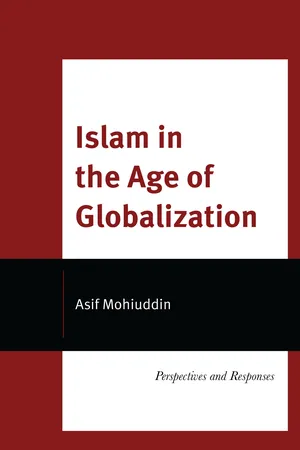
Globalization has been a central theme in political, economic, cultural, and religious debates since the turn of the century. While some see it as a solution, others consider it the root of our problems. The intensification of cultural and military warfare, and the "West v. the Rest" mentality, fuels a deep-seated ethnocentrism. Religion, meanwhile, faces scrutiny from various fundamentalisms and grand narratives. Many modern Muslim thinkers are skeptical of globalization, perceiving it as a homogenizing force that spreads Western culture and concentrates power among a few nations. They argue that Islam promotes human oneness and provides an intellectual and spiritual framework for a more civilized and universal approach to globalization, opposing the Western-centric hegemonic tendencies.
The goal of this book is to demonstrate that Islam favors globalization in its original, voluntary form, as opposed to the violent imposition of the West on the East. It will examine Muslim responses to globalization and their attempts to find global answers to local problems in their own local, regional, national, and global contexts. Several academic works have explored various aspects of globalization, focusing on tensions and conflicts, such as power politics, religious authority, and legislative issues. However, there is a notable absence of attention given to the Islamic perspective on globalization, including both appreciation and critique. This book addresses this gap by offering not only a Muslim critique of globalization but also a broader framework for understanding Islam's unique perspective on globalization. Does globalization support the inclusivity that Islam advocates? How does Islam fit into the globalization era? What impact and influence may Muslims have on the future of globalization? What unique prospects does globalization provide Muslims and the Islamic faith? Is Islamic revivalism a reaction to globalization? Alternatives to globalization could exist. What kind of structure will the Islamic globalization paradigm have?
In addition to addressing these questions, the book attempts to provide a theoretical framework for Islamic globalization, which incorporates the shuratic practice and the vision of an international community extending beyond the Arabs and non-Arabs. This underscores the importance of historical contexts for contemporary actions and beliefs. In the process the book attempts to extend the debate on Islam and globalization by mapping out the effects of globalization on various aspects of Muslim culture.
- 359 pages
- English
- PDF
- Available on iOS & Android
eBook - PDF
About this book
Information
Topic
Theology & ReligionSubtopic
GlobalisationTable of contents
- Cover
- Half Title
- Series Page
- Title Page
- Copyright Page
- Contents
- Foreword
- Acknowledgments
- Introduction
- Part I: Globalization and Islam
- Chapter 1: Revisiting Globalization: Definitions, Discourses, and Domains
- Chapter 2: Globalization and Islam: Exploring the Alternative Paradigm
- Chapter 3: From Globalization to Global Islam: Tracing Intersections and Convergence
- Chapter 4: Islamic Revivalism in the Era of Globalization: Unraveling the Dynamics of Religion, Culture, and Resistance
- Part II: Adaptive Islam
- Chapter 5: Embracing or Resisting Globalization? Ali Mazrui’s Exploration of Interdependence and the Muslim World’s Dilemma
- Chapter 6: Islam and the Globalization Paradox: Akbar Ahmad’s Reflections on Crisis and Resilience
- Chapter 7: Toward a Moral Dimension in Globalization: Umar Chapra’s Exploration of Islam’s Response to Economic Challenges
- Chapter 8: Islamic Thought in the Age of Globalization: Ibrahim Abu Rabi’s Perspective on Epistemological, Ethical, and Socioeconomic Changes
- Conclusion
- Bibliography
- Index
- About the Author
Trusted by 375,005 students
Access to over 1.5 million titles for a fair monthly price.
Study more efficiently using our study tools.
Frequently asked questions
Yes, you can cancel anytime from the Subscription tab in your account settings on the Perlego website. Your subscription will stay active until the end of your current billing period. Learn how to cancel your subscription
No, books cannot be downloaded as external files, such as PDFs, for use outside of Perlego. However, you can download books within the Perlego app for offline reading on mobile or tablet. Learn how to download books offline
Perlego offers two plans: Essential and Complete
- Essential is ideal for learners and professionals who enjoy exploring a wide range of subjects. Access the Essential Library with 800,000+ trusted titles and best-sellers across business, personal growth, and the humanities. Includes unlimited reading time and Standard Read Aloud voice.
- Complete: Perfect for advanced learners and researchers needing full, unrestricted access. Unlock 1.5M+ books across hundreds of subjects, including academic and specialized titles. The Complete Plan also includes advanced features like Premium Read Aloud and Research Assistant.
We are an online textbook subscription service, where you can get access to an entire online library for less than the price of a single book per month. With over 1.5 million books across 990+ topics, we’ve got you covered! Learn about our mission
Look out for the read-aloud symbol on your next book to see if you can listen to it. The read-aloud tool reads text aloud for you, highlighting the text as it is being read. You can pause it, speed it up and slow it down. Learn more about Read Aloud
Yes! You can use the Perlego app on both iOS and Android devices to read anytime, anywhere — even offline. Perfect for commutes or when you’re on the go.
Please note we cannot support devices running on iOS 13 and Android 7 or earlier. Learn more about using the app
Please note we cannot support devices running on iOS 13 and Android 7 or earlier. Learn more about using the app
Yes, you can access Islam in the Age of Globalization by Asif Mohiuddin in PDF and/or ePUB format, as well as other popular books in Theology & Religion & Globalisation. We have over 1.5 million books available in our catalogue for you to explore.