The post-Cold War order established by the United States of America is currently at a crossroads. No longer is the liberal order and United States hegemonic power a given. Moscow and Beijing have both begun their challenges to the United States. While long dissatisfied with US hegemony, in February, 2022, Russian President Vladimir Putin ordered the invasion of Ukraine by the Russian military.
The response by the United States and its allies was swift and unprecedented. Wave after wave of sanctions were levied against Moscow, and NATO member states began to provide military support to Kyiv in trying to maintain its independence from Moscow. The first major war on the European continent since World War II was to have a profound global effect on relations with other countries. First, there was a significant demographic impact as migrants left Ukraine either to the West or to Russia. Further, as men were prevented from leaving Ukraine due to mandatory conscription, the refugees were overwhelmingly made up of either old people, or women with children. Russia also was not spared from a huge demographic crisis. Not only has it lost an enormous amount of young men to the war, but it also instituted forced conscription, leading to many men fleeing the country.
Initially Washington described the invasion of Ukraine as a war between democracy and autocracy, with Kyiv being on the front lines of this new war. However, the real situation was much more complicated than a simple framing of the conflict. While Kyiv enjoyed overwhelming support from the United States and its NATO allies, other democracies globally were a lot warier of supporting Ukraine. Countries like India, Turkey, Hungary, South Africa, Brazil, and other democracies began a strategy of hedging. Publicly, they urged caution in the conflict stating that while Moscow possessed legitimate security concerns, that the conflict had to be resolved peacefully.
The hedging strategy employed by much of the world confused Washington, however, the United States found its attention torn between two continents. The war in Ukraine was its main concern, however, a newly resurgent China threatened to begin its own war against Taiwan. Washington could ill afford a diplomatic blitz to force hedging states to support its policies in Kyiv. Moscow, on the other hand, recognized that it stood to gain from Washington's focus. It began to bolster its diplomatic efforts to woo those hedging countries into not aligning with the United States. Further, the alliance between Moscow and Beijing deepened during this period. In other words, a period of tremendous uncertainty about the future of the global order was born.
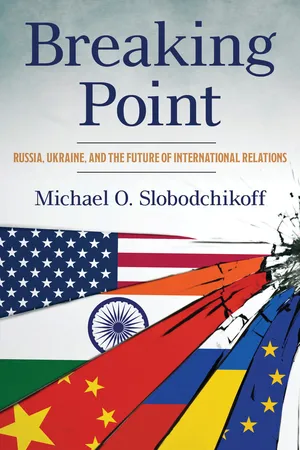
In this book, we examine the aftermath of Moscow's invasion and its implications on the global order. In this edited volume, we first examine the regional effects of the invasion. We then examine Moscow's relations with other states globally, and argue that while it is not possible to predict who will win the war in Ukraine, that the war has had a profound impact on both Russia's relations with the world as well as on the United States' global relations.
eBook - PDF
Breaking Point
Russia, Ukraine, and the Future of International Relations
- 207 pages
- English
- PDF
- Available on iOS & Android
eBook - PDF
About this book
Information
Table of contents
- Cover
- Half Title
- Title Page
- Copyright Page
- Dedication
- Contents
- Acknowledgments
- Part 1
- Part 2
- Index
- About the Editor and Contributors
Trusted by 375,005 students
Access to over 1.5 million titles for a fair monthly price.
Study more efficiently using our study tools.
Frequently asked questions
Yes, you can cancel anytime from the Subscription tab in your account settings on the Perlego website. Your subscription will stay active until the end of your current billing period. Learn how to cancel your subscription
No, books cannot be downloaded as external files, such as PDFs, for use outside of Perlego. However, you can download books within the Perlego app for offline reading on mobile or tablet. Learn how to download books offline
Perlego offers two plans: Essential and Complete
- Essential is ideal for learners and professionals who enjoy exploring a wide range of subjects. Access the Essential Library with 800,000+ trusted titles and best-sellers across business, personal growth, and the humanities. Includes unlimited reading time and Standard Read Aloud voice.
- Complete: Perfect for advanced learners and researchers needing full, unrestricted access. Unlock 1.5M+ books across hundreds of subjects, including academic and specialized titles. The Complete Plan also includes advanced features like Premium Read Aloud and Research Assistant.
We are an online textbook subscription service, where you can get access to an entire online library for less than the price of a single book per month. With over 1.5 million books across 990+ topics, we’ve got you covered! Learn about our mission
Look out for the read-aloud symbol on your next book to see if you can listen to it. The read-aloud tool reads text aloud for you, highlighting the text as it is being read. You can pause it, speed it up and slow it down. Learn more about Read Aloud
Yes! You can use the Perlego app on both iOS and Android devices to read anytime, anywhere — even offline. Perfect for commutes or when you’re on the go.
Please note we cannot support devices running on iOS 13 and Android 7 or earlier. Learn more about using the app
Please note we cannot support devices running on iOS 13 and Android 7 or earlier. Learn more about using the app
Yes, you can access Breaking Point by Michael O. Slobodchikoff in PDF and/or ePUB format, as well as other popular books in Politics & International Relations & Military & Maritime History. We have over 1.5 million books available in our catalogue for you to explore.