Moving from cosmology to creativity to criminology, the Torah explores the breadth of human existence: ethics and ritual, narratives of Patriarchs and Matriarchs, history and a philosophy of history--all of these drive the first five books of Hebrew Scripture. But as Rabbi Hillel Goldberg explains in this probing and insightful commentary, these sacred texts are governed by one idea-one God. God blesses the human being with power, and also imposes limits. A human being may not kill, not commit any sacrilege, not act unjustly. God retains ultimate power, including the prerogative to make ethical, ritual, and spiritual laws, which fill the Torah. The Torah is a kaleidoscope, and Rabbi Goldberg refracts it through its fifty-four prisms-its fifty-four chapters. But a single reality undergirds all-one God.
Rabbi Goldberg's exploration of the diversity of disciplines in the Torah demonstrates how naturally the idea of monotheism emerges. In Genesis, God chooses one family to carry out His mission in history. The book of Exodus narrates God's liberation of this family's descendants in order to bring His mission to fruition. Leviticus details the laws by which God's people serve Him through ethics, ritual, even agriculture. Numbers begins with the metahistory of God's people as He sustains it with manna and guides it with a pillar of fire and a pillar of cloud; then resumes the history of His people as it wages war and prepares to conquer the promised land. Fearful of idolatry there, Moses in Deuteronomy concludes his exhortation to remain faithful to the invisible presence of God.
Bible commentary, according to Rabbi Goldberg, should mirror the many ways God enters into the human experience. Offering philosophic inquiry, personal reflection, and fresh exegesis-plus a touch of poetry, humor, and storytelling-God Spoke Once, I Heard Twice is a brilliant, learned, and inspired contribution to an ongoing chronicle of faith.
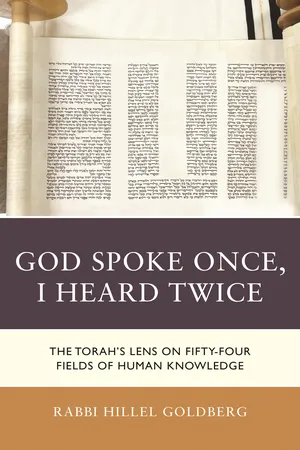
eBook - PDF
God Spoke Once, I Heard Twice
The Torah’s Lens on Fifty-Four Fields of Human Knowledge
- 459 pages
- English
- PDF
- Available on iOS & Android
eBook - PDF
God Spoke Once, I Heard Twice
The Torah’s Lens on Fifty-Four Fields of Human Knowledge
About this book
Information
Topic
Theology & ReligionSubtopic
Jewish TheologyTable of contents
- Cover
- Half Title
- Title Page
- Copyright Page
- Dedication
- Epigraph
- Contents
- Acknowledgments
- Introduction to the Torah
- Introduction to the Book
- Technical Note
- Part I: Genesis
- Genesis
- Chapter 1: Science: “Genesis”
- Chapter 2: Culture: “Noah”
- Chapter 3: Literature: “Go You Forth”
- Chapter 4: Philosophy: “And [God] Appeared”
- Chapter 5: The Personal: “The Life of Sarah”
- Chapter 6: Ethics, I: Practice
- Chapter 7: Storytelling: “And He [Jacob] Departed”
- Chapter 8: Marriage: “And Jacob Sent”
- Chapter 9: Journalism: “And He [Jacob] Settled”
- Chapter 10: Dreams: “At the End”
- Chapter 11: Typology: “And He [Judah] Approached”
- Chapter 12: Family: “And He [Jacob] Lived”
- Part II: Exodus
- Exodus
- Chapter 13: Hatred: “Exodus”
- Chapter 14: Leadership: “And He [God] Appeared”
- Chapter 15: Hegelianism: “Come”
- Chapter 16: Miracle: “When He [Pharaoh] Sent Out”
- Chapter 17: Sleuthing: “Jethro”
- Chapter 18: Exegesis: “Ordinances”
- Chapter 19: Emotion: “Portion”
- Chapter 20: Theology: “And You Shall Command”
- Chapter 21: Creativity: “When You Take a Census”
- Chapter 22: Music: “And He [Moses] Gathered”
- Chapter 23: Collective Memory: “Reckonings”
- Part III: Leviticus
- Leviticus
- Chapter 24: Cultural Anthropology: “And He [God] Called”
- Chapter 25: Allegory: “Command”
- Chapter 26: Eulogy: “Eighth”
- Chapter 27: Psychology: “She Shall Seed”
- Chapter 28: Ecology: “Leper”
- Chapter 29: Randomness: “After the Death”
- Chapter 30: Love: “You Shall Be Holy”
- Chapter 31: Holiness: “Saying”
- Chapter 32: Criminology: “On Mount [Sinai]”
- Chapter 33: Philosophy of History: “In My Statutes”
- Part IV: Numbers
- Numbers
- Chapter 34: Government, I: The Ideal
- Chapter 35: The Supernatural: “Take a Census”
- Chapter 36: Poetry: “When You Kindle”
- Chapter 37: Anthropomorphism: “Send Forth”
- Chapter 38: Government, II: The Reality
- Chapter 39: Asceticism: “Statute”
- Chapter 40: Humor: “Balak”
- Chapter 41: Territorial Imperative: “Phineas”
- Chapter 42: Kabbalah: “Tribes”
- Chapter 43: Geography: “Journeys”
- Part V: Deuteronomy
- Deuteronomy
- Chapter 44: Existentialism: “Words”
- Chapter 45: Reason: “And I Beseeched”
- Chapter 46: Racism and Covenant: “As a Result”
- Chapter 47: Polemics: “See”
- Chapter 48: Civil Law: “Judges”
- Chapter 49: War: “When You Go Out [to War]”
- Chapter 50: Ethics, II: Theory
- Chapter 51: Generation: “Standing”
- Chapter 52: Biblical Criticism: “And He Went”
- Chapter 53: Typography and Calligraphy: “Give Ear”
- Chapter 54: Intimacy: “And This Is the Blessing”
- Conclusion
- Bibliography
- Subject Index
- Scripture Index
- About the Author
Trusted by 375,005 students
Access to over 1.5 million titles for a fair monthly price.
Study more efficiently using our study tools.
Frequently asked questions
Yes, you can cancel anytime from the Subscription tab in your account settings on the Perlego website. Your subscription will stay active until the end of your current billing period. Learn how to cancel your subscription
No, books cannot be downloaded as external files, such as PDFs, for use outside of Perlego. However, you can download books within the Perlego app for offline reading on mobile or tablet. Learn how to download books offline
Perlego offers two plans: Essential and Complete
- Essential is ideal for learners and professionals who enjoy exploring a wide range of subjects. Access the Essential Library with 800,000+ trusted titles and best-sellers across business, personal growth, and the humanities. Includes unlimited reading time and Standard Read Aloud voice.
- Complete: Perfect for advanced learners and researchers needing full, unrestricted access. Unlock 1.5M+ books across hundreds of subjects, including academic and specialized titles. The Complete Plan also includes advanced features like Premium Read Aloud and Research Assistant.
We are an online textbook subscription service, where you can get access to an entire online library for less than the price of a single book per month. With over 1.5 million books across 990+ topics, we’ve got you covered! Learn about our mission
Look out for the read-aloud symbol on your next book to see if you can listen to it. The read-aloud tool reads text aloud for you, highlighting the text as it is being read. You can pause it, speed it up and slow it down. Learn more about Read Aloud
Yes! You can use the Perlego app on both iOS and Android devices to read anytime, anywhere — even offline. Perfect for commutes or when you’re on the go.
Please note we cannot support devices running on iOS 13 and Android 7 or earlier. Learn more about using the app
Please note we cannot support devices running on iOS 13 and Android 7 or earlier. Learn more about using the app
Yes, you can access God Spoke Once, I Heard Twice by Rabbi Dr. Hillel Goldberg in PDF and/or ePUB format, as well as other popular books in Theology & Religion & Jewish Theology. We have over 1.5 million books available in our catalogue for you to explore.