From the award-winning author of Revolutionizing the Sciences, a monumental historical account of how we came to see the world through the lens of science
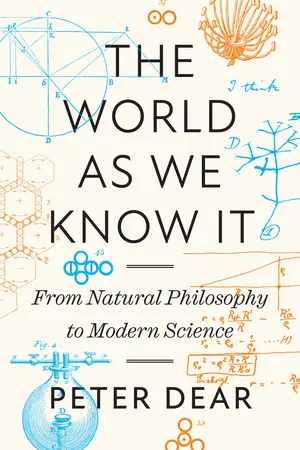
Science is the basis of our assumptions about ourselves and our world, from ideas about our evolutionary past to our conceptions of the vast expanses of space and the smallest particles of matter. In this panoramic book, acclaimed historian of science Peter Dear uncovers the roots of such beliefs, revealing how they constitute a natural philosophy that has been developed and refined over the course of centuries—and how the world as we have come to know it was by no means inevitable.
In a sweeping, multifaceted narrative, Dear describes some of the most breathtaking accomplishments in the advance of human knowledge, such as Isaac Newton’s laws of motion and gravitation, Carl Linnaeus’s taxonomy, Antoine Lavoisier’s new chemistry, Charles Darwin’s theory of evolution, and Albert Einstein’s theories of relativity. Challenging the notion that science is only about “making discoveries,” he shows how our world has been formed by people, institutions, and cultural assumptions, giving rise to disciplines ranging from biology and astrophysics to electromagnetism and the social sciences.
Taking readers from the early eighteenth century to today, The World as We Know It reveals how our ideas about our place in the universe were bequeathed to us by individuals, cultures, and a curiosity that knows no bounds.
- English
- ePUB (mobile friendly)
- Available on iOS & Android
eBook - ePub
About this book
Information
Publisher
Princeton University PressYear
2025Print ISBN
9780691236520
9780691235844
eBook ISBN
9780691235851
Table of contents
- Cover Page
- Title Page
- Copyright Page
- Dedication
- Contents
- Introduction: Natural Philosophy and the Sciences
- 1. Divine Order: Isaac Newton and Physico-Theology
- 2. Celestial Order and Universal Gravity
- 3. Mixed Mathematics and Probability
- 4. Inventories of Electricity
- 5. Organization: Living Things
- 6. Cleaning up Chemistry: The Classification of Matter
- 7. Laplace, Revolutionary Order, and the Invention of Mathematical Physics
- Entr’acte: Institutions and Pedagogy
- 8. Classification and Extinction: Cuvier and Natural History in the Early Nineteenth Century
- 9. Darwin’s Taxonomy: Geology and the Organization of Life
- 10. Evolution and Scientific Naturalism
- 11. Thermodynamics and Modern Physics
- 12. Chance and Determinism: New Models of Science
- 13. Electromagnetism, Action at a Distance, and Aether
- 14. The Chemical Use of Atoms
- 15. Laboratories of the Heavens: Physics in the Observatory
- 16. New Modes of Natural Philosophy
- Conclusion. The World We Have Gained … and Lost
- Acknowledgments
- Notes
- Bibliography
- Index
Trusted by 375,005 students
Access to over 1.5 million titles for a fair monthly price.
Study more efficiently using our study tools.
Frequently asked questions
Yes, you can cancel anytime from the Subscription tab in your account settings on the Perlego website. Your subscription will stay active until the end of your current billing period. Learn how to cancel your subscription
No, books cannot be downloaded as external files, such as PDFs, for use outside of Perlego. However, you can download books within the Perlego app for offline reading on mobile or tablet. Learn how to download books offline
Perlego offers two plans: Essential and Complete
- Essential is ideal for learners and professionals who enjoy exploring a wide range of subjects. Access the Essential Library with 800,000+ trusted titles and best-sellers across business, personal growth, and the humanities. Includes unlimited reading time and Standard Read Aloud voice.
- Complete: Perfect for advanced learners and researchers needing full, unrestricted access. Unlock 1.5M+ books across hundreds of subjects, including academic and specialized titles. The Complete Plan also includes advanced features like Premium Read Aloud and Research Assistant.
We are an online textbook subscription service, where you can get access to an entire online library for less than the price of a single book per month. With over 1.5 million books across 990+ topics, we’ve got you covered! Learn about our mission
Look out for the read-aloud symbol on your next book to see if you can listen to it. The read-aloud tool reads text aloud for you, highlighting the text as it is being read. You can pause it, speed it up and slow it down. Learn more about Read Aloud
Yes! You can use the Perlego app on both iOS and Android devices to read anytime, anywhere — even offline. Perfect for commutes or when you’re on the go.
Please note we cannot support devices running on iOS 13 and Android 7 or earlier. Learn more about using the app
Please note we cannot support devices running on iOS 13 and Android 7 or earlier. Learn more about using the app
Yes, you can access The World as We Know It by Peter Dear in PDF and/or ePUB format, as well as other popular books in History & Science History. We have over 1.5 million books available in our catalogue for you to explore.