Love and Romance in China examines love, affection, and emotions in China from Maoist to contemporary China, focusing on the intersections with politics, economics, gender, class, race and technology.
From the founding of the People's Republic of China to the end of the Cultural Revolution, political ideology and class struggle dominated everyday life, and love was subordinated to the communist revolution and socialism. During the Cultural Revolution, this turbulent period witnessed the paradoxical existence of self-abstinence and self-indulgence. Since China changed its political ideology in 1979 and shifted to a market-oriented economy, the country embraced the idea of romantic love. This "emotional turn" fostered opportunities for diverse intimate relationships characterized by the growth of cross-cultural love, LGBTQI+ love, and the emergence of a "sexual revolution" (Zhang 2011; Jeffreys and Yu 2015). The new dynamic was linked to contested discourses of (fantasised, eroticized, and racialized) foreign love intertwined with nationalist sentiments and ongoing tensions between sexual minorities and the government. The new millennium has witnessed love crises characterised by growing concerns about "leftover" men and women, high divorce rates, declining marriage and birth rates, and other relationship problems. The deepening of the market economy and technological advances have turned love into a "fast food" commodity for mass consumption, manifested in dating shows, digital platforms and intimacy between humans and AI/dolls.
Wang draws on a wide range of texts, including government statistics on marriages and divorces, legal documents, Maoist folk songs, poems, posters, love letters, media texts, popular discourses, online dating websites, and ethnographic observations and interviews.
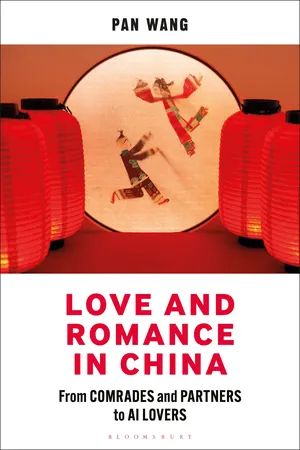
- English
- ePUB (mobile friendly)
- Available on iOS & Android
eBook - ePub
About this book
Information
Table of contents
- Cover
- Half-Title
- Title
- Contents
- List of figures
- About the author
- Acknowledgements
- Abbreviations
- 1 Introduction
- 2 Love and China’s socialist revolutions (1950s–1970s)
- 3 Love under market reform (1980s–2020s)
- 4 Intercultural love
- 5 LGBTQ+ love and rights
- 6 Love crises
- 7 A booming singles ‘love economy’
- 8 Conclusion
- Notes
- Glossary
- References
- Index
- Copyright
Trusted by 375,005 students
Access to over 1.5 million titles for a fair monthly price.
Study more efficiently using our study tools.
Frequently asked questions
Yes, you can cancel anytime from the Subscription tab in your account settings on the Perlego website. Your subscription will stay active until the end of your current billing period. Learn how to cancel your subscription
No, books cannot be downloaded as external files, such as PDFs, for use outside of Perlego. However, you can download books within the Perlego app for offline reading on mobile or tablet. Learn how to download books offline
Perlego offers two plans: Essential and Complete
- Essential is ideal for learners and professionals who enjoy exploring a wide range of subjects. Access the Essential Library with 800,000+ trusted titles and best-sellers across business, personal growth, and the humanities. Includes unlimited reading time and Standard Read Aloud voice.
- Complete: Perfect for advanced learners and researchers needing full, unrestricted access. Unlock 1.5M+ books across hundreds of subjects, including academic and specialized titles. The Complete Plan also includes advanced features like Premium Read Aloud and Research Assistant.
We are an online textbook subscription service, where you can get access to an entire online library for less than the price of a single book per month. With over 1.5 million books across 990+ topics, we’ve got you covered! Learn about our mission
Look out for the read-aloud symbol on your next book to see if you can listen to it. The read-aloud tool reads text aloud for you, highlighting the text as it is being read. You can pause it, speed it up and slow it down. Learn more about Read Aloud
Yes! You can use the Perlego app on both iOS and Android devices to read anytime, anywhere — even offline. Perfect for commutes or when you’re on the go.
Please note we cannot support devices running on iOS 13 and Android 7 or earlier. Learn more about using the app
Please note we cannot support devices running on iOS 13 and Android 7 or earlier. Learn more about using the app
Yes, you can access Love and Romance in China by Pan Wang in PDF and/or ePUB format, as well as other popular books in History & Chinese History. We have over 1.5 million books available in our catalogue for you to explore.