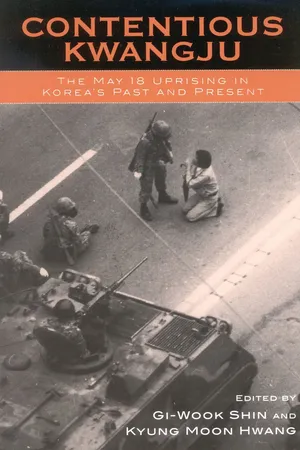
One of the largest political protests in contemporary Korean history, the May 1980 Kwangju Uprising still exerts a profound, often contested, influence in Korean society. Through a deft combination of personal reflections and academic analysis, Contentious Kwangju offers a comprehensive examination of the multiple, shifting meanings of this seminal event and explains how the memory of Kwangju has affected Korean life from politics to culture. The first half of the book offers highly personal perspectives on the details of the uprising itself, including the Citizens' Army, the fleeting days of Kwangju citizen autonomy, the activities of American missionaries, and the aftermath following the uprising's suppression by government forces. The second half provides a wide-ranging scholarly assessment of the impact of Kwangju in South Korea, from democratization and the fate of survivors to regional identity and popular culture, concluding with an examination of Kwangju's significance in the larger flow of modern Korean history. In keeping with the book's title, the essays offer competing interpretations of the Kwangju Uprising, yet together provide the most thorough English-language treatment to date of the multifaceted, sweeping significance of this pivotal event.
Contributions by: Jong-chul Ahn, Don Baker, Ju-na Byun, Jung-kwan Cho, Jung-woon Choi, Kyung Moon Hwang, Keun-sik Jung, Linda S. Lewis, Gi-Wook Shin, Jean W. Underwood, and Sallie Yea
eBook - ePub
Contentious Kwangju
The May 18th Uprising in Korea's Past and Present
- English
- ePUB (mobile friendly)
- Available on iOS & Android
eBook - ePub
About this book
Information
Table of contents
- Cover
- Half title
- Title
- Copyright
- Contents
- List of Tables
- Acknowledgments
- Introduction
- Part I: Origins and Development
- Part II: Legacy and Representation
- Afterword: Kwangju: The Historical Watershed
- Appendix
- Index
- About the Contributors
Trusted by 375,005 students
Access to over 1.5 million titles for a fair monthly price.
Study more efficiently using our study tools.
Frequently asked questions
Yes, you can cancel anytime from the Subscription tab in your account settings on the Perlego website. Your subscription will stay active until the end of your current billing period. Learn how to cancel your subscription
No, books cannot be downloaded as external files, such as PDFs, for use outside of Perlego. However, you can download books within the Perlego app for offline reading on mobile or tablet. Learn how to download books offline
Perlego offers two plans: Essential and Complete
- Essential is ideal for learners and professionals who enjoy exploring a wide range of subjects. Access the Essential Library with 800,000+ trusted titles and best-sellers across business, personal growth, and the humanities. Includes unlimited reading time and Standard Read Aloud voice.
- Complete: Perfect for advanced learners and researchers needing full, unrestricted access. Unlock 1.5M+ books across hundreds of subjects, including academic and specialized titles. The Complete Plan also includes advanced features like Premium Read Aloud and Research Assistant.
We are an online textbook subscription service, where you can get access to an entire online library for less than the price of a single book per month. With over 1.5 million books across 990+ topics, we’ve got you covered! Learn about our mission
Look out for the read-aloud symbol on your next book to see if you can listen to it. The read-aloud tool reads text aloud for you, highlighting the text as it is being read. You can pause it, speed it up and slow it down. Learn more about Read Aloud
Yes! You can use the Perlego app on both iOS and Android devices to read anytime, anywhere — even offline. Perfect for commutes or when you’re on the go.
Please note we cannot support devices running on iOS 13 and Android 7 or earlier. Learn more about using the app
Please note we cannot support devices running on iOS 13 and Android 7 or earlier. Learn more about using the app
Yes, you can access Contentious Kwangju by Gi-Wook Shin,Kyung Moon Hwang in PDF and/or ePUB format, as well as other popular books in History & Korean History. We have over 1.5 million books available in our catalogue for you to explore.