Hegel's enduring importance lies in the fact that his philosophy sheds light on many contemporary problems; his conception of freedom enables us to reconcile many of the differences that divide liberalism and communitarianism. While liberalism tends to overemphasize the individual and devalue the community, communitarianism tends to do the reverse. One of his central aims is to integrate liberalism's concern for the political rights and interests of individuals within the framework of a community. He tries to reconcile the individual and community in a way that creates the proper mix of liberty and authority.
One of Hegel's goals is to discover social structures that will allow individuals to escape the alienation that characterizes contemporary life. He sought a method of reconciling his contemporaries to the modern world by overcoming the things that split the self from the social world; that is, a place where people are at home in the social world. A sense of estrangement is all too common, even for those who enjoy more personal freedom and material abundance than ever thought possible. While Hegel is speaking directly to and about his contemporaries, their social world bears much in common with ours. Consequently, his attempt to reconcile philosophical and social contradictions can elucidate our own condition. While the modern world reflects important contributions, the advent of modern liberalism leads to excessive individualism that fragments social life, leaving individuals disconnected and adrift from meaningful social life. The major goal of Hegel's political philosophy is to reconcile the individual with his or her political community in a way that overcomes the alienation of modern life.
eBook - ePub
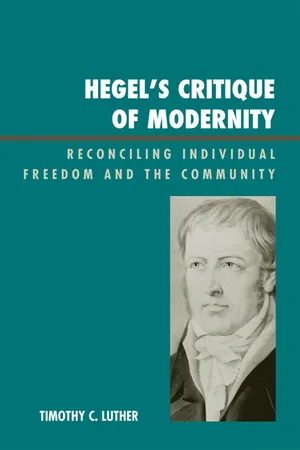
Hegel's Critique of Modernity
Reconciling Individual Freedom and the Community
- English
- ePUB (mobile friendly)
- Available on iOS & Android
eBook - ePub
About this book
Information
Table of contents
- Acknowledgements
- Chapter One: Introduction
- Chapter Two: Georg Wilhelm Friedrich Hegel: His Philosophy and Context
- Chapter Three: The Dialectic and History: The Odyssey of Liberty
- Chapter Four: Hegel’s Sittlichkeit: Individual Freedom in Ethical Life
- Chapter Five: The Family and Bürgerliche Gesellschaft: The Realm of Particular Freedom
- Chapter Six: Autonomy and Solidarity: Hegel’s Rechtsstaat
- Chapter Seven: The Emergence of Hegelianism: Right and Left Movements
- Chapter Eight: Nineteenth-Century Rejections of Hegelianism: Kierkegaard, Nietzsche, and Criticisms of Metaphysics
- Chapter Nine: Hegel and Postmodernism
- Chapter Ten: Conclusion: Hegel Today
- Bibliography
Trusted by 375,005 students
Access to over 1.5 million titles for a fair monthly price.
Study more efficiently using our study tools.
Frequently asked questions
Yes, you can cancel anytime from the Subscription tab in your account settings on the Perlego website. Your subscription will stay active until the end of your current billing period. Learn how to cancel your subscription
No, books cannot be downloaded as external files, such as PDFs, for use outside of Perlego. However, you can download books within the Perlego app for offline reading on mobile or tablet. Learn how to download books offline
Perlego offers two plans: Essential and Complete
- Essential is ideal for learners and professionals who enjoy exploring a wide range of subjects. Access the Essential Library with 800,000+ trusted titles and best-sellers across business, personal growth, and the humanities. Includes unlimited reading time and Standard Read Aloud voice.
- Complete: Perfect for advanced learners and researchers needing full, unrestricted access. Unlock 1.5M+ books across hundreds of subjects, including academic and specialized titles. The Complete Plan also includes advanced features like Premium Read Aloud and Research Assistant.
We are an online textbook subscription service, where you can get access to an entire online library for less than the price of a single book per month. With over 1.5 million books across 990+ topics, we’ve got you covered! Learn about our mission
Look out for the read-aloud symbol on your next book to see if you can listen to it. The read-aloud tool reads text aloud for you, highlighting the text as it is being read. You can pause it, speed it up and slow it down. Learn more about Read Aloud
Yes! You can use the Perlego app on both iOS and Android devices to read anytime, anywhere — even offline. Perfect for commutes or when you’re on the go.
Please note we cannot support devices running on iOS 13 and Android 7 or earlier. Learn more about using the app
Please note we cannot support devices running on iOS 13 and Android 7 or earlier. Learn more about using the app
Yes, you can access Hegel's Critique of Modernity by Timothy C. Luther in PDF and/or ePUB format, as well as other popular books in Politics & International Relations & Ethics & Moral Philosophy. We have over 1.5 million books available in our catalogue for you to explore.