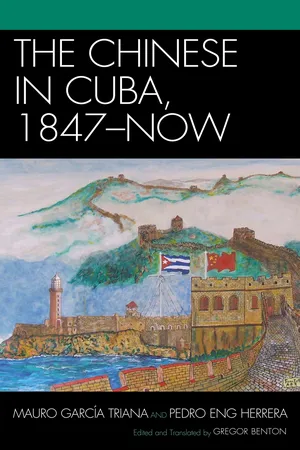
This book deals with Chinese immigrants' role in the struggle for Cuban liberation and in Cuba's twentieth-century revolutionary social movement; the history of the Chinese economy in Cuba; and the Chinese contribution to Cuban music, painting, food, sport, and language. The centerpiece of the book is a translation of a study by Mauro García Triana and Pedro Eng Herrera on the history of the Chinese presence in Cuba. Over many years, García and Eng have collaborated closely on scholarly research on the Chinese contribution to Cuban life and politics, although their work is not widely known. Both are well equipped for such an enterprise: Eng as a Cuban of Chinese descent and a participant in the ethnic-Chinese revolutionary movement in Cuba, starting in the 1950s; García as a participant in the struggle against Batista and Cuban Ambassador to China during the period of the Cultural Revolution.
The study is supplemented by an extensive collection of archival photographs and of paintings on Cuban-Chinese themes by Pedro Eng, who is not just a chronicler of the community but a well-known worker-artist who paints in a style described by commentators as "naive." The volume has three appendices: excerpts from the Cuba Commission's 1877 report on Chinese emigration to Cuba; the rebel leader Gonzalo de Quesada y Aróstegui's pamphlet "The Chinese and Cuban Independence," translated from his book Mi primera ofrenda (My first offering), first published in 1892; and the chapter on "Coolie Life in Cuba" from Duvon Clough Corbitt's Study of the Chinese in Cuba, 1847-1947 (Wilmore 1971).
- English
- ePUB (mobile friendly)
- Available on iOS & Android
eBook - ePub
The Chinese in Cuba, 1847-Now
About this book
Information
Table of contents
- Frontispiece
- Photospread
- Preface
- Editor’s Introduction
- Authors’ Introduction
- Chapter 1 The Chinese in Cuba’s Wars of Independence
- Chapter 2 Chinese Business in Cuba in the Twentieth Century
- Chapter 3 Chinese in Cuban Cultural Life
- Appendix 1: Chinese Emigration, the Cuba Commission. Report of the Commission Sent by China to Ascertain the Condition of Life of Chinese Coolies in Cuba (1877)
- Appendix 2: Gonzalo de Quesada, The Chinese and Cuban Independence (1892)
- Appendix 3: Duvon Clough Corbitt, Coolie Life in Cuba (1971)
- About the Authors
- About the Editor and Translator
Trusted by 375,005 students
Access to over 1.5 million titles for a fair monthly price.
Study more efficiently using our study tools.
Frequently asked questions
Yes, you can cancel anytime from the Subscription tab in your account settings on the Perlego website. Your subscription will stay active until the end of your current billing period. Learn how to cancel your subscription
No, books cannot be downloaded as external files, such as PDFs, for use outside of Perlego. However, you can download books within the Perlego app for offline reading on mobile or tablet. Learn how to download books offline
Perlego offers two plans: Essential and Complete
- Essential is ideal for learners and professionals who enjoy exploring a wide range of subjects. Access the Essential Library with 800,000+ trusted titles and best-sellers across business, personal growth, and the humanities. Includes unlimited reading time and Standard Read Aloud voice.
- Complete: Perfect for advanced learners and researchers needing full, unrestricted access. Unlock 1.5M+ books across hundreds of subjects, including academic and specialized titles. The Complete Plan also includes advanced features like Premium Read Aloud and Research Assistant.
We are an online textbook subscription service, where you can get access to an entire online library for less than the price of a single book per month. With over 1.5 million books across 990+ topics, we’ve got you covered! Learn about our mission
Look out for the read-aloud symbol on your next book to see if you can listen to it. The read-aloud tool reads text aloud for you, highlighting the text as it is being read. You can pause it, speed it up and slow it down. Learn more about Read Aloud
Yes! You can use the Perlego app on both iOS and Android devices to read anytime, anywhere — even offline. Perfect for commutes or when you’re on the go.
Please note we cannot support devices running on iOS 13 and Android 7 or earlier. Learn more about using the app
Please note we cannot support devices running on iOS 13 and Android 7 or earlier. Learn more about using the app
Yes, you can access The Chinese in Cuba, 1847-Now by Mauro García Triana,Pedro Eng Herrera, Gregor Benton in PDF and/or ePUB format, as well as other popular books in History & Chinese History. We have over 1.5 million books available in our catalogue for you to explore.