New infections with HIV remain an urgent problem among young people in Africa, but many young Africans pursue sexual relationships with little thought about the epidemic. This book examines young people's sexual relationships in a region typical of rural sub-Saharan Africa and investigates why the risk of HIV infection generally was not a salient concern for them. It is based on an extraordinarily large and representative qualitative study that was affiliated with an adolescent sexual health intervention trial and included three person-years of participant observation conducted by young East Africans in nine Tanzanian villages.
The book describes typical patterns of sexual relationship formation in adolescence and early adult life, the variety of young people's relationships and practices, and the contradictory social ideals and expectations that led premarital and extramarital relationships to be concealed. Young men's main motivations for sex were pleasure and masculine identity, while young women's was to receive money or materials to meet their basic needs, such as soap or a daytime meal. By their late teens most young people had experienced one-time sexual encounters, open-ended opportunistic relationships, and "main" sometimes semi-public partnerships. Relationships could involve desire, possessiveness, and affection, but romantic idealization of a partner was rare. Many young people expected their partners to be monogamous, but themselves had had concurrent relationships by age 20. The practice of hiding premarital sexual relationships from adults often also concealed them from other sexual partners, which helped maintain concurrency and inhibited realistic risk perception. Understanding of the biology of HIV/AIDS was very limited. Condoms were rarely used because they were associated with reduced pleasure, infection and promiscuity. Sexually transmitted infections were common, but several factors hindered young people from seeking biomedical treatment for them. Many instead relied on tradit
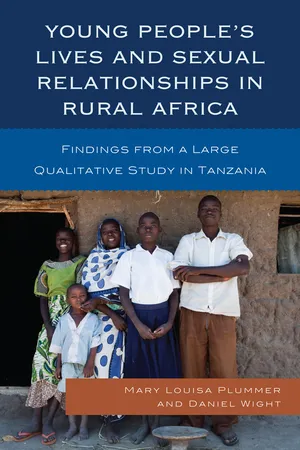
eBook - ePub
Young People's Lives and Sexual Relationships in Rural Africa
Findings from a Large Qualitative Study in Tanzania
- English
- ePUB (mobile friendly)
- Available on iOS & Android
eBook - ePub
Young People's Lives and Sexual Relationships in Rural Africa
Findings from a Large Qualitative Study in Tanzania
About this book
Information
Table of contents
- Acknowledgments
- Chapter 1: Introduction
- Chapter 2: Research Methods
- Chapter 3: Village Life
- Chapter 4: Children’s Relationships with Parents, Peers, and Teachers1
- Chapter 5: Contradictory Sexual Norms and Expectations1
- Case Study Series 1
- Chapter 6: Unmarried Young People’s Sexual Relationships
- Chapter 7: Sexual Negotiation, Exchange, and Coercion1
- Chapter 8: Sexual Practices
- Case Study Series 2
- Chapter 9: Married Young People’s Sexual Relationships
- Chapter 10: Contraception, Abortion, and Fertility1
- Chapter 11: HIV/AIDS and Other Sexually Transmitted Infections1
- Case Study Series 3
- Chapter 12: Barriers and Facilitators of Sexual Risk Reduction
- Swahili and Sukuma Glossary
- Bibliography
- About the Authors
Trusted by 375,005 students
Access to over 1.5 million titles for a fair monthly price.
Study more efficiently using our study tools.
Frequently asked questions
Yes, you can cancel anytime from the Subscription tab in your account settings on the Perlego website. Your subscription will stay active until the end of your current billing period. Learn how to cancel your subscription
No, books cannot be downloaded as external files, such as PDFs, for use outside of Perlego. However, you can download books within the Perlego app for offline reading on mobile or tablet. Learn how to download books offline
Perlego offers two plans: Essential and Complete
- Essential is ideal for learners and professionals who enjoy exploring a wide range of subjects. Access the Essential Library with 800,000+ trusted titles and best-sellers across business, personal growth, and the humanities. Includes unlimited reading time and Standard Read Aloud voice.
- Complete: Perfect for advanced learners and researchers needing full, unrestricted access. Unlock 1.5M+ books across hundreds of subjects, including academic and specialized titles. The Complete Plan also includes advanced features like Premium Read Aloud and Research Assistant.
We are an online textbook subscription service, where you can get access to an entire online library for less than the price of a single book per month. With over 1.5 million books across 990+ topics, we’ve got you covered! Learn about our mission
Look out for the read-aloud symbol on your next book to see if you can listen to it. The read-aloud tool reads text aloud for you, highlighting the text as it is being read. You can pause it, speed it up and slow it down. Learn more about Read Aloud
Yes! You can use the Perlego app on both iOS and Android devices to read anytime, anywhere — even offline. Perfect for commutes or when you’re on the go.
Please note we cannot support devices running on iOS 13 and Android 7 or earlier. Learn more about using the app
Please note we cannot support devices running on iOS 13 and Android 7 or earlier. Learn more about using the app
Yes, you can access Young People's Lives and Sexual Relationships in Rural Africa by Mary Louisa Plummer,Daniel Wight in PDF and/or ePUB format, as well as other popular books in Social Sciences & Diseases & Allergies. We have over 1.5 million books available in our catalogue for you to explore.