- English
- ePUB (mobile friendly)
- Available on iOS & Android
eBook - ePub
About this book
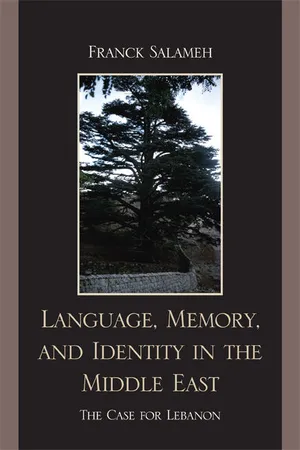
Since the West's very early flirtations with the modern Near East, and especially in the past 100 years of East-West relations, there has been considerable difficulty in understanding and defining the Middle East, the Arab world, pan-Arabism, Arab nationalism, and Middle Eastern identities in general. The Western impulse of conflating national identity with language, state, and ethnicity—often subsuming Arabic language into Arab ethnicity—has contributed to this misunderstanding and misreading of the region. For, while the Middle East can be accurately referred to by way of the generic "Arab world" label, the appellation itself is a misleading oversimplification that conceals an inherent diversity and multiplicity of Middle Eastern cultures, ethnicities, languages, and nationalities. And while there is certainly a dominant Arab ethnos, there are also significant numbers of Middle Eastern peoples and nationalities with historical memories and ethno-cultural bonds that challenge the dominant Arabist paradigm. Language, Memory, and Identity in the Middle East proposes a new reading of modern Middle Eastern history and suggests alternate solutions to the region's problems. The book is an attempt to rehabilitate and bring back to the fore of Middle East Studies the issue of language as a key factor in shaping (and misshaping) the region, with the hope of rediscovering a broader, more honest, and less ideologically tainted discussion on the Middle East. Language, Memory, and Identity in the Middle East has a special focus on Lebanon, a "Christian homeland," because Lebanon has traditionally acted as the region's template for change and a barometer gauging its problems and charting its progress.
Information
Table of contents
- Acknowledgments
- Introduction
- 1
- 2
- 3
- 4
- 5
- 6
- 7
- Conclusion
- Bibliography
- Index
- About the Author
Trusted by 375,005 students
Access to over 1.5 million titles for a fair monthly price.
Study more efficiently using our study tools.
Frequently asked questions
Yes, you can cancel anytime from the Subscription tab in your account settings on the Perlego website. Your subscription will stay active until the end of your current billing period. Learn how to cancel your subscription
No, books cannot be downloaded as external files, such as PDFs, for use outside of Perlego. However, you can download books within the Perlego app for offline reading on mobile or tablet. Learn how to download books offline
Perlego offers two plans: Essential and Complete
- Essential is ideal for learners and professionals who enjoy exploring a wide range of subjects. Access the Essential Library with 800,000+ trusted titles and best-sellers across business, personal growth, and the humanities. Includes unlimited reading time and Standard Read Aloud voice.
- Complete: Perfect for advanced learners and researchers needing full, unrestricted access. Unlock 1.5M+ books across hundreds of subjects, including academic and specialized titles. The Complete Plan also includes advanced features like Premium Read Aloud and Research Assistant.
We are an online textbook subscription service, where you can get access to an entire online library for less than the price of a single book per month. With over 1.5 million books across 990+ topics, we’ve got you covered! Learn about our mission
Look out for the read-aloud symbol on your next book to see if you can listen to it. The read-aloud tool reads text aloud for you, highlighting the text as it is being read. You can pause it, speed it up and slow it down. Learn more about Read Aloud
Yes! You can use the Perlego app on both iOS and Android devices to read anytime, anywhere — even offline. Perfect for commutes or when you’re on the go.
Please note we cannot support devices running on iOS 13 and Android 7 or earlier. Learn more about using the app
Please note we cannot support devices running on iOS 13 and Android 7 or earlier. Learn more about using the app
Yes, you can access Language, Memory, and Identity in the Middle East by Franck Salameh in PDF and/or ePUB format, as well as other popular books in Social Sciences & Regional Studies. We have over 1.5 million books available in our catalogue for you to explore.