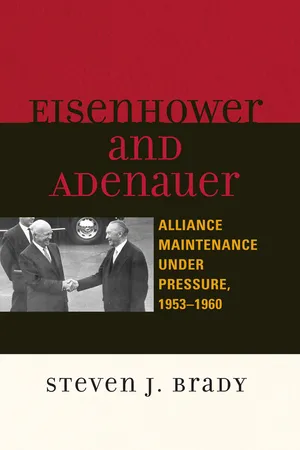
In the early years of the Atlantic Alliance, no bilateral relationship was more important than that between the Federal Republic of Germany and the United States. Even so, the West German-American alliance was taxing for both sides during much of the first two decades of the Cold War. Ultimately, despite frequent, significant challenges to the alliance from without and within, the two allies managed to achieve a positive and productive relationship - Eisenhower and Adenauer explains how they did so.
In both capitals, the top foreign policy makers were deeply involved in the conduct of what they viewed as a vital bilateral alliance, with both President Dwight Eisenhower and Chancellor Konrad Adenauer taking the lead in his own government. For the Americans, a rearmed FRG tightly bound to the West was the bedrock of any European security policy that could contain the Soviet Union for the long-term. For the West German government, their relationship with the United States was the bedrock of rehabilitation and, indeed, survival as an independent country. In this book, their alliance is closely analyzed to form new knowledge on the West German-American relationship during the Cold War.
- English
- ePUB (mobile friendly)
- Available on iOS & Android
eBook - ePub
About this book
Information
Table of contents
- Acknowledgments
- Chapter 1: Introduction: Issues, Events, and Personalities
- Chapter 2: “Confined to the Smallest Number of Powers”: The Peace Offensive after Stalin
- Chapter 3: “There Is No Other Foreign Policy”: The Road to Berlin
- Chapter 4: “The Year Things Began to Get Unstuck”: 1955
- Chapter 5: “The Key to World Dominance”: Western Unity and the Foreign Policy Initiative, 1956
- Chapter 6: Toward Berlin and the Status Quo: 1957–1958
- Chapter 7: “The Strongest Weapon Is Unity”: Berlin, 1958–1960
- Bibliography
- About the Author
Trusted by 375,005 students
Access to over 1.5 million titles for a fair monthly price.
Study more efficiently using our study tools.
Frequently asked questions
Yes, you can cancel anytime from the Subscription tab in your account settings on the Perlego website. Your subscription will stay active until the end of your current billing period. Learn how to cancel your subscription
No, books cannot be downloaded as external files, such as PDFs, for use outside of Perlego. However, you can download books within the Perlego app for offline reading on mobile or tablet. Learn how to download books offline
Perlego offers two plans: Essential and Complete
- Essential is ideal for learners and professionals who enjoy exploring a wide range of subjects. Access the Essential Library with 800,000+ trusted titles and best-sellers across business, personal growth, and the humanities. Includes unlimited reading time and Standard Read Aloud voice.
- Complete: Perfect for advanced learners and researchers needing full, unrestricted access. Unlock 1.5M+ books across hundreds of subjects, including academic and specialized titles. The Complete Plan also includes advanced features like Premium Read Aloud and Research Assistant.
We are an online textbook subscription service, where you can get access to an entire online library for less than the price of a single book per month. With over 1.5 million books across 990+ topics, we’ve got you covered! Learn about our mission
Look out for the read-aloud symbol on your next book to see if you can listen to it. The read-aloud tool reads text aloud for you, highlighting the text as it is being read. You can pause it, speed it up and slow it down. Learn more about Read Aloud
Yes! You can use the Perlego app on both iOS and Android devices to read anytime, anywhere — even offline. Perfect for commutes or when you’re on the go.
Please note we cannot support devices running on iOS 13 and Android 7 or earlier. Learn more about using the app
Please note we cannot support devices running on iOS 13 and Android 7 or earlier. Learn more about using the app
Yes, you can access Eisenhower and Adenauer by Steven J. Brady in PDF and/or ePUB format, as well as other popular books in History & German History. We have over 1.5 million books available in our catalogue for you to explore.