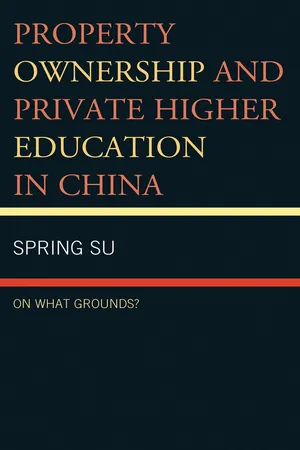
Recent decades have witnessed the proliferation in China of huge numbers of private universities and colleges in response to a wide-ranging spectrum of socio-economic and political demands under the country's flourishing market economy and its wholesale pursuit of decentralization. This book explores the issue of property ownership, an area which is regarded as an essential element in the attraction into the sector of local private institutions and foreign partnerships, as well as in facilitating the future development of the country's existing institutions.
The focus throughout this book is primarily on the legal, economic, managerial and financial aspects of the relevant issues, as well as other related topics, such as consumer protections and fund-raising activities. A feasibility analysis and discussion is also provided on 'for-profit' universities and their potential market niches in China, in recognition of the fact that the current regulations-which allow private universities to maintain a non-profit status whilst actually enjoying profit returns-clearly provides some legitimacy to the phenomenon of "for-profit in disguise." It is argued in this book that such quasi-profit regulations may further exacerbate profiteering behavior, whilst it is also noted that, in the short term, there is a clear need to provide adequate protections within the apparent hybrid version of an ownership system-a system characterized by a mix of capitalism and socialism-through the adoption of a definitive legal framework within which economic actors can coordinate their efforts through a mutually understood framework of action.
Finally, it is clear that in the transition from the "rule-of-the-people" to the "rule-of-law," legislation, practices and compliance do not always go hand-in-hand in China; thus the healthy development of the educational sector will undoubtedly require some time, as well as the introduction of complementary mechanisms, for such legislation to be fully enforced in practice. This book concludes
- English
- ePUB (mobile friendly)
- Available on iOS & Android
eBook - ePub
About this book
Information
Table of contents
- Acknowledgments
- Introduction: The Evolution of Private Higher Education in China
- 1 Private Higher Education Development in China
- 2 Literature Review: Property Ownership, Property Right Economics and For-Profit Higher Education
- 3 Comparative Analysis of Non-Profit and For-Profit Private Higher Education
- 4 Individual Case Studies of Property Ownership Systems of Private Higher Education Institutions in China
- 5 Comparisons of the Case Studies
- 6 Case Studies of Different Types of Private Higher Education Institutions in China
- 7 Conclusions and Recommendations
- Appendix
- Bibliography
- About the Author
Trusted by 375,005 students
Access to over 1.5 million titles for a fair monthly price.
Study more efficiently using our study tools.
Frequently asked questions
Yes, you can cancel anytime from the Subscription tab in your account settings on the Perlego website. Your subscription will stay active until the end of your current billing period. Learn how to cancel your subscription
No, books cannot be downloaded as external files, such as PDFs, for use outside of Perlego. However, you can download books within the Perlego app for offline reading on mobile or tablet. Learn how to download books offline
Perlego offers two plans: Essential and Complete
- Essential is ideal for learners and professionals who enjoy exploring a wide range of subjects. Access the Essential Library with 800,000+ trusted titles and best-sellers across business, personal growth, and the humanities. Includes unlimited reading time and Standard Read Aloud voice.
- Complete: Perfect for advanced learners and researchers needing full, unrestricted access. Unlock 1.5M+ books across hundreds of subjects, including academic and specialized titles. The Complete Plan also includes advanced features like Premium Read Aloud and Research Assistant.
We are an online textbook subscription service, where you can get access to an entire online library for less than the price of a single book per month. With over 1.5 million books across 990+ topics, we’ve got you covered! Learn about our mission
Look out for the read-aloud symbol on your next book to see if you can listen to it. The read-aloud tool reads text aloud for you, highlighting the text as it is being read. You can pause it, speed it up and slow it down. Learn more about Read Aloud
Yes! You can use the Perlego app on both iOS and Android devices to read anytime, anywhere — even offline. Perfect for commutes or when you’re on the go.
Please note we cannot support devices running on iOS 13 and Android 7 or earlier. Learn more about using the app
Please note we cannot support devices running on iOS 13 and Android 7 or earlier. Learn more about using the app
Yes, you can access Property Ownership and Private Higher Education in China by Spring Su in PDF and/or ePUB format, as well as other popular books in Law & Higher Education. We have over 1.5 million books available in our catalogue for you to explore.