eBook - ePub
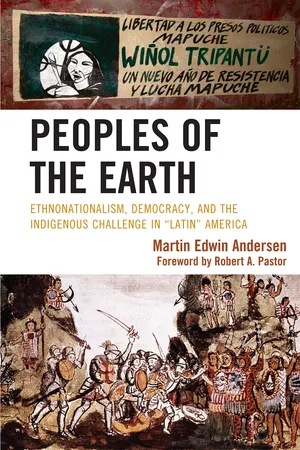
Peoples of the Earth
Ethnonationalism, Democracy, and the Indigenous Challenge in 'Latin' America
- English
- ePUB (mobile friendly)
- Available on iOS & Android
eBook - ePub
Peoples of the Earth
Ethnonationalism, Democracy, and the Indigenous Challenge in 'Latin' America
About this book
Peoples of the Earth employs a comparative history of ethno-nationalism to examine Indian activism and its challenges to the political, social and economic status quo in the countries of Central and South America. It explores the intersect between problems of democratic empowerment and security-including the appearance of radical Islam among Indians in two important countries-arising from the re-emergence of dormant forms of ethnic militancy and unprecedented internal challenges to nation-states. The institutions and practices of Indian self-government in the United States and Canada are examined as a means of comparison with contemporary phenomena in Central and South America, suggesting frameworks for the successful democratic incorporation of the region's most disenfranchised peoples. European models emerging from 'intermestic' dilemmas are considered, as are those involving the Inuit people (or Eskimos) in the Canadian far north, as policymakers there 'think outside the box' in ways that include more robust roles for both sub-national and international bodies. Finally, the work challenges policymakers to broaden the debate about how to approach the issues of political and economic empowerment and regional security concerning Native peoples, to include consideration of new ways of protecting both land rights and the environment, thus avoiding a zero-sum solution between the region's 40 million Indians and the rest of its peoples. Peoples of the Earth has the potential to become a pioneer study addressing ethnic activism, characterized by multiple, small groups pressing for state recognition and democratic participation, while also promoting a defence of the environment and natural resources. Part of its attractiveness is the likelihood that the work will lead to further investigations and will become an authoritative point of departure for the fertile area of ethnonationalism studies in Latin America. Each country chapter provides a succinct but substantial presentation of the basic issues and challenges facing the Native peoples of the country. Overall, the book has an excellent mix of historical and contemporary analysis.
Information
Table of contents
- Cover
- Half title
- Title
- Copyright
- Contents
- Tables and Figures
- Dedication
- Foreword: The Last Frontier of De-Colonization in the Americas: Indigenous Peoples
- Acknowledgments
- 1 Introduction
- 2 The “Miner’s Canary” of Democracy
- 3 Elite Neglect and “Rediscovery”
- 4 Is Democracy a Zero-Sum Game?
- 5 Imagined Communities: Marxism and the Indian Nation-State
- 6 Indian Lands, “Ungoverned Spaces,” and Failing States
- 7 Bolivia: Unraveling a Present Past
- 8 Perú: the Emergence of the Unbowed “Other”
- 9 Ecuador: A Populist Test of Plurinationalism
- 10 Guatemala: Many Nations Within a Single Nation-State
- 11 Chile: Contesting the Lands of the “People of the Earth”
- 12 Colombia: Special Rights Within a Context of Lawlessness
- 13 Toward a New American Identity
- 14 Conclusions
- Appendices: U.S. State Department Annual Human Rights Country Reports 2008
- Notes
- Bibliography
- Index
- About the Author
Trusted by 375,005 students
Access to over 1.5 million titles for a fair monthly price.
Study more efficiently using our study tools.
Frequently asked questions
Yes, you can cancel anytime from the Subscription tab in your account settings on the Perlego website. Your subscription will stay active until the end of your current billing period. Learn how to cancel your subscription
No, books cannot be downloaded as external files, such as PDFs, for use outside of Perlego. However, you can download books within the Perlego app for offline reading on mobile or tablet. Learn how to download books offline
We are an online textbook subscription service, where you can get access to an entire online library for less than the price of a single book per month. With over 1.5 million books across 990+ topics, we’ve got you covered! Learn about our mission
Look out for the read-aloud symbol on your next book to see if you can listen to it. The read-aloud tool reads text aloud for you, highlighting the text as it is being read. You can pause it, speed it up and slow it down. Learn more about Read Aloud
Yes! You can use the Perlego app on both iOS and Android devices to read anytime, anywhere — even offline. Perfect for commutes or when you’re on the go.
Please note we cannot support devices running on iOS 13 and Android 7 or earlier. Learn more about using the app
Please note we cannot support devices running on iOS 13 and Android 7 or earlier. Learn more about using the app
Yes, you can access Peoples of the Earth by Martin Edwin Andersen in PDF and/or ePUB format, as well as other popular books in Politics & International Relations & American Government. We have over 1.5 million books available in our catalogue for you to explore.