The postcolonial African culture, as it is discoursed in the academia, is largely influenced by Africa's response to colonialism. To the degree that it is a response, it is to considerably reactive, and lacks forceful moral incentives for social critical consciousness and nation-building. Quite on the contrary, it allows especially African political leaders to luxuriate in the delusions of moral rectitude, imploring, at will, the evil of imperialism as a buffer to their disregard of their people. This book acknowledges the social and psychological devastations of colonialism on the African world. It, however, argues that the totality of African intellectual response to colonialism and Western imperialism is equally, if not more, damaging to the African world. In what ways does the average African leader, indeed, the average African, judge and respond to his world? How does he conceive of his responsibility towards his community and society?
The most obvious impact of African response to colonialism is the implicit search for a pristine, innocent paradigm in, for instance, literary, philosophical, social, political and gender studies. This search has its own moral implication in the sense that it makes the taking of responsibility on individual and social level highly difficult. Focusing on the moral impact of responses to colonialism in Africa and the African Diaspora, this book analyzes the various manifestations of delusions of moral innocence that has held the African leadership from the onerous task of bearing responsibility for their countries; it argues that one of the ways to recast the African leaders' responsibility towards Africa is to let go, on the one hand, the gaze of the West, and on the other, of the search for the innocent African experience and cultures.
Relying on the insights of thinkers such as Frantz Fanon, Wole Soyinka, Kwame Anthony Appiah, Achille Mbembe and Wolgang Welsch, this book suggests new approaches to interpreting African experiences. It discusses select African works of fiction as a paradigm for new interpretations of African experiences.
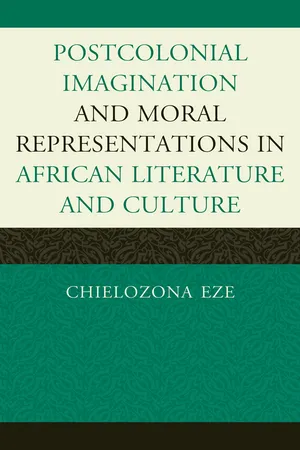
eBook - ePub
Postcolonial Imaginations and Moral Representations in African Literature and Culture
- English
- ePUB (mobile friendly)
- Available on iOS & Android
eBook - ePub
Postcolonial Imaginations and Moral Representations in African Literature and Culture
About this book
Information
Table of contents
- Acknowledgments
- Introduction: Postcolonial Imagination and Moral Representations—Africa in Discourse and Culture
- 1 Postcolonial States of Injury and Moral Imaginations
- 2 The Moral Reinvention of Africa
- 3 Things Fall Apart and the Invention of African Culture
- 4 The Pitfalls of African Feminism
- 5 Robert Mugabe and the Symbolic Power of History
- 6 Frantz Fanon and the Search for New Discourse Paradigms
- 7 Wole Soyinka and the Moral Foundations of Community
- 8 Literature and the Task of Increasing the Sum Total of Humanity
- Bibliography
- Index
- About the Author
Trusted by 375,005 students
Access to over 1.5 million titles for a fair monthly price.
Study more efficiently using our study tools.
Frequently asked questions
Yes, you can cancel anytime from the Subscription tab in your account settings on the Perlego website. Your subscription will stay active until the end of your current billing period. Learn how to cancel your subscription
No, books cannot be downloaded as external files, such as PDFs, for use outside of Perlego. However, you can download books within the Perlego app for offline reading on mobile or tablet. Learn how to download books offline
Perlego offers two plans: Essential and Complete
- Essential is ideal for learners and professionals who enjoy exploring a wide range of subjects. Access the Essential Library with 800,000+ trusted titles and best-sellers across business, personal growth, and the humanities. Includes unlimited reading time and Standard Read Aloud voice.
- Complete: Perfect for advanced learners and researchers needing full, unrestricted access. Unlock 1.5M+ books across hundreds of subjects, including academic and specialized titles. The Complete Plan also includes advanced features like Premium Read Aloud and Research Assistant.
We are an online textbook subscription service, where you can get access to an entire online library for less than the price of a single book per month. With over 1.5 million books across 990+ topics, we’ve got you covered! Learn about our mission
Look out for the read-aloud symbol on your next book to see if you can listen to it. The read-aloud tool reads text aloud for you, highlighting the text as it is being read. You can pause it, speed it up and slow it down. Learn more about Read Aloud
Yes! You can use the Perlego app on both iOS and Android devices to read anytime, anywhere — even offline. Perfect for commutes or when you’re on the go.
Please note we cannot support devices running on iOS 13 and Android 7 or earlier. Learn more about using the app
Please note we cannot support devices running on iOS 13 and Android 7 or earlier. Learn more about using the app
Yes, you can access Postcolonial Imaginations and Moral Representations in African Literature and Culture by Chielozona Eze in PDF and/or ePUB format, as well as other popular books in Literature & African Literary Criticism. We have over 1.5 million books available in our catalogue for you to explore.