- English
- ePUB (mobile friendly)
- Available on iOS & Android
eBook - ePub
About this book
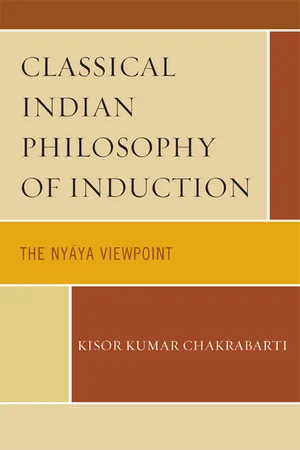
Induction is a basic method of scientific and philosophical inquiry. The work seeks to show against the skeptical tide that the method is secure and reliable. The problem of induction has been a hotly debated issue in modern and contemporary philosophy since David Hume. However, long before the modern era Indian philosophers have addressed this problem for about two thousand years. This work examines some major Indian viewpoints including those of Jayarasi (7th century), Dharmakirti (7th century), Prabhakara (8th century), Udayana (11th century) and Prabhacandra (14th century). It also discusses some influential contemporary positions including those of Russell, Strawson, Popper, Reichenbach, Carnap, Goodman and Quine. The main focus is on the Nyaya view developed by Gangesa (13th century). A substantial part of the work is devoted to annotated translation of selected chapters from Gangesa's work dealing with the problem of induction with copious references to the later Nyaya philosophers including Raghunatha (15th century), Mathuranatha (16th century), Jagadisa (17th century) and Gadadhara (17th century). An annotated translation of selections from Sriharsa (12th century) of the Vedanta school, Prabhacandra of the Jaina school and Dharmakirti of the Buddhist school is also included. A solution is presented to the classical problem of induction and the Grue paradox based on the Nyaya perspective. The solution includes an argument from counterfactual reasoning, arguments in defense of causality, analyses of circularity and logical economy, arguments for objective universals and an argument from belief-behavior contradiction.
Information
Topic
PhilosophySubtopic
Eastern PhilosophyTable of contents
- Contents
- Abbreviations
- Preface
- Acknowledgments
- 1: The Problem of Induction: East and West
- 2: The Later Nyāya Solution
- 3: The Method of Generalization: Vyāptigrahopāyah
- 4: Counterfactual Reasoning: Tarka
- 5: Universal-Based Extraordinary Perception: Sāmānyalakşaņapratyakşa
- 6: Earlier Views of Adjuncts: Upādhivādah
- 7: The Accepted View of Adjuncts: Upādhivādasiddhāntah
- 8: Classification of Adjuncts: Upādhivibhāgah
- 9: Sriharsa’s Khaņdanakhaņdakhādyam on Pervasion
- 10: Selected Passages from Prabhacandra’s Prameyakamalamārtaņda on Critique of Pervasion and Inference
- 11: Selections from Dharmakirti’s Nyāyabindu on Nonperception as a Probans
- Selected Bibliography
- Index
- About the Author
Trusted by 375,005 students
Access to over 1.5 million titles for a fair monthly price.
Study more efficiently using our study tools.
Frequently asked questions
Yes, you can cancel anytime from the Subscription tab in your account settings on the Perlego website. Your subscription will stay active until the end of your current billing period. Learn how to cancel your subscription
No, books cannot be downloaded as external files, such as PDFs, for use outside of Perlego. However, you can download books within the Perlego app for offline reading on mobile or tablet. Learn how to download books offline
Perlego offers two plans: Essential and Complete
- Essential is ideal for learners and professionals who enjoy exploring a wide range of subjects. Access the Essential Library with 800,000+ trusted titles and best-sellers across business, personal growth, and the humanities. Includes unlimited reading time and Standard Read Aloud voice.
- Complete: Perfect for advanced learners and researchers needing full, unrestricted access. Unlock 1.5M+ books across hundreds of subjects, including academic and specialized titles. The Complete Plan also includes advanced features like Premium Read Aloud and Research Assistant.
We are an online textbook subscription service, where you can get access to an entire online library for less than the price of a single book per month. With over 1.5 million books across 990+ topics, we’ve got you covered! Learn about our mission
Look out for the read-aloud symbol on your next book to see if you can listen to it. The read-aloud tool reads text aloud for you, highlighting the text as it is being read. You can pause it, speed it up and slow it down. Learn more about Read Aloud
Yes! You can use the Perlego app on both iOS and Android devices to read anytime, anywhere — even offline. Perfect for commutes or when you’re on the go.
Please note we cannot support devices running on iOS 13 and Android 7 or earlier. Learn more about using the app
Please note we cannot support devices running on iOS 13 and Android 7 or earlier. Learn more about using the app
Yes, you can access Classical Indian Philosophy of Induction by Kisor Kumar Chakrabarti in PDF and/or ePUB format, as well as other popular books in Philosophy & Eastern Philosophy. We have over 1.5 million books available in our catalogue for you to explore.