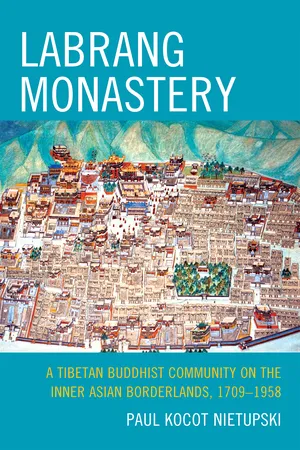
The Labrang Tibetan Buddhist Monastery in Amdo and its extended support community are one of the largest and most famous in Tibetan history. This crucially important and little-studied community is on the northeast corner of the Tibetan Plateau in modern Gansu Province, in close proximity to Chinese, Mongol, and Muslim communities. It is Tibetan but located in China; it was founded by Mongols, and associated with Muslims. Its wide-ranging Tibetan religious institutions are well established and serve as the foundations for the community's social and political infrastructures. The Labrang community's borderlands location, the prominence of its religious institutions, and the resilience and identity of its nomadic and semi-nomadic cultures were factors in the growth and survival of the monastery and its enormous estate.
This book tells the story of the status and function of the Tibetan Buddhist religion in its fully developed monastic and public dimensions. It is an interdisciplinary project that examines the history of social and political conflict and compromise between the different local ethnic groups. The book presents new perspectives on Qing Dynasty and Republican-era Chinese politics, with far-reaching implications for contemporary China. It brings a new understanding of Sino-Tibetan-Mongol-Muslim histories and societies. This volume will be of interest to undergraduate and graduate student majors in Tibetan and Buddhist studies, in Chinese and Mongol studies, and to scholars of Asian social and political studies.
eBook - ePub
Labrang Monastery
A Tibetan Buddhist Community on the Inner Asian Borderlands, 1709-1958
- English
- ePUB (mobile friendly)
- Available on iOS & Android
eBook - ePub
Labrang Monastery
A Tibetan Buddhist Community on the Inner Asian Borderlands, 1709-1958
About this book
Information
Topic
GeschichteSubtopic
Zentralasiatische GeschichteTable of contents
- Cover
- Half title
- Title
- Copyright
- Contents
- Maps
- Preface
- Introduction
- 1 Amdo: An Overview
- 2 Tibetan Religions in Amdo
- 3 Labrang’s Society
- 4 Growth and Development: The Evolution of Labrang Monastery
- 5 Twentieth-Century Labrang
- 6 Visions and Realities at Labrang
- Appendix 1 Family History: Gönpo Döndrup
- Appendix 2 Pronunciation and Word Lists
- Bibliography
- Index
- About the Author
Trusted by 375,005 students
Access to over 1.5 million titles for a fair monthly price.
Study more efficiently using our study tools.
Frequently asked questions
Yes, you can cancel anytime from the Subscription tab in your account settings on the Perlego website. Your subscription will stay active until the end of your current billing period. Learn how to cancel your subscription
No, books cannot be downloaded as external files, such as PDFs, for use outside of Perlego. However, you can download books within the Perlego app for offline reading on mobile or tablet. Learn how to download books offline
Perlego offers two plans: Essential and Complete
- Essential is ideal for learners and professionals who enjoy exploring a wide range of subjects. Access the Essential Library with 800,000+ trusted titles and best-sellers across business, personal growth, and the humanities. Includes unlimited reading time and Standard Read Aloud voice.
- Complete: Perfect for advanced learners and researchers needing full, unrestricted access. Unlock 1.5M+ books across hundreds of subjects, including academic and specialized titles. The Complete Plan also includes advanced features like Premium Read Aloud and Research Assistant.
We are an online textbook subscription service, where you can get access to an entire online library for less than the price of a single book per month. With over 1.5 million books across 990+ topics, we’ve got you covered! Learn about our mission
Look out for the read-aloud symbol on your next book to see if you can listen to it. The read-aloud tool reads text aloud for you, highlighting the text as it is being read. You can pause it, speed it up and slow it down. Learn more about Read Aloud
Yes! You can use the Perlego app on both iOS and Android devices to read anytime, anywhere — even offline. Perfect for commutes or when you’re on the go.
Please note we cannot support devices running on iOS 13 and Android 7 or earlier. Learn more about using the app
Please note we cannot support devices running on iOS 13 and Android 7 or earlier. Learn more about using the app
Yes, you can access Labrang Monastery by Paul Kocot Nietupski in PDF and/or ePUB format, as well as other popular books in Geschichte & Zentralasiatische Geschichte. We have over 1.5 million books available in our catalogue for you to explore.