- English
- ePUB (mobile friendly)
- Available on iOS & Android
eBook - ePub
About this book
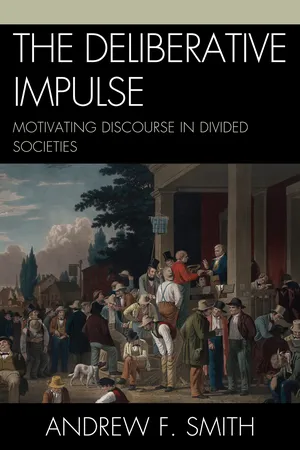
What can motivate citizens in divided societies to engage in free, open, and reasoned dialogue? Attempts by philosophers to answer this question focus largely on elucidating what citizens owe to one another as free and equal citizens, as members of a shared social context, or as agents who are mutually dependent on one another for our well-being. In The Deliberative Impulse: Motivating Discourse in Divided Societies, Andrew F. Smith suggests that that a better answer can be offered in terms of what we owe to our convictions. Given the defining role they play in how we live our lives and regard ourselves, among the highest-order interests that we maintain is being in a position to do right by our convictions_to abide by conscience. By developing a clear understanding of how best to act on this interest, we see that we are well served by engaging in public deliberation. Particularly for citizens in societies that are fragmented along ethnic, cultural, ideological, and religious lines, our interest in abiding by conscience should give us clear moral, epistemic, and religious incentives to deliberatively engage with allies and adversaries alike. Scholars who focus on issues in political philosophy, ethics, and political theory will value this book for how it suggests we can overcome the motivational roadblocks to active political participation and robust deliberation.
Information
Topic
PhilosophySubtopic
Political PhilosophyTable of contents
- Cover
- Half title
- Title
- Copyright
- Dedication
- Contents
- Preface
- Acknowledgments
- 1 The Deliberative Impulse
- 2 In Defense of Abiding by Conscience
- 3 Catalysts of Conflict and the Facilitation of Deliberation
- 4 Liberty of Conscience and Discursive Control: On the Moral Incentive to Deliberate Publicly
- 5 Doubt, Insistence, and Validation: On the Epistemic Incentives to Deliberate Publicly
- 6 Commitment, Criticism, and Restraint: On a Religious Incentive to Deliberate Publicly
- Postscript
- Notes
- Bibliography
- Index
- About the Author
Trusted by 375,005 students
Access to over 1.5 million titles for a fair monthly price.
Study more efficiently using our study tools.
Frequently asked questions
Yes, you can cancel anytime from the Subscription tab in your account settings on the Perlego website. Your subscription will stay active until the end of your current billing period. Learn how to cancel your subscription
No, books cannot be downloaded as external files, such as PDFs, for use outside of Perlego. However, you can download books within the Perlego app for offline reading on mobile or tablet. Learn how to download books offline
Perlego offers two plans: Essential and Complete
- Essential is ideal for learners and professionals who enjoy exploring a wide range of subjects. Access the Essential Library with 800,000+ trusted titles and best-sellers across business, personal growth, and the humanities. Includes unlimited reading time and Standard Read Aloud voice.
- Complete: Perfect for advanced learners and researchers needing full, unrestricted access. Unlock 1.5M+ books across hundreds of subjects, including academic and specialized titles. The Complete Plan also includes advanced features like Premium Read Aloud and Research Assistant.
We are an online textbook subscription service, where you can get access to an entire online library for less than the price of a single book per month. With over 1.5 million books across 990+ topics, we’ve got you covered! Learn about our mission
Look out for the read-aloud symbol on your next book to see if you can listen to it. The read-aloud tool reads text aloud for you, highlighting the text as it is being read. You can pause it, speed it up and slow it down. Learn more about Read Aloud
Yes! You can use the Perlego app on both iOS and Android devices to read anytime, anywhere — even offline. Perfect for commutes or when you’re on the go.
Please note we cannot support devices running on iOS 13 and Android 7 or earlier. Learn more about using the app
Please note we cannot support devices running on iOS 13 and Android 7 or earlier. Learn more about using the app
Yes, you can access The Deliberative Impulse by Andrew F. Smith in PDF and/or ePUB format, as well as other popular books in Philosophy & Political Philosophy. We have over 1.5 million books available in our catalogue for you to explore.