James S. Baumlin's Theologies of Language in English Renaissance Literature offers a revisionist history of discourse, taking Shakespeare, Donne, and Milton as its touchstones. Their works mark stages in dieEntzauberung or "disenchantment," as Max Weber has termed it: that is, in the "elimination of magic from the world." Shakespeare's Hamlet questions the word-magic associated with medieval Catholicism; Donne's love lyrics ironize the sacramental gestures of their poetic-priestly speakers; more radical still, Milton's major poems and polemical prose empty language of sacral power, repudiating human persuasion entirely over matters of "saving faith."
Baumlin describes four archetypes of historical rhetoric: sophism, skepticism, incarnationism, and transcendence. Undergirding the age's competing theologies, each makes unique assumptions regarding the powers of language (both communicative and performative); the nature of being (including transcendent being or deity); the structure of the psyche (whether sin-weakened or self-sufficient); and the capacities of human knowing (whether certain knowledge is communicable—or even possible). Working within divergent theologies of language, the poets here studied take theological controversies as explicit themes.
The crisis of Hamlet begins not in a king's murder simply, but in his dying without benefit of the sacraments. As if compensating for their loss, young Hamlet "minister[s]" to Gertrude while acting as "scourge" to Claudius. Alternating between soul-cursing and soul-curing, Hamlet plays sorcerer and priest indiscriminately.
Appropriating the speech-acts of Catholic sacramentalism, Donne's lyrics describe a private "religion of Love," over which the poet-lover presides as officiant. Or rather, some lyrics present him as Love's Priest, there being as many personae as there are theologies of language. Beyond Love's Priest, Baumlin describes three such personae: Love's Apostate, Love's Atheist, and Love's Reformer.
Focusing on "Lycidas" and De Doctrina Christiana, Baumlin outlines Milton's plerophoristic "rhetoric of certitude." Such texts as these explore the problematic status of preaching. (Can human eloquencecontribute to salvation?) They explore competing definitions (Aristotelian vs. Pauline) of pistis—meaningalternatively (religious) "faith" and (rhetorical) "persuasion." And they invoke conflicting typologies (classical vs. Hebraic) of authorial ethos.
Baumlin's study ends with a glance at the Restoration and Royal Society's final "disenchantment" or secularization of discourse.
eBook - ePub
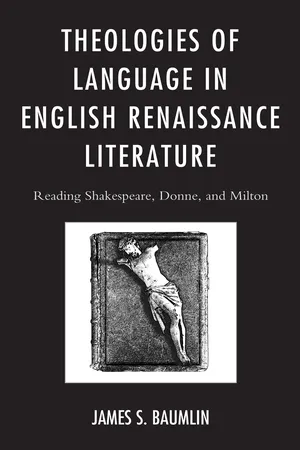
Theologies of Language in English Renaissance Literature
Reading Shakespeare, Donne, and Milton
- English
- ePUB (mobile friendly)
- Available on iOS & Android
eBook - ePub
Theologies of Language in English Renaissance Literature
Reading Shakespeare, Donne, and Milton
About this book
Information
Table of contents
- Abbreviations
- List of Figures
- Prelude: On Reading Rhetorically
- Acknowledgments
- Chapter One “Resistless Eloquence”
- Chapter Two Hamlet’s Sorcery
- Chapter Three “Scourge” or “Minister”?
- Chapter Four The Donnean Doubting-Game
- Chapter Five Love’s Atheist: Reading Donne’s “Communitie”
- Chapter Six “The Token” among Donne’s Songs and Sonets
- Chapter Seven “Outward Preaching” Vs. “Inward Persuasion”
- Chapter Eight The Protestant Allegory of “Lycidas”
- Chapter Nine Milton’s “Rhetoric of Certitude”
- Postlude: From “Enthusiasm” to Enlightenment
- Bibliography
- About the Author
Trusted by 375,005 students
Access to over 1.5 million titles for a fair monthly price.
Study more efficiently using our study tools.
Frequently asked questions
Yes, you can cancel anytime from the Subscription tab in your account settings on the Perlego website. Your subscription will stay active until the end of your current billing period. Learn how to cancel your subscription
No, books cannot be downloaded as external files, such as PDFs, for use outside of Perlego. However, you can download books within the Perlego app for offline reading on mobile or tablet. Learn how to download books offline
Perlego offers two plans: Essential and Complete
- Essential is ideal for learners and professionals who enjoy exploring a wide range of subjects. Access the Essential Library with 800,000+ trusted titles and best-sellers across business, personal growth, and the humanities. Includes unlimited reading time and Standard Read Aloud voice.
- Complete: Perfect for advanced learners and researchers needing full, unrestricted access. Unlock 1.5M+ books across hundreds of subjects, including academic and specialized titles. The Complete Plan also includes advanced features like Premium Read Aloud and Research Assistant.
We are an online textbook subscription service, where you can get access to an entire online library for less than the price of a single book per month. With over 1.5 million books across 990+ topics, we’ve got you covered! Learn about our mission
Look out for the read-aloud symbol on your next book to see if you can listen to it. The read-aloud tool reads text aloud for you, highlighting the text as it is being read. You can pause it, speed it up and slow it down. Learn more about Read Aloud
Yes! You can use the Perlego app on both iOS and Android devices to read anytime, anywhere — even offline. Perfect for commutes or when you’re on the go.
Please note we cannot support devices running on iOS 13 and Android 7 or earlier. Learn more about using the app
Please note we cannot support devices running on iOS 13 and Android 7 or earlier. Learn more about using the app
Yes, you can access Theologies of Language in English Renaissance Literature by James S. Baumlin in PDF and/or ePUB format, as well as other popular books in Literature & Literary Criticism of Shakespeare. We have over 1.5 million books available in our catalogue for you to explore.