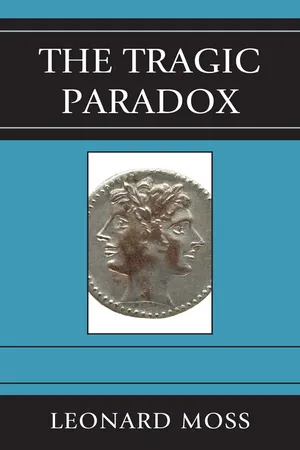
Paradox informs the narrative sequence, images, and rhetorical tactics contrived by skilled dramatists and novelists. Their literary languages depict not only a war between rivals but also simultaneous affirmation and negation voiced by a tragic individual. They reveal the treason, flux, and duplicity brought into play by an unrelenting drive for respect. Their patterns of speech, action, and image project a convergence of polarities, the convergence of integrity and radical change, of constancy and infidelity. A fanatical drive to fulfill a traditional code of masculine conduct produces the ironic consequence of de-forming that code—the tragic paradox.
Tragic literature exploits irony. In Athenian and Shakespearean tragedy, self-righteous male or female aristocrats instigate their own disgrace, shame, and guilt, an un-expected diminishment. They are victimized by a magnificent obsession, a fantasy of un-alloyed authority or virtue, a dream of perfect self-sufficiency or trust. The authors of tragedy revised the concept of "nobility" to reflect the strange fact that grandeur elicits its own annulment. "Strengths by strengths do fail," Shakespeare wrote in Coriolanus.
The playwrights made this paradoxical predicament concrete with a narrative format that equates self-assertion with self-detraction, images that revolve between incredible reversals and provisional reinstatements, and speech that sounds impressively weighty but masks deception, disloyalty, cynicism, and insecurity. Three heroic philosophers, Plato, Hegel, and Nietzsche, contributed invaluable but contrasting accounts of these literary languages (Aristotle's Poetics will be discussed in connection with Plato's attitude toward poetry). Their divergent descriptions can be reconciled to show that invalidations as well as affirmations—the transmission of contraries—are essential for tragic composition.
An equivocal rhetoric, a mutable imagery, and an ironic progression convey the tortuous pursuit of personal preeminence or (in later tragic works by Kafka and Strindberg) family solidarity and communal safety. I am trying to integrate the disparate arguments offered by several notable theorists with technical procedures fashioned by the Athenian dramatists and recast by Shakespeare and other writers, procedures that articulate the tragic paradox.
eBook - ePub
The Tragic Paradox
About this book
Information
Table of contents
- Acknowledgments
- Introduction: The Languages of Paradox
- Part I: The Narrative Language
- Part II: The Metaphorical Language
- Part III: The Rhetorical Language
- Conclusion: The Truth of Tragedy
- Notes
- Two Bibliographies, 1900–2010
- About the Author
Trusted by 375,005 students
Access to over 1.5 million titles for a fair monthly price.
Study more efficiently using our study tools.
Frequently asked questions
Yes, you can cancel anytime from the Subscription tab in your account settings on the Perlego website. Your subscription will stay active until the end of your current billing period. Learn how to cancel your subscription
No, books cannot be downloaded as external files, such as PDFs, for use outside of Perlego. However, you can download books within the Perlego app for offline reading on mobile or tablet. Learn how to download books offline
Perlego offers two plans: Essential and Complete
- Essential is ideal for learners and professionals who enjoy exploring a wide range of subjects. Access the Essential Library with 800,000+ trusted titles and best-sellers across business, personal growth, and the humanities. Includes unlimited reading time and Standard Read Aloud voice.
- Complete: Perfect for advanced learners and researchers needing full, unrestricted access. Unlock 1.5M+ books across hundreds of subjects, including academic and specialized titles. The Complete Plan also includes advanced features like Premium Read Aloud and Research Assistant.
We are an online textbook subscription service, where you can get access to an entire online library for less than the price of a single book per month. With over 1.5 million books across 990+ topics, we’ve got you covered! Learn about our mission
Look out for the read-aloud symbol on your next book to see if you can listen to it. The read-aloud tool reads text aloud for you, highlighting the text as it is being read. You can pause it, speed it up and slow it down. Learn more about Read Aloud
Yes! You can use the Perlego app on both iOS and Android devices to read anytime, anywhere — even offline. Perfect for commutes or when you’re on the go.
Please note we cannot support devices running on iOS 13 and Android 7 or earlier. Learn more about using the app
Please note we cannot support devices running on iOS 13 and Android 7 or earlier. Learn more about using the app
Yes, you can access The Tragic Paradox by Leonard Moss in PDF and/or ePUB format, as well as other popular books in Literature & Literary Criticism. We have over 1.5 million books available in our catalogue for you to explore.