War, Evacuation, and the Exercise of Power examines the history of the Pedagogical Institute, located in the USSR's Kirov region from 1941 to 1952. Holmes reveals a tangled and complex relationship of local, regional, and national agencies. While it recognizes the immense strength of the center, it emphasizes a contentious diffusion, although not a confusion, of authority. In so doing, it departs from traditional models of Soviet power with their neatly drawn vertical and horizontal lines of command. It also demonstrates institutional and personal behavior simultaneously consistent with and at odds with a triumphalist wartime narrative.
The Nazi invasion of Soviet-held territory in 1941 set off a massive evacuation eastward that included the relocation in Kirov of the Commissariat of Forest Industry and a large factory under the jurisdiction of the Commissariat of Aviation Industry. By occupying the two main buildings of Kirov's Pedagogical Institute, these commissariats forced the Institute to abandon the provincial capital for a remote rural location, Iaransk. Then and for years thereafter, the Pedagogical Institute portrayed itself as the victim of these commissariats' bad behavior that included the physical destruction of the Institute's buildings and much of its property. In its quest for justice, as it understood it, the Institute had the support of the Commissariat of Education. But that agency was far too weak in comparison with its institutional competitors, the offending commissariats, to provide much help. Of greater significance, the Institute forged a remarkable alliance with governing party and state organs in the city and region of Kirov. A united Kirov compelled the entry into the dispute of the Council of Peoples Commissars of both the Russian Republic and Soviet Union and the party's Central Committee.
In addition to a focus on the exercise of power at the center and periphery, this study also assesses the Institute's wartime exile in Iaransk. The difficulties of life there led to a Soviet version of town vs. gown and provoked the Institute's further resentment of Moscow. They also exacerbated conflict among distinct groups at the Institute as each advanced its own interests and authority. Faculty and administration, ranked and unranked faculty, communists and non-communists, and evacuated instructors and the Institute's own all fought amongst themselves over the relationship of politics and scholarship and over the legitimacy of a highly stratified system of food rationing.
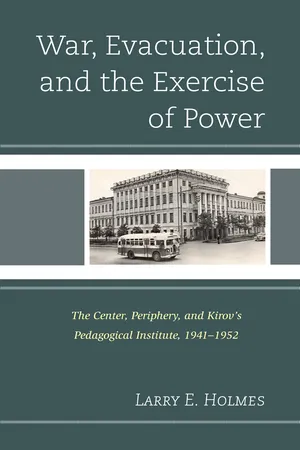
eBook - ePub
War, Evacuation, and the Exercise of Power
The Center, Periphery, and Kirov's Pedagogical Institute 1941–1952
- English
- ePUB (mobile friendly)
- Available on iOS & Android
eBook - ePub
War, Evacuation, and the Exercise of Power
The Center, Periphery, and Kirov's Pedagogical Institute 1941–1952
About this book
Trusted by 375,005 students
Access to over 1.5 million titles for a fair monthly price.
Study more efficiently using our study tools.
Information
Table of contents
- Acknowledgments
- Preface
- Introduction
- Chapter 1: Origins and a Troubled History, 1914–1941
- Chapter 2: War and Eviction in 1941: Business as Usual?
- Chapter 3: Life in Exile, 1941–1945
- Chapter 4: Getting Nasty Over the Privileges of Rank
- Chapter 5: The Politics of Scholarship
- Chapter 6: Town and Gown
- Chapter 7: Occupiers and Vandals, 1941–1945
- Chapter 8: Going Home
- Chapter 9: Criminal Behavior: Narkomles, 1945–1946
- Chapter 10: Restoration and Recovery at Lenin and Svoboda Streets, 1945–1948
- Chapter 11: Zaruchevskii Embattled, 1945–1952
- Conclusion
- Selected Bibliography
- About the Author
Frequently asked questions
Yes, you can cancel anytime from the Subscription tab in your account settings on the Perlego website. Your subscription will stay active until the end of your current billing period. Learn how to cancel your subscription
No, books cannot be downloaded as external files, such as PDFs, for use outside of Perlego. However, you can download books within the Perlego app for offline reading on mobile or tablet. Learn how to download books offline
We are an online textbook subscription service, where you can get access to an entire online library for less than the price of a single book per month. With over 1.5 million books across 990+ topics, we’ve got you covered! Learn about our mission
Look out for the read-aloud symbol on your next book to see if you can listen to it. The read-aloud tool reads text aloud for you, highlighting the text as it is being read. You can pause it, speed it up and slow it down. Learn more about Read Aloud
Yes! You can use the Perlego app on both iOS and Android devices to read anytime, anywhere — even offline. Perfect for commutes or when you’re on the go.
Please note we cannot support devices running on iOS 13 and Android 7 or earlier. Learn more about using the app
Please note we cannot support devices running on iOS 13 and Android 7 or earlier. Learn more about using the app
Yes, you can access War, Evacuation, and the Exercise of Power by Larry E. Holmes in PDF and/or ePUB format, as well as other popular books in History & Eastern European History. We have over 1.5 million books available in our catalogue for you to explore.