In the closing days of World War II, scientists working for the U.S. government invented nuclear explosives by splitting the atoms of heavy metals. Germany had already surrendered, but the United States and its allies remained at war with Japan. In the summer of 1945, the Japanese city of Hiroshima was flattened by a single nuclear bomb. A second bombing occurred just a few days later, decimating the city of Nagasaki. These were the first nuclear weapons ever used in war.
And - so far - they are the last.
Since then, tens of thousands of nuclear weapons have been manufactured and deployed by governments around the world. Many of these weapons are much more powerful than the atomic bombs that destroyed the two Japanese cities. None have been used so far, and the absence of nuclear war among nations armed to the teeth with nuclear weapons is a great mystery.
While the threat of a nuclear attack on the United States has receded, the possibility of a nuclear attack on an American city by terrorists has taken its place in our official nightmares. So far, no terrorist group has made a serious effort to buy, steal, or build a nuclear weapon. The absence of nuclear terrorism in a world swarming with fanatical terrorists is another great mystery.
The slippery slope to a nuclear Armageddon has been present for more than sixty years. In secure locations in Washington, Moscow, Beijing, London, and Paris, there are buttons to push than could put an end to human civilization, but these buttons have never been pushed.
Why not? What has so far kept us safe from these mortal dangers?
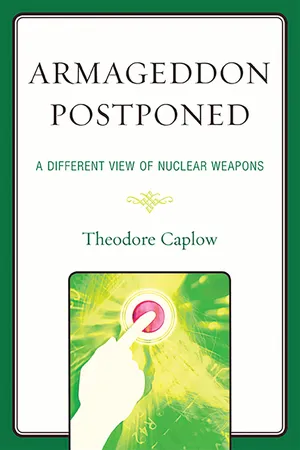
Those are the questions that Caplow asks and answers in Armageddon Postponed.
- English
- ePUB (mobile friendly)
- Available on iOS & Android
eBook - ePub
About this book
Information
Table of contents
- Preface
- Chapter One
- Chapter Two
- Chapter Three
- Chapter Four
- Chapter Five
- Chapter Six
- Chapter Seven
- Chapter Eight
- Chapter Nine
- Chapter Ten
- Chapter Eleven
- Chapter Twelve
- Postscript
- References
- Index
- About the Author
Trusted by 375,005 students
Access to over 1.5 million titles for a fair monthly price.
Study more efficiently using our study tools.
Frequently asked questions
Yes, you can cancel anytime from the Subscription tab in your account settings on the Perlego website. Your subscription will stay active until the end of your current billing period. Learn how to cancel your subscription
No, books cannot be downloaded as external files, such as PDFs, for use outside of Perlego. However, you can download books within the Perlego app for offline reading on mobile or tablet. Learn how to download books offline
Perlego offers two plans: Essential and Complete
- Essential is ideal for learners and professionals who enjoy exploring a wide range of subjects. Access the Essential Library with 800,000+ trusted titles and best-sellers across business, personal growth, and the humanities. Includes unlimited reading time and Standard Read Aloud voice.
- Complete: Perfect for advanced learners and researchers needing full, unrestricted access. Unlock 1.5M+ books across hundreds of subjects, including academic and specialized titles. The Complete Plan also includes advanced features like Premium Read Aloud and Research Assistant.
We are an online textbook subscription service, where you can get access to an entire online library for less than the price of a single book per month. With over 1.5 million books across 990+ topics, we’ve got you covered! Learn about our mission
Look out for the read-aloud symbol on your next book to see if you can listen to it. The read-aloud tool reads text aloud for you, highlighting the text as it is being read. You can pause it, speed it up and slow it down. Learn more about Read Aloud
Yes! You can use the Perlego app on both iOS and Android devices to read anytime, anywhere — even offline. Perfect for commutes or when you’re on the go.
Please note we cannot support devices running on iOS 13 and Android 7 or earlier. Learn more about using the app
Please note we cannot support devices running on iOS 13 and Android 7 or earlier. Learn more about using the app
Yes, you can access Armageddon Postponed by Theodore Caplow in PDF and/or ePUB format, as well as other popular books in Politics & International Relations & Political Philosophy. We have over 1.5 million books available in our catalogue for you to explore.