Taiwan was able to solidly build and sustain a film industry only after locally-produced Mandarin films secured markets in Hong Kong and Southeast Asia during the 1960s and 1970s. Though only a small island with a limited population, in its heyday, Taiwan was among the top-10 film producing countries/areas in the world, turning out hundreds of martial arts kung fu films and romantic melodramas annually that were screened in theaters across Southeast Asia and other areas internationally. However, except for one acclaimed film by director King Hu, Taiwan cinema was nearly invisible on the art cinema map until the 1980s, when the films of Hou Hsiao-hsien, Edward Yang, and other Taiwan New Cinema directors gained recognition at international film festivals, first in Europe, and later, throughout the world. Since then, many other Taiwan directors have also become an important part of cinema history, such as Ang Lee and Tsai Ming-liang.
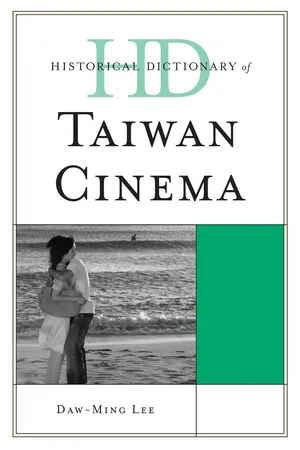
The Historical Dictionary of Taiwan Cinema covers the history of cinema in Taiwan during both the Japanese colonial period (1895-1945) and the Chinese Nationalist period (1945-present). This is accomplished through a chronology highlighting the main events during the long period and an introduction which carefully analyses the progression. The bulk of the information, however, appears in a dictionary section including over a hundred very extensive entries on directors, producers, performers, films, film studios and genres. Photos are also included in the dictionary section. More information can be found through the bibliography. Taiwan cinema is truly unique and this book is a good place to find out more about it, whether you are a student, or teacher, or just a fan.
- English
- ePUB (mobile friendly)
- Available on iOS & Android
eBook - ePub
Historical Dictionary of Taiwan Cinema
About this book
Information
Subtopic
Asian HistoryTable of contents
- Editor’s Foreword
- Preface
- Acknowledgments
- Reader’s Note
- Acronyms and Abbreviations
- Chronology
- Introduction
- THE DICTIONARY
- Bibliography
- About the Author and Contributors
Trusted by 375,005 students
Access to over 1.5 million titles for a fair monthly price.
Study more efficiently using our study tools.
Frequently asked questions
Yes, you can cancel anytime from the Subscription tab in your account settings on the Perlego website. Your subscription will stay active until the end of your current billing period. Learn how to cancel your subscription
No, books cannot be downloaded as external files, such as PDFs, for use outside of Perlego. However, you can download books within the Perlego app for offline reading on mobile or tablet. Learn how to download books offline
Perlego offers two plans: Essential and Complete
- Essential is ideal for learners and professionals who enjoy exploring a wide range of subjects. Access the Essential Library with 800,000+ trusted titles and best-sellers across business, personal growth, and the humanities. Includes unlimited reading time and Standard Read Aloud voice.
- Complete: Perfect for advanced learners and researchers needing full, unrestricted access. Unlock 1.5M+ books across hundreds of subjects, including academic and specialized titles. The Complete Plan also includes advanced features like Premium Read Aloud and Research Assistant.
We are an online textbook subscription service, where you can get access to an entire online library for less than the price of a single book per month. With over 1.5 million books across 990+ topics, we’ve got you covered! Learn about our mission
Look out for the read-aloud symbol on your next book to see if you can listen to it. The read-aloud tool reads text aloud for you, highlighting the text as it is being read. You can pause it, speed it up and slow it down. Learn more about Read Aloud
Yes! You can use the Perlego app on both iOS and Android devices to read anytime, anywhere — even offline. Perfect for commutes or when you’re on the go.
Please note we cannot support devices running on iOS 13 and Android 7 or earlier. Learn more about using the app
Please note we cannot support devices running on iOS 13 and Android 7 or earlier. Learn more about using the app
Yes, you can access Historical Dictionary of Taiwan Cinema by Daw-Ming Lee in PDF and/or ePUB format, as well as other popular books in Media & Performing Arts & Asian History. We have over 1.5 million books available in our catalogue for you to explore.