As stage and screen artists explore new means to enhance their craft, a new wave of interest in expressive movement and physical improvisation has developed. And in order to bring authenticity and believability to a character, it has become increasingly vital for actors to be aware of movement and physical acting. Stage and screen artists must now call upon physical presence, movement on stage, non-verbal interactions, and gestures to fully convey themselves.
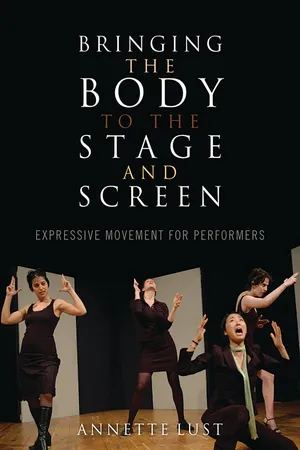
In Bringing the Body to the Stage and Screen, Annette Lust provides stage and screen artists with a program of physical and related expressive exercises that can empower their art with more creativity. In this book, Lust provides a general introduction to movement, including definitions and differences between movement on the stage and screen, how to conduct a class or learn on one's own, and choosing a movement style. Throughout the book and in the appendixes, Lust incorporates learning programs that cover the use of basic physical and expressive exercises for the entire body. In addition, she provides original solo and group pantomimes; improvisational exercises; examples of plays, fiction, poetry, and songs that may be interpreted with movement; a list of training centers in America and Europe; and an extensive bibliography and videography.
With 15 interviews and essays by prominent stage and screen actors, mimes, clowns, dancers, and puppeteers who describe the importance of movement in their art and illustrated with dozens of photos of renowned world companies and artists, Bringing the Body to the Stage and Screen will be a valuable resource for theater teachers and students, as well as anyone engaged in the performing arts.
eBook - ePub
Bringing the Body to the Stage and Screen
Expressive Movement for Performers
- English
- ePUB (mobile friendly)
- Available on iOS & Android
eBook - ePub
About this book
Information
Subtopic
Acting & AuditioningTable of contents
- Foreword
- Preface
- Acknowledgments
- Introduction: Goals and Objectives for Learning to Move Expressively
- Part I: Physical and Expressive Exercises
- Chapter 1: Definitions of Stage and Screen Movement, Mime, Pantomime, Corporeal Mime, Stage Combat, Physical Theatre, and Physical Improvisation
- Chapter 2: Conducting a Class and Practicing on One’s Own
- Chapter 3: Basic Physical and Expressive Exercises
- Chapter 4: Utilizing Movements to Create a Visual Image
- Part II: Subjects for Improvisation, Pantomimes, Nonverbal Acting, Physicalizing the Word, and Mime and Text
- Chapter 5: Improvisation
- Chapter 6: Pantomimes and Scenes for Nonverbal Acting
- Chapter 7: Physicalizing the Word
- Part III: Interviews and Essays
- Chapter 8: A Conversation with Bill Irwin on Mime and Acting
- Chapter 9: Interview with Bernie Schürch and Floriana Frassetto of the Swiss Mummenschanz Company
- Chapter 10: Interview with Geoff Hoyle on the Mime-Clown-Actor’s Art
- Chapter 11: Etienne Decroux and the Contemporary Theatre: Decroux Corporeal Mime
- Chapter 12: Interview with Joanna Sherman and Michael McGuigan on the Bond Street Theatre
- Chapter 13: On Movement Training for the Actor
- Chapter 14: Dance and the Female Body
- Chapter 15: Interview with Liebe Wetzel on Movement in Puppetry
- Chapter 16: Images and Body Expression in Film
- Chapter 17: Theatrical Dance
- Chapter 18: The Clown Conservatory Teaching of Professional Clowns in the Twenty-first Century
- Chapter 19: Movement for Puppeteers
- Chapter 20: Too Much Geniality: Notes and Quotes on a Reappraisal: Stage versus Screen Acting
- Chapter 21: The Body of Theater
- Chapter 22: How Charlie Chaplin Spun Stagecraft into Cinematic Gold
- Epilogue
- Appendix A: Creating a Movement Training Program: Ten Sample Lessons
- Appendix B: Resources for Mime Plays, Pantomimes, Themes for Improvisation, and Scenes with and without Words
- Appendix C: Constructing a Mime Piece or Mimodrama
- Appendix D: Schools and Movement Training Centers
- Appendix E: Publications, Organizations, Festivals, and Resource Centers
- Appendix F: Selected Videography and DVDs
- Selected Bibliography
- About the Author
Trusted by 375,005 students
Access to over 1.5 million titles for a fair monthly price.
Study more efficiently using our study tools.
Frequently asked questions
Yes, you can cancel anytime from the Subscription tab in your account settings on the Perlego website. Your subscription will stay active until the end of your current billing period. Learn how to cancel your subscription
No, books cannot be downloaded as external files, such as PDFs, for use outside of Perlego. However, you can download books within the Perlego app for offline reading on mobile or tablet. Learn how to download books offline
Perlego offers two plans: Essential and Complete
- Essential is ideal for learners and professionals who enjoy exploring a wide range of subjects. Access the Essential Library with 800,000+ trusted titles and best-sellers across business, personal growth, and the humanities. Includes unlimited reading time and Standard Read Aloud voice.
- Complete: Perfect for advanced learners and researchers needing full, unrestricted access. Unlock 1.5M+ books across hundreds of subjects, including academic and specialized titles. The Complete Plan also includes advanced features like Premium Read Aloud and Research Assistant.
We are an online textbook subscription service, where you can get access to an entire online library for less than the price of a single book per month. With over 1.5 million books across 990+ topics, we’ve got you covered! Learn about our mission
Look out for the read-aloud symbol on your next book to see if you can listen to it. The read-aloud tool reads text aloud for you, highlighting the text as it is being read. You can pause it, speed it up and slow it down. Learn more about Read Aloud
Yes! You can use the Perlego app on both iOS and Android devices to read anytime, anywhere — even offline. Perfect for commutes or when you’re on the go.
Please note we cannot support devices running on iOS 13 and Android 7 or earlier. Learn more about using the app
Please note we cannot support devices running on iOS 13 and Android 7 or earlier. Learn more about using the app
Yes, you can access Bringing the Body to the Stage and Screen by Annette Lust in PDF and/or ePUB format, as well as other popular books in Media & Performing Arts & Acting & Auditioning. We have over 1.5 million books available in our catalogue for you to explore.