Preservation of historical documents and library related materials is a growing problem in all library types and institutions. Fortunately, editors Carol Smallwood and Elaine Williams have pulled together the wisdom of practicing professionals to elucidate how to cope with the many problems that arise when preserving, managing, and digitizing important collections.
Preserving Local Writers, Genealogy, Photographs, Newspapers, and Related Materials contains informative chapters on physical preservation, collection management, cooperation with organizations and communities, various formats, and special projects. Each part covers the preservation of specific materials, from newspapers and scrapbooks to photographs and oral histories. In addition, chapters cover repair and restoration of materials, while taking into consideration the current state of funding for agencies with an interest in history. Contributors also shed light on how the racial, economic, and political dynamics of the past affect how collections are gathered, maintained, and presented today.
Preserving Local Writers, Genealogy, Photographs, Newspapers, and Related Materials offers plenty to inspire anyone facing backlogs of unprocessed papers or boxes of artifacts. Stories of the rescue efforts of a group of volunteers, or the discovery of a lost diary, show that the hard work of preservation is well worth it. Libraries, archives, and historical and genealogical societies all have their role to play in preserving important historical materials, as do patrons, sponsors, and volunteers; such institutions and individuals will find this book extremely helpful in their preservation efforts.
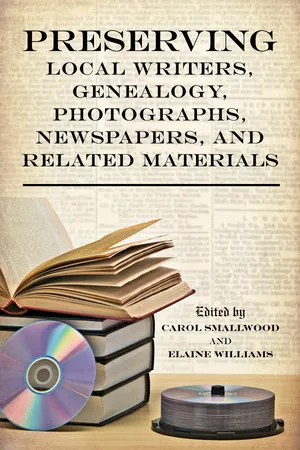
eBook - ePub
Preserving Local Writers, Genealogy, Photographs, Newspapers, and Related Materials
- English
- ePUB (mobile friendly)
- Available on iOS & Android
eBook - ePub
Preserving Local Writers, Genealogy, Photographs, Newspapers, and Related Materials
About this book
Information
Table of contents
- Foreword
- Acknowledgments
- Introduction
- Part I: Basics
- Chapter 1: Band-Aids and Superglue for the Cash-Strapped Local History Preservation Librarian
- Chapter 2: Basic In-House Book and Paper Repair
- Chapter 3: Emergency Preparedness
- Chapter 4: You Can’t Keep It All
- Part II: Newspapers
- Chapter 5: Balancing Selection and Digitization: Selecting Nineteenth- and Early Twentieth-Century Newspaper Titles for Online Access
- Chapter 6: Indexing Your Local Newspapers on Microfilm
- Chapter 7: Newspaper Preservation in Developing Countries: Issues and Strategies for Intervention
- Part III: Scrapbooks
- Chapter 8: How to Get Scrapbooks into the Hands of Users
- Chapter 9: Keeping Scrapbooks Secure and Available
- Chapter 10: Physical Properties of Scrapbooks
- Part IV: Local History
- Chapter 11: Creating Local History Collection Development Guidelines
- Chapter 12: Keeping a Past: Preservation Issues in Local History
- Chapter 13: Minimizing Privacy and Copyright Concerns with Online Local History Collections
- Chapter 14: Lavaca County Records Retention Project
- Chapter 15: Managing Archives in Local History Collections
- Part V: Genealogy
- Chapter 16: Partnering with Local Genealogical Societies
- Chapter 17: Patron-Driven Family History Preservation
- Part VI: Photographs
- Chapter 18: Collecting and Preserving Photographic Materials
- Chapter 19: Organizing and Indexing Photo Collections
- Chapter 20: Photograph Selection, Access, and Preservation for the Public Librarian
- Part VII: Digital
- Chapter 21: Digital Preservation of the Emilie Davis Diaries
- Chapter 22: Preserving and “Publishing” Local Biographies
- Chapter 23: Promoting Local History through the Catablog
- Chapter 24: Reinventing the Obituary File for the Digital Age
- Part VIII: Oral Histories
- Chapter 25: Preserving Born-Digital Oral Histories
- Chapter 26: Preserving Indiana Women’s Voices: A University Oral History Project
- Chapter 27: Steps in Preserving Oral Histories
- Part IX: Approaches to Preservation
- Chapter 28: Affiliation Agreements
- Chapter 29: Educating the Community: Preserving Tomorrow’s Treasures Today
- Chapter 30: Historical Sheet Music Collections: Practical Wisdom, Racial Sensitivity
- Chapter 31: Tracing History through Nontraditional Methods
- Afterword
- About the Editors and Contributors
Trusted by 375,005 students
Access to over 1.5 million titles for a fair monthly price.
Study more efficiently using our study tools.
Frequently asked questions
Yes, you can cancel anytime from the Subscription tab in your account settings on the Perlego website. Your subscription will stay active until the end of your current billing period. Learn how to cancel your subscription
No, books cannot be downloaded as external files, such as PDFs, for use outside of Perlego. However, you can download books within the Perlego app for offline reading on mobile or tablet. Learn how to download books offline
Perlego offers two plans: Essential and Complete
- Essential is ideal for learners and professionals who enjoy exploring a wide range of subjects. Access the Essential Library with 800,000+ trusted titles and best-sellers across business, personal growth, and the humanities. Includes unlimited reading time and Standard Read Aloud voice.
- Complete: Perfect for advanced learners and researchers needing full, unrestricted access. Unlock 1.5M+ books across hundreds of subjects, including academic and specialized titles. The Complete Plan also includes advanced features like Premium Read Aloud and Research Assistant.
We are an online textbook subscription service, where you can get access to an entire online library for less than the price of a single book per month. With over 1.5 million books across 990+ topics, we’ve got you covered! Learn about our mission
Look out for the read-aloud symbol on your next book to see if you can listen to it. The read-aloud tool reads text aloud for you, highlighting the text as it is being read. You can pause it, speed it up and slow it down. Learn more about Read Aloud
Yes! You can use the Perlego app on both iOS and Android devices to read anytime, anywhere — even offline. Perfect for commutes or when you’re on the go.
Please note we cannot support devices running on iOS 13 and Android 7 or earlier. Learn more about using the app
Please note we cannot support devices running on iOS 13 and Android 7 or earlier. Learn more about using the app
Yes, you can access Preserving Local Writers, Genealogy, Photographs, Newspapers, and Related Materials by Carol Smallwood,Elaine Williams in PDF and/or ePUB format, as well as other popular books in Business & Museum Administration. We have over 1.5 million books available in our catalogue for you to explore.