- English
- ePUB (mobile friendly)
- Available on iOS & Android
eBook - ePub
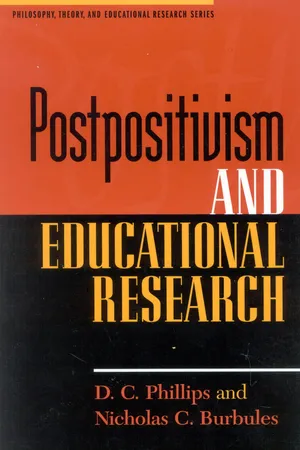
Postpositivism and Educational Research
About this book
This volume presents in a forthright and lively way, an account of the philosophical position generally identified as 'Postpositivistic' that undergirds much of mainstream research in education and the related social sciences. The discussion throughout is informed by recent developments in philosophy of science. Authors D. C. Phillips and Nicholas C. Burbules cite a number of interesting examples from the educational research and evaluation literature to illustrate the value of a scientific approach. Many educational researchers aspire to carry out rigorous or disciplined inquiry aimed at producing accurate (and generally 'truthful') accounts of educational phenomena and the causal psychological or social processes that lay behind them. However, many recent critics have argued that it is a mistake to believe that research can yield theories, or advance claims that are true, objective, and value-neutral. In other words, that researchers always work within frameworks that embody important (and often questionable) assumptions about values and the nature of human knowledge. This book argues that , while there is much to be learned from recent critiques, traditional scientific values and assumptions are not outmoded. The authors show students how to implement and benefit from the scientific method in ways that take into account recent critiques.
Information
Topic
EducationSubtopic
Research in EducationTable of contents
- Philosophy, Theory, and Educational Research
- Title Page
- Copyright Page
- Table of Contents
- Table of Figures
- Series Preface
- Acknowledgments
- 1 - What Is Postpositivism?
- 2 - Philosophical Commitments of Postpositivist Researchers
- 3 - Objectivity, Relativity, and Value Neutrality
- 4 - Can, and Should, Educational Inquiry Be Scientific?
- Index
- About the Authors
Trusted by 375,005 students
Access to over 1.5 million titles for a fair monthly price.
Study more efficiently using our study tools.
Frequently asked questions
Yes, you can cancel anytime from the Subscription tab in your account settings on the Perlego website. Your subscription will stay active until the end of your current billing period. Learn how to cancel your subscription
No, books cannot be downloaded as external files, such as PDFs, for use outside of Perlego. However, you can download books within the Perlego app for offline reading on mobile or tablet. Learn how to download books offline
Perlego offers two plans: Essential and Complete
- Essential is ideal for learners and professionals who enjoy exploring a wide range of subjects. Access the Essential Library with 800,000+ trusted titles and best-sellers across business, personal growth, and the humanities. Includes unlimited reading time and Standard Read Aloud voice.
- Complete: Perfect for advanced learners and researchers needing full, unrestricted access. Unlock 1.5M+ books across hundreds of subjects, including academic and specialized titles. The Complete Plan also includes advanced features like Premium Read Aloud and Research Assistant.
We are an online textbook subscription service, where you can get access to an entire online library for less than the price of a single book per month. With over 1.5 million books across 990+ topics, we’ve got you covered! Learn about our mission
Look out for the read-aloud symbol on your next book to see if you can listen to it. The read-aloud tool reads text aloud for you, highlighting the text as it is being read. You can pause it, speed it up and slow it down. Learn more about Read Aloud
Yes! You can use the Perlego app on both iOS and Android devices to read anytime, anywhere — even offline. Perfect for commutes or when you’re on the go.
Please note we cannot support devices running on iOS 13 and Android 7 or earlier. Learn more about using the app
Please note we cannot support devices running on iOS 13 and Android 7 or earlier. Learn more about using the app
Yes, you can access Postpositivism and Educational Research by D. C. Phillips,Nicholas C. Burbules in PDF and/or ePUB format, as well as other popular books in Education & Research in Education. We have over 1.5 million books available in our catalogue for you to explore.