eBook - ePub
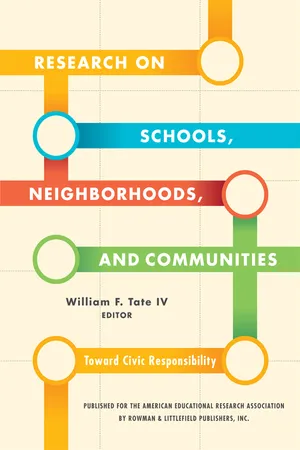
Research on Schools, Neighborhoods and Communities
Toward Civic Responsibility
- English
- ePUB (mobile friendly)
- Available on iOS & Android
eBook - ePub
About this book
Research on Schools, Neighborhoods, and Communities: Toward Civic Responsibility focuses on research and theoretical developments related to the role of geography in education, human development, and health. William F. Tate IV, the Edward Mallinckrodt Distinguished University Professor in Arts & Sciences at Washington University in St. Louis and former President of the American Educational Research Association, presents a collection of chapters from across disciplines to further understand the strengths of and problems in our communities. Today, many research literatures—e.g., health, housing, transportation, and education—focus on civic progress, yet rarely are there efforts to interrelate these literatures to better understand urgent problems and promising possibilities in education, wherein social context is central. In this volume, social context—in particular, the unequal opportunities that result from geography—is integral to the arguments, analyses, and case studies presented. Written by more than 40 educational scholars from top universities across the nation, the research presented in this volume provides historical, moral, and scientifically based arguments with the potential to inform understandings of civic problems associated with education, youth, and families, and to guide the actions of responsible citizens and institutions dedicated to advancing the public good.
Information
Topic
EducationTable of contents
- Acknowledgments
- Introduction
- Part I: Conceptualizing Urban Space
- Chapter 1: Neighborhood Inequality, Violence, and the Social Infrastructure of the American City
- Chapter 2: Toward a Theory of Place
- Chapter 3: Urban Opportunity Structure and Racial/Ethnic Polarization
- Chapter 4: Racial Segregation in Multiethnic Schools
- Part II: The Growing Complexity of Metropolitan America
- Chapter 5: Suburbanization and School Segregation
- Chapter 6: Schools Matter
- Chapter 7: Still Separate, Still Unequal, But Not Always So “Suburban”
- Chapter 8: Adding Geospatial Perspective to Research on Schools, Communities, and Neighborhoods
- Part III: Teaching and Learning Research in Social Context
- Chapter 9: Conceptual and Methodological Challenges to a Cultural and Ecological Framework for Studying Human Learning and Development
- Chapter 10: An Ecological and Activity Theoretic Approach to Studying Diasporic and Nondominant Communities
- Chapter 11: Reconstructing Education in America
- Chapter 12: Can School Improvement Reduce Racial Inequality?
- Chapter 13: Seeing Our Way Into Learning Science in Informal Environments
- Chapter 14: No Color Necessary
- Chapter 15: Taking Math and Science to Black Parents
- Part IV: Research on Human Development, Health, and Human Service Providers in Social Context
- Chapter 16: Maximizing Culturally and Contextually Sensitive Assessment Strategies in Developmental and Educational Research
- Chapter 17: Immigrant Children
- Chapter 18: Delivering High-Quality Public Services to Vulnerable Families and Children in America’s Cities
- Chapter 19: Health Disparities Among African Americans in Urban Populations
- Chapter 20: A “Tragic Dichotomy”
- Chapter 21: Pandemic Preparedness
- Part V: Case Studies of Metropolitan Communities
- Chapter 22: Urban America in Distress
- Chapter 23: God’s Will or Government Policy?
- Epilogue
- Chapter 24: Research Infrastructure for Improving Urban Education
- Chapter 25: The White House Office of Urban Affairs
- Chapter 26: Toward Civic Responsibility and Civic Engagement
- About the Contributors
Trusted by 375,005 students
Access to over 1.5 million titles for a fair monthly price.
Study more efficiently using our study tools.
Frequently asked questions
Yes, you can cancel anytime from the Subscription tab in your account settings on the Perlego website. Your subscription will stay active until the end of your current billing period. Learn how to cancel your subscription
No, books cannot be downloaded as external files, such as PDFs, for use outside of Perlego. However, you can download books within the Perlego app for offline reading on mobile or tablet. Learn how to download books offline
Perlego offers two plans: Essential and Complete
- Essential is ideal for learners and professionals who enjoy exploring a wide range of subjects. Access the Essential Library with 800,000+ trusted titles and best-sellers across business, personal growth, and the humanities. Includes unlimited reading time and Standard Read Aloud voice.
- Complete: Perfect for advanced learners and researchers needing full, unrestricted access. Unlock 1.5M+ books across hundreds of subjects, including academic and specialized titles. The Complete Plan also includes advanced features like Premium Read Aloud and Research Assistant.
We are an online textbook subscription service, where you can get access to an entire online library for less than the price of a single book per month. With over 1.5 million books across 990+ topics, we’ve got you covered! Learn about our mission
Look out for the read-aloud symbol on your next book to see if you can listen to it. The read-aloud tool reads text aloud for you, highlighting the text as it is being read. You can pause it, speed it up and slow it down. Learn more about Read Aloud
Yes! You can use the Perlego app on both iOS and Android devices to read anytime, anywhere — even offline. Perfect for commutes or when you’re on the go.
Please note we cannot support devices running on iOS 13 and Android 7 or earlier. Learn more about using the app
Please note we cannot support devices running on iOS 13 and Android 7 or earlier. Learn more about using the app
Yes, you can access Research on Schools, Neighborhoods and Communities by William F. Tate IV in PDF and/or ePUB format, as well as other popular books in Education & Evaluation & Assessment in Education. We have over 1.5 million books available in our catalogue for you to explore.