- English
- ePUB (mobile friendly)
- Available on iOS & Android
eBook - ePub
About this book
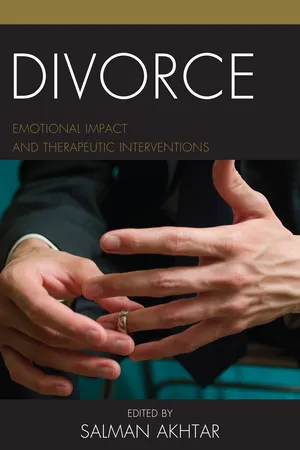
Divorce: Emotional Impact and Therapeutic Interventions offers a broad survey of psychodynamic observations on the antecedents and consequences of divorce. In this volume, distinguished clinical psychologists and psychoanalysts explore the emotional divorce that invariably precedes the one granted by a court and focus as well upon the emotional impact of the actual divorce upon the spouses, children, friends, and family. Examining a variety of modern families, chapters address both short-term and long-term sequelae of divorce, transgenerational reverberations, and the occasional, unsung benefits of divorce. The concept of a "good-enough divorce" further illustrates how the adverse effects of divorce can be kept at a minimum, and the process itself can allow patients unexpected self-reflection. A valuable resource for clinicians, Divorce: Emotional Impact and Therapeutic Interventions demonstrates how therapists and patients can work through a divorce to yield deeper insights into the self, greater tolerance of one's own limitations, and lay the groundwork for contentment with a future partner.
Information
Table of contents
- Cover
- Half Title
- Series Information
- Title Page
- Copyright Page
- Dedication
- Contents
- Acknowledgments
- Chapter One The Emotional Impact of Divorce: An Overview
- Chapter Two Divorce Is Not Good for Children and Other Living Things
- Chapter Three The Role of Hostility and Destructive Aggression Between Parents in the Lives of Their Children
- Chapter Four Some Countertransference Challenges in Working with Divorcing Adults
- Chapter Five Transference and Countertransference in the Divorce Process: A Psycho-legal Challenge for Lawyers and Judges
- Chapter Six Stories from the Edge: Divorce as Redemption
- Chapter Seven On Fragments, Metaphor, and the Edge
- Chapter Eight The Intersection of Divorce, Psychoanalytic Theory, and Clinical Practice: A Concluding Commentary
- About the Editor and Contributors
- References
- Index
Trusted by 375,005 students
Access to over 1.5 million titles for a fair monthly price.
Study more efficiently using our study tools.
Frequently asked questions
Yes, you can cancel anytime from the Subscription tab in your account settings on the Perlego website. Your subscription will stay active until the end of your current billing period. Learn how to cancel your subscription
No, books cannot be downloaded as external files, such as PDFs, for use outside of Perlego. However, you can download books within the Perlego app for offline reading on mobile or tablet. Learn how to download books offline
Perlego offers two plans: Essential and Complete
- Essential is ideal for learners and professionals who enjoy exploring a wide range of subjects. Access the Essential Library with 800,000+ trusted titles and best-sellers across business, personal growth, and the humanities. Includes unlimited reading time and Standard Read Aloud voice.
- Complete: Perfect for advanced learners and researchers needing full, unrestricted access. Unlock 1.5M+ books across hundreds of subjects, including academic and specialized titles. The Complete Plan also includes advanced features like Premium Read Aloud and Research Assistant.
We are an online textbook subscription service, where you can get access to an entire online library for less than the price of a single book per month. With over 1.5 million books across 990+ topics, we’ve got you covered! Learn about our mission
Look out for the read-aloud symbol on your next book to see if you can listen to it. The read-aloud tool reads text aloud for you, highlighting the text as it is being read. You can pause it, speed it up and slow it down. Learn more about Read Aloud
Yes! You can use the Perlego app on both iOS and Android devices to read anytime, anywhere — even offline. Perfect for commutes or when you’re on the go.
Please note we cannot support devices running on iOS 13 and Android 7 or earlier. Learn more about using the app
Please note we cannot support devices running on iOS 13 and Android 7 or earlier. Learn more about using the app
Yes, you can access Divorce by Salman Akhtar in PDF and/or ePUB format, as well as other popular books in Psychology & Psychoanalysis. We have over 1.5 million books available in our catalogue for you to explore.