eBook - ePub
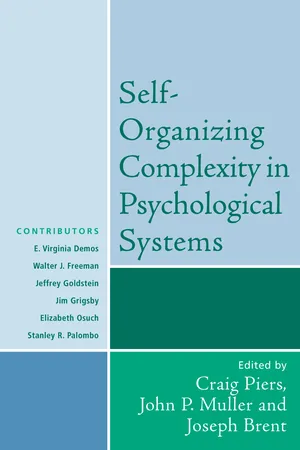
Self-Organizing Complexity in Psychological Systems
- English
- ePUB (mobile friendly)
- Available on iOS & Android
eBook - ePub
Self-Organizing Complexity in Psychological Systems
About this book
This volume addresses itself to the ways in which the so-called 'new sciences of complexity' can deepen and broaden neurobiological and psychological theories of mind. Complexity theory has gained increasing attention over the past 20 years across diverse areas of inquiry, including mathematics, physics, economics, biology, and the social sciences. Complexity theory concerns itself with how nonlinear dynamical systems evolve and change over time and draws on research arising from chaos theory, self-organization, artificial intelligence and cellular automata, to name a few. This emerging discipline shows many points of convergence with psychological theory and practice, emphasizing that history is irreversible and discontinuous, that small early interventions can have large and unexpected later effects, that each life trajectory is unique yet patterned, that measurement error is not random and cannot be justifiably distributed equally across experimental conditions, that a system's collective and coordinated organization is emergent and often arises from simple components in interaction, and that change is more likely to emerge under conditions of optimal turbulence.
Information
Table of contents
- Psychological Issues
- Title Page
- Copyright Page
- Table of Contents
- Introduction
- CHAPTER ONE - Complexity Theory as the Parent Science of Psychoanalysis
- CHAPTER TWO - A Biological Theory of Brain Function and Its Relevance to Psychoanalysis
- CHAPTER THREE - Neurodynamics, State, Agency, and Psychological Functioning
- CHAPTER FOUR - Emergence: When a Difference in Degree Becomes a Difference in Kind
- CHAPTER FIVE - Emergence and Psychological Morphogenesis
- CHAPTER SIX - The Dynamics of Development
- The Language of Complexity Theory
- Author Index
- Subject Index
- Contributors
Trusted by 375,005 students
Access to over 1.5 million titles for a fair monthly price.
Study more efficiently using our study tools.
Frequently asked questions
Yes, you can cancel anytime from the Subscription tab in your account settings on the Perlego website. Your subscription will stay active until the end of your current billing period. Learn how to cancel your subscription
No, books cannot be downloaded as external files, such as PDFs, for use outside of Perlego. However, you can download books within the Perlego app for offline reading on mobile or tablet. Learn how to download books offline
Perlego offers two plans: Essential and Complete
- Essential is ideal for learners and professionals who enjoy exploring a wide range of subjects. Access the Essential Library with 800,000+ trusted titles and best-sellers across business, personal growth, and the humanities. Includes unlimited reading time and Standard Read Aloud voice.
- Complete: Perfect for advanced learners and researchers needing full, unrestricted access. Unlock 1.5M+ books across hundreds of subjects, including academic and specialized titles. The Complete Plan also includes advanced features like Premium Read Aloud and Research Assistant.
We are an online textbook subscription service, where you can get access to an entire online library for less than the price of a single book per month. With over 1.5 million books across 990+ topics, we’ve got you covered! Learn about our mission
Look out for the read-aloud symbol on your next book to see if you can listen to it. The read-aloud tool reads text aloud for you, highlighting the text as it is being read. You can pause it, speed it up and slow it down. Learn more about Read Aloud
Yes! You can use the Perlego app on both iOS and Android devices to read anytime, anywhere — even offline. Perfect for commutes or when you’re on the go.
Please note we cannot support devices running on iOS 13 and Android 7 or earlier. Learn more about using the app
Please note we cannot support devices running on iOS 13 and Android 7 or earlier. Learn more about using the app
Yes, you can access Self-Organizing Complexity in Psychological Systems by Craig Piers,John P. Muller,Joseph Brent in PDF and/or ePUB format, as well as other popular books in Psychology & Psychoanalysis. We have over 1.5 million books available in our catalogue for you to explore.