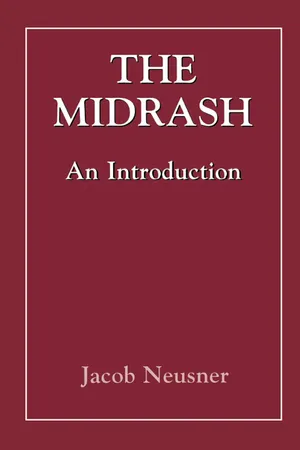
The Midrash: An Introduction sets forth the way in which Judaism reads the Hebrew Bible. In this masterful presentation, the reader is introduced to the classics of Jewish Bible interpretation, with special attention to the way in which the ribbis of Talmudic times read the Pentateuch, the Book of Ruth, and Song of Songs. The seven Midrash compilations are introduced with a lucid account of their main points, accompanied by selections that give the reader a direct encounter, in English, with the Bible as Judaism understands it.
The word midrash, based on the Hebrew root DaRaSH ("search"), means "interpretation" or "exegesis." Midrash also more formally refers to the compilations of such interpretations of Scripture. As Dr. Jacob Neusner explains, these compilations "reached closure and conclusion in the formative stage of Judaism, that is, the first seven centuries of the Common Era, the time in which the Mishnah (ca. 200), Talmud of the Land of Israel (ca. 400), and Talmud of Babylonia (ca. 600) were written."
Midrash is not so much about Scripture as it is a subordinate part of Scripture: "They did not write about Scripture," Dr. Neusner says. "They wrote with Scripture … much as painters paint with a palette of colors."
The Midrash: An Introduction is the second volume in Dr. Jacob Neusner's series of introductory volumes on classical rabbinic literature. As with the first volume – The Mishnah: An Introduction – this book offers the layperson a concise description of the religious literature and, drawing on Dr. Neusner's own translations of the texts, walks readers through the selections, providing them with firsthand experience with the document itself.
As Dr. Neusner says in his preface to The Midrash: An Introduction, "In these pages I mean to make it possible for readers to know one such compilation from the other and so to begin studying their own."
- English
- ePUB (mobile friendly)
- Available on iOS & Android
eBook - ePub
About this book
Information
Topic
Theology & ReligionSubtopic
Jewish TheologyTable of contents
- Cover
- Half title
- Title
- Copyright
- Dedication
- Contents
- Preface
- Prologue
- Part I The Second- and Third-Century Compilations
- Part II The Fourth- and Fifth-Century Compilations
- Part III The Sixth- and Seventh-Century Compilations
- Bibliography of Midrash Studies
- Index
Trusted by 375,005 students
Access to over 1.5 million titles for a fair monthly price.
Study more efficiently using our study tools.
Frequently asked questions
Yes, you can cancel anytime from the Subscription tab in your account settings on the Perlego website. Your subscription will stay active until the end of your current billing period. Learn how to cancel your subscription
No, books cannot be downloaded as external files, such as PDFs, for use outside of Perlego. However, you can download books within the Perlego app for offline reading on mobile or tablet. Learn how to download books offline
Perlego offers two plans: Essential and Complete
- Essential is ideal for learners and professionals who enjoy exploring a wide range of subjects. Access the Essential Library with 800,000+ trusted titles and best-sellers across business, personal growth, and the humanities. Includes unlimited reading time and Standard Read Aloud voice.
- Complete: Perfect for advanced learners and researchers needing full, unrestricted access. Unlock 1.5M+ books across hundreds of subjects, including academic and specialized titles. The Complete Plan also includes advanced features like Premium Read Aloud and Research Assistant.
We are an online textbook subscription service, where you can get access to an entire online library for less than the price of a single book per month. With over 1.5 million books across 990+ topics, we’ve got you covered! Learn about our mission
Look out for the read-aloud symbol on your next book to see if you can listen to it. The read-aloud tool reads text aloud for you, highlighting the text as it is being read. You can pause it, speed it up and slow it down. Learn more about Read Aloud
Yes! You can use the Perlego app on both iOS and Android devices to read anytime, anywhere — even offline. Perfect for commutes or when you’re on the go.
Please note we cannot support devices running on iOS 13 and Android 7 or earlier. Learn more about using the app
Please note we cannot support devices running on iOS 13 and Android 7 or earlier. Learn more about using the app
Yes, you can access The Midrash by Jacob Neusner in PDF and/or ePUB format, as well as other popular books in Theology & Religion & Jewish Theology. We have over 1.5 million books available in our catalogue for you to explore.