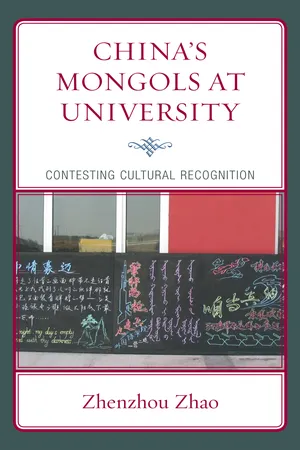
Minority students in China often receive preferential treatment for access to universities. However, very little is known about minority student experiences and perceptions on campus after they are accorded what's called "meaningful access" to university.
The Mongols emerged as a distinct ethnic group in China starting in the 11th century and, in the centuries that followed, conquered a large part of the world. However, in modern times this nomadic people's influence has declined, and even their survival in China has been threatened. This decline is evidenced by the fact that increasing numbers of Mongols have abandoned their native language and traditional customs, especially those who live in cities.
How do Mongol university students, who form the backbone of the Mongol intellectual community, identify themselves in a modern Chinese context? How do they react as university students to the way in which their culture is recognized and represented? Do Mongol students suffer from injustice in the cultural dimension of campus life? China's Mongols at University: Contesting Cultural Recognition seeks to answer these questions.
Zhenzhou Zhao addresses these issues by comparing the university discourse (on minority culture policy, institutional structure and daily life) and the Mongol student discourse (concerning their experiences, perceptions of recognition, and dedication to self-representation on campus) Additionally, Gao compares three universities in China. Located in Inner Mongolia Autonomous Region, Beijing, and Hubei Province, respectively, each of these universities represents one of three types of higher education accessible to minority students in China: universities located in ethnic areas, standard universities, and universities for nationalities.
China's Mongols at University explores and discusses an intrinsic connection between marketization and globalization and the disadvantages faced by minority groups. This book argues that China must move from a policy of preferential tre
- English
- ePUB (mobile friendly)
- Available on iOS & Android
eBook - ePub
About this book
Information
Topic
EducationSubtopic
Comparative EducationTable of contents
- Cover
- Half title
- Title
- Copyright
- Contents
- Map
- Figures
- Tables
- Plates
- Abbreviations
- Series Editor’s Foreword
- Foreword
- Acknowledgments
- 1 China, the Mongols, and Ethnic Representation
- 2 Recognition and Education: A New Perspective on Ethnic Inequality
- 3 Minorities and Chinese Higher Education
- 4 The Case of Inner Mongolia Normal University
- 5 The Case of Beijing Normal University
- 6 The Case of South China University for Nationalities
- 7 Privileged and Cultural Recognition: Challenges Facing Higher Education
- 8 Self-Reflection by the Author
- Appendix
- Bibliography
- Index
- About the Author
Trusted by 375,005 students
Access to over 1.5 million titles for a fair monthly price.
Study more efficiently using our study tools.
Frequently asked questions
Yes, you can cancel anytime from the Subscription tab in your account settings on the Perlego website. Your subscription will stay active until the end of your current billing period. Learn how to cancel your subscription
No, books cannot be downloaded as external files, such as PDFs, for use outside of Perlego. However, you can download books within the Perlego app for offline reading on mobile or tablet. Learn how to download books offline
Perlego offers two plans: Essential and Complete
- Essential is ideal for learners and professionals who enjoy exploring a wide range of subjects. Access the Essential Library with 800,000+ trusted titles and best-sellers across business, personal growth, and the humanities. Includes unlimited reading time and Standard Read Aloud voice.
- Complete: Perfect for advanced learners and researchers needing full, unrestricted access. Unlock 1.5M+ books across hundreds of subjects, including academic and specialized titles. The Complete Plan also includes advanced features like Premium Read Aloud and Research Assistant.
We are an online textbook subscription service, where you can get access to an entire online library for less than the price of a single book per month. With over 1.5 million books across 990+ topics, we’ve got you covered! Learn about our mission
Look out for the read-aloud symbol on your next book to see if you can listen to it. The read-aloud tool reads text aloud for you, highlighting the text as it is being read. You can pause it, speed it up and slow it down. Learn more about Read Aloud
Yes! You can use the Perlego app on both iOS and Android devices to read anytime, anywhere — even offline. Perfect for commutes or when you’re on the go.
Please note we cannot support devices running on iOS 13 and Android 7 or earlier. Learn more about using the app
Please note we cannot support devices running on iOS 13 and Android 7 or earlier. Learn more about using the app
Yes, you can access China's Mongols at University by Zhenzhou Zhao,Wing On Lee in PDF and/or ePUB format, as well as other popular books in Education & Comparative Education. We have over 1.5 million books available in our catalogue for you to explore.