Western civilization is founded upon the assumption that there exists a "natural order" to the world, an embedded principle of justice with which human reason is aligned. The imagery is seductive. However, Emil Fackenheim raises a troubling fact in his To Mend the World when he names the Holocaust the "rupture that ruptures philosophy." The Holocaust and countless other horrors over thousands of years of eager philosophical pursuit could not order the troublesome human soul to that state of justice that the Plato claims to be the most natural and happy state of human beings, if they can simply know their best interests. The philosopher, physician to the human soul, has proven impotent in healing the open ethical wound of human inhumanity; worse, the grand ontological and epistemological structures that philosophers have constructed may be linked to the ethical failures of the planet, to colonial and imperial worldviews.
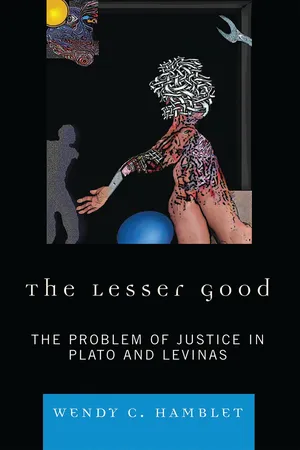
The work of post-Holocaust phenomenologist, Emmanuel Levinas, is written under the somber backdrop of the Holocaust. Levinas, by his own admission, stages a return to Plato. He shares Plato's sense of ethical urgency in the philosophical task, but he sets course for a new Platonism that thinks the difference separating (rather than the unity gathering) being. Levinas, more than Plato, appreciates that the exigencies and labor of everyday life can eclipse the needs of others and waylay the ethical life. Levinas too holds out more hope than Plato that the worst human beings can simply forget themselves and their self-interested projects, and become their brothers' keepers. Levinas quests for the good beyond being as he challenges the tradition of Western thought and the post-Holocaust world to a new ethos: we must decide between the starry skies above (the ordered ontologies of the Western tradition) and the moral law within. The Lesser Good represents a timely consideration of the ethical exigencies of human life, politics, and justice, demonstrating that philosophy's fa
- English
- ePUB (mobile friendly)
- Available on iOS & Android
eBook - ePub
About this book
Information
Topic
PhilosophySubtopic
Ancient & Classical PhilosophyTable of contents
- Cover
- Half title
- Title
- Copyright
- Dedication
- Contents
- One From Humility to Truth to Rupture
- Two Ethics as First Philosophy
- Three The Time of Ethics and Justice
- Four Ethics and the Places of Justice
- Five The Nature of Human Life
- Six The Nurture of Ethics and Justice
- Seven Justice Misplaced and Out of Time
- Eight Resolving the Mystery of Unethical Justice
- Nine Between Ethics and Justice
- Bibliography
- Index
- About the Author
Trusted by 375,005 students
Access to over 1.5 million titles for a fair monthly price.
Study more efficiently using our study tools.
Frequently asked questions
Yes, you can cancel anytime from the Subscription tab in your account settings on the Perlego website. Your subscription will stay active until the end of your current billing period. Learn how to cancel your subscription
No, books cannot be downloaded as external files, such as PDFs, for use outside of Perlego. However, you can download books within the Perlego app for offline reading on mobile or tablet. Learn how to download books offline
Perlego offers two plans: Essential and Complete
- Essential is ideal for learners and professionals who enjoy exploring a wide range of subjects. Access the Essential Library with 800,000+ trusted titles and best-sellers across business, personal growth, and the humanities. Includes unlimited reading time and Standard Read Aloud voice.
- Complete: Perfect for advanced learners and researchers needing full, unrestricted access. Unlock 1.5M+ books across hundreds of subjects, including academic and specialized titles. The Complete Plan also includes advanced features like Premium Read Aloud and Research Assistant.
We are an online textbook subscription service, where you can get access to an entire online library for less than the price of a single book per month. With over 1.5 million books across 990+ topics, we’ve got you covered! Learn about our mission
Look out for the read-aloud symbol on your next book to see if you can listen to it. The read-aloud tool reads text aloud for you, highlighting the text as it is being read. You can pause it, speed it up and slow it down. Learn more about Read Aloud
Yes! You can use the Perlego app on both iOS and Android devices to read anytime, anywhere — even offline. Perfect for commutes or when you’re on the go.
Please note we cannot support devices running on iOS 13 and Android 7 or earlier. Learn more about using the app
Please note we cannot support devices running on iOS 13 and Android 7 or earlier. Learn more about using the app
Yes, you can access The Lesser Good by Wendy C. Hamblet in PDF and/or ePUB format, as well as other popular books in Philosophy & Ancient & Classical Philosophy. We have over 1.5 million books available in our catalogue for you to explore.