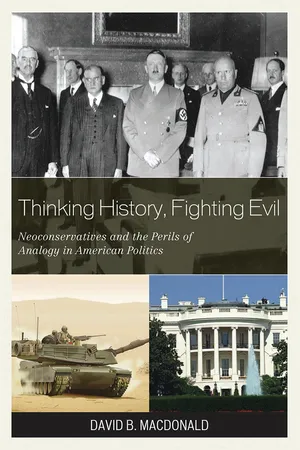
Thinking History, Fighting Evil presents the most thorough exploration to date of how World War II analogies, particularly those focused on the Holocaust, have colored American foreign policy-making after 9/11. In particular, this book highlights how influential neoconservatives inside and outside the Bush administration used analogies of the "Good War" to reinterpret domestic and international events, often with disastrous consequences. On the surface, World War II promotes a simple but compelling range of images and symbols: valiant Roosevelts and Churchills, appeasing Chamberlains, evil Hitlers, Jewish victims, European bystanders, and American liberators. However, the simplistic use of analogies was precisely what doomed the neoconservative project to failure. This book explores the misuse of ten key analogies arising from World War II and charts their problematic deployment after the 9/11 attacks.
Divided into eight chapters, Thinking History, Fighting Evil engages with timely issues such as the moral legacies of the civil rights era, identity politics movements, the representation of the Holocaust in American life, the rise of victim politics on the neoconservative right, the instrumentalization of anti-American and anti-Semitic discourses, the trans-Atlantic rift between Europe and the United States, and the war on terror. While the book focuses on the post-9/11 security environment, it also explores the history of negative exceptionalism in U.S. history and politics, tracing back Manichean conceptions of good and evil to the foundation of the early colonies.
eBook - ePub
Thinking History, Fighting Evil
Neoconservatives and the Perils of Analogy in American Politics
- English
- ePUB (mobile friendly)
- Available on iOS & Android
eBook - ePub
Thinking History, Fighting Evil
Neoconservatives and the Perils of Analogy in American Politics
About this book
Information
Table of contents
- Title Page
- Copyright Page
- Table of Contents
- Acknowledgments
- Introduction
- Chapter 1 - Thinking History: Analogies and Schemas in International Politics
- Chapter 2 - Fighting Evil: The Hebrew Schema and the Munich and Vietnam Analogies
- Chapter 3 - Americanizing the “Good War”: Nine Analogies in U.S. Politics
- Chapter 4 - Neoconservatives and the American Weimar
- Chapter 5 - 9/11 and the New “Good War”
- Chapter 6 - Swastikas in the Sand?: Neoconservatives and the War in Iraq
- Chapter 7 - Righteous Victims: The Pathologies of Anti-Americanism
- Chapter 8 - Near Enemies: The European Collaborators
- Conclusions
- Index
- About the Author
Trusted by 375,005 students
Access to over 1.5 million titles for a fair monthly price.
Study more efficiently using our study tools.
Frequently asked questions
Yes, you can cancel anytime from the Subscription tab in your account settings on the Perlego website. Your subscription will stay active until the end of your current billing period. Learn how to cancel your subscription
No, books cannot be downloaded as external files, such as PDFs, for use outside of Perlego. However, you can download books within the Perlego app for offline reading on mobile or tablet. Learn how to download books offline
Perlego offers two plans: Essential and Complete
- Essential is ideal for learners and professionals who enjoy exploring a wide range of subjects. Access the Essential Library with 800,000+ trusted titles and best-sellers across business, personal growth, and the humanities. Includes unlimited reading time and Standard Read Aloud voice.
- Complete: Perfect for advanced learners and researchers needing full, unrestricted access. Unlock 1.5M+ books across hundreds of subjects, including academic and specialized titles. The Complete Plan also includes advanced features like Premium Read Aloud and Research Assistant.
We are an online textbook subscription service, where you can get access to an entire online library for less than the price of a single book per month. With over 1.5 million books across 990+ topics, we’ve got you covered! Learn about our mission
Look out for the read-aloud symbol on your next book to see if you can listen to it. The read-aloud tool reads text aloud for you, highlighting the text as it is being read. You can pause it, speed it up and slow it down. Learn more about Read Aloud
Yes! You can use the Perlego app on both iOS and Android devices to read anytime, anywhere — even offline. Perfect for commutes or when you’re on the go.
Please note we cannot support devices running on iOS 13 and Android 7 or earlier. Learn more about using the app
Please note we cannot support devices running on iOS 13 and Android 7 or earlier. Learn more about using the app
Yes, you can access Thinking History, Fighting Evil by David B. MacDonald in PDF and/or ePUB format, as well as other popular books in Politics & International Relations & Political History & Theory. We have over 1.5 million books available in our catalogue for you to explore.