eBook - ePub
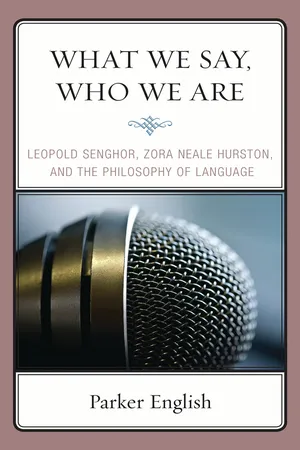
What We Say, Who We Are
Leopold Senghor, Zora Neale Hurston, and the Philosophy of Language
- English
- ePUB (mobile friendly)
- Available on iOS & Android
eBook - ePub
What We Say, Who We Are
Leopold Senghor, Zora Neale Hurston, and the Philosophy of Language
About this book
In What We Say, Who We Are: Leopold Senghor, Zora Neale Hurston, and the Philosophy of Language, Parker English explores the commonality between Leopold Senghor's concept of "negritude" and Zora Neale Hurston's view of "Negro expression." For English, these two concepts emphasize that a person's view of herself is above all dictated by the way in which she talks about herself. Focusing on what he identifies as "performism," English discusses the presentational/representational and externalistic/internalistic facets of "performism" as they relate to the ideas of Senghor and Hurston. English ends his work by closely examining Hurston's Their Eyes Were Watching God in light of his discussion of "performism," and draws new, intriguing conclusions about the extent to which Hurston's main character exemplifies W.E.B. DuBois's concept of double-consciousness. What We Say, Who We Are will certainly pique the interest of scholars interested in Africana studies, African-American literature, and the philosophy of language.
Information
Topic
PhilosophySubtopic
LinguisticsTable of contents
- Cover
- Half title
- Title
- Copyright
- Contents
- Acknowledgments
- Introduction
- Chapter 1 Senghor’s Discussion of “Negritude” and Hurston’s Discussion of “Negro Expression”
- Chapter 2 Performism: A View Gleaned from Senghor and from Hurston
- Chapter 3 Performatives and Reflexivity in Light of Hurston’s Ethnography and Fiction
- Chapter 4 Exchanges of Speech
- Chapter 5 Speech and Senses of Self in Their Eyes Were Watching God
- Chapter 6 Performism in the World
- Works Cited
- Index
- About the Author
Trusted by 375,005 students
Access to over 1.5 million titles for a fair monthly price.
Study more efficiently using our study tools.
Frequently asked questions
Yes, you can cancel anytime from the Subscription tab in your account settings on the Perlego website. Your subscription will stay active until the end of your current billing period. Learn how to cancel your subscription
No, books cannot be downloaded as external files, such as PDFs, for use outside of Perlego. However, you can download books within the Perlego app for offline reading on mobile or tablet. Learn how to download books offline
Perlego offers two plans: Essential and Complete
- Essential is ideal for learners and professionals who enjoy exploring a wide range of subjects. Access the Essential Library with 800,000+ trusted titles and best-sellers across business, personal growth, and the humanities. Includes unlimited reading time and Standard Read Aloud voice.
- Complete: Perfect for advanced learners and researchers needing full, unrestricted access. Unlock 1.5M+ books across hundreds of subjects, including academic and specialized titles. The Complete Plan also includes advanced features like Premium Read Aloud and Research Assistant.
We are an online textbook subscription service, where you can get access to an entire online library for less than the price of a single book per month. With over 1.5 million books across 990+ topics, we’ve got you covered! Learn about our mission
Look out for the read-aloud symbol on your next book to see if you can listen to it. The read-aloud tool reads text aloud for you, highlighting the text as it is being read. You can pause it, speed it up and slow it down. Learn more about Read Aloud
Yes! You can use the Perlego app on both iOS and Android devices to read anytime, anywhere — even offline. Perfect for commutes or when you’re on the go.
Please note we cannot support devices running on iOS 13 and Android 7 or earlier. Learn more about using the app
Please note we cannot support devices running on iOS 13 and Android 7 or earlier. Learn more about using the app
Yes, you can access What We Say, Who We Are by Parker English in PDF and/or ePUB format, as well as other popular books in Philosophy & Linguistics. We have over 1.5 million books available in our catalogue for you to explore.