Set in the larger context of the evolution of international human rights, this cogent book examines the tragic development and ultimate resolution of Latin America's human rights crisis of the 1970s and 1980s. Thomas Wright focuses especially on state terrorism in Chile under General Augusto Pinochet (1973–1990) and in Argentina during the Dirty War (1976–1983). The author probes the background of these regimes, the methodology of state terrorism, and the human rights movements that emerged in urgent response to the brutality of institutionalized torture, murder, and disappearance. He also discusses the legacies of state terrorism in the post-dictatorial period, particularly the bitter battle between demands for justice and the military's claim of impunity. Central to this struggle was the politics of memory as two radically different versions of the countries' recent history clashed: had the militaries conducted legitimate wars against subversion or had they exercised terrorism based on a misguided concept of national security?
The book offers a nuanced exploration of the reciprocal relationship between state terrorism and its legacies, on one hand, and international human rights on the other. When the Chilean and Argentine militaries seized power, the international human rights lobby was too weak to prevent the massive toll of state terrorism. But the powerful worldwide response to these regimes ultimately strengthened international human rights treaties, institutions, and jurisprudence, paving the way for the Rwanda and Yugoslavia genocide tribunals and the International Criminal Court. Indeed, Chile and Argentina today routinely try and convict former repressors in their own courts.
This compelling history demonstrates that the experiences of Chile and Argentina contributed to strengthening the international human rights movement, which in turn gave it the influence to affect the outcome in these two South American countries. Ironically, the brutal regimes of Chile and Argentina played the major role in transforming a largely dormant international lobby into a powerful force that today is capable of bringing major repressors from anywhere in the world to justice. These intertwined themes make this book important reading not only for Latin Americanists but for students of human rights and of international relations as well.
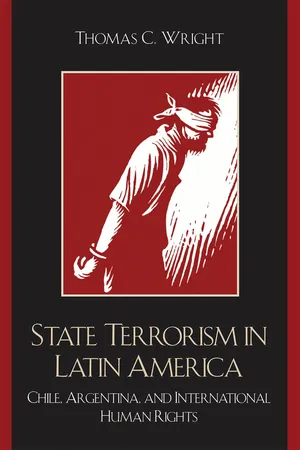
eBook - ePub
State Terrorism in Latin America
Chile, Argentina, and International Human Rights
- English
- ePUB (mobile friendly)
- Available on iOS & Android
eBook - ePub
About this book
Information
Table of contents
- Cover
- Half title
- Title
- Copyright
- Contents
- Acknowledgments
- List of Acronyms
- Introduction
- Part I Human Rights, State Terrorism, and Latin America
- Part II The Dirty Wars
- Part III Justice versus Impunity
- Conclusion: Chile, Argentina, and International Human Rights
- Selected Bibliography
- Index
- About the Author
Trusted by 375,005 students
Access to over 1.5 million titles for a fair monthly price.
Study more efficiently using our study tools.
Frequently asked questions
Yes, you can cancel anytime from the Subscription tab in your account settings on the Perlego website. Your subscription will stay active until the end of your current billing period. Learn how to cancel your subscription
No, books cannot be downloaded as external files, such as PDFs, for use outside of Perlego. However, you can download books within the Perlego app for offline reading on mobile or tablet. Learn how to download books offline
Perlego offers two plans: Essential and Complete
- Essential is ideal for learners and professionals who enjoy exploring a wide range of subjects. Access the Essential Library with 800,000+ trusted titles and best-sellers across business, personal growth, and the humanities. Includes unlimited reading time and Standard Read Aloud voice.
- Complete: Perfect for advanced learners and researchers needing full, unrestricted access. Unlock 1.5M+ books across hundreds of subjects, including academic and specialized titles. The Complete Plan also includes advanced features like Premium Read Aloud and Research Assistant.
We are an online textbook subscription service, where you can get access to an entire online library for less than the price of a single book per month. With over 1.5 million books across 990+ topics, we’ve got you covered! Learn about our mission
Look out for the read-aloud symbol on your next book to see if you can listen to it. The read-aloud tool reads text aloud for you, highlighting the text as it is being read. You can pause it, speed it up and slow it down. Learn more about Read Aloud
Yes! You can use the Perlego app on both iOS and Android devices to read anytime, anywhere — even offline. Perfect for commutes or when you’re on the go.
Please note we cannot support devices running on iOS 13 and Android 7 or earlier. Learn more about using the app
Please note we cannot support devices running on iOS 13 and Android 7 or earlier. Learn more about using the app
Yes, you can access State Terrorism in Latin America by Thomas C. Wright in PDF and/or ePUB format, as well as other popular books in History & Latin American & Caribbean History. We have over 1.5 million books available in our catalogue for you to explore.