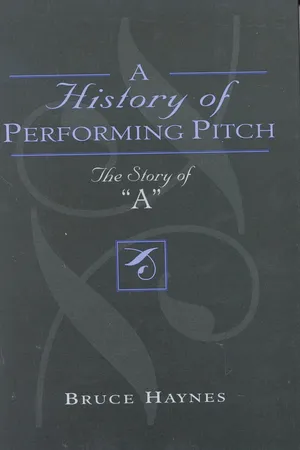
This is the first complete survey of the historical pitch standards used by musicians during the last four centuries. Written from a practical perspective and addressed to performers it is the first book to attach frequency values to pitch names and describe where, when, and why various historical pitch levels were used. It surveys a period from the 16th century to the present and focuses on Italy, France, Germany, the northern and southern Netherlands, and the Habsburg Lands, following the developments in the design and function of instruments and how they influenced and were influenced by pitch changes.
The History of Performing Pitch explores the relationships between pitches like Chorton, Cammerton, and Consort-Pitch and what pitch frequencies they represented at various times and places. It also examines what effect pitch differences had on musical notation and choice of key, and discusses practical considerations musicians would have had to make when transposing, especially with regards to the range of singers' voices.
What distinguishes this book from previous pitch studies is that it has been written since the rise of the early music revival within the context of the growing understanding of how "early" instruments work. This development has provided a new source of empirical information not previously available, which allows this book to base its conclusions on a much larger and more relevant sample than has ever been possible before. It refers to the original pitches of some 1,382 historical instruments, including cornetts, Renaissance flutes, traversos, recorders, clarinets, organs, pitchpipes, and automatic instruments from all over Europe and compares this information with music and written texts. While this study avoids categorical answers where historical information is not yet sufficient to justify them, it locates a number of historical pitch levels, discovers several that were previously unnoticed, and disproves several common myths about pitch.
- English
- ePUB (mobile friendly)
- Available on iOS & Android
eBook - ePub
About this book
Information
Subtopic
History ReferenceTable of contents
- Cover
- Title
- Copyright
- Dedication
- Contents
- List of Illustrations
- List of Graphs
- Preface
- Acknowledgements
- Mechanics
- Introduction
- 1 The Evidence
- 2 Pitch before the Instrument Revolution of ca.1670
- 3 The Instrument Revolution and Pitch Fragmentation, 1670-1700
- 4 The General Adoption of A-1, 1700-1730
- 5 Germany, 1700-1730: Cammerton, Chorton, Cornet-Ton
- 6 Sebastian Bach and Pitch
- 7 1730-1770: A “Diversity of Pitches”
- 8 Classical Pitches, 1770-1800
- 9 Early Romantic Pitches, 1800-1830
- 10 Pitch Standards, 1830-2001
- 11 Summary: Pitch Change by Country
- Graphs
- Appendixes
- Citations in Original Languages
- Bibliography
- Index
- About the Author
Trusted by 375,005 students
Access to over 1.5 million titles for a fair monthly price.
Study more efficiently using our study tools.
Frequently asked questions
Yes, you can cancel anytime from the Subscription tab in your account settings on the Perlego website. Your subscription will stay active until the end of your current billing period. Learn how to cancel your subscription
No, books cannot be downloaded as external files, such as PDFs, for use outside of Perlego. However, you can download books within the Perlego app for offline reading on mobile or tablet. Learn how to download books offline
Perlego offers two plans: Essential and Complete
- Essential is ideal for learners and professionals who enjoy exploring a wide range of subjects. Access the Essential Library with 800,000+ trusted titles and best-sellers across business, personal growth, and the humanities. Includes unlimited reading time and Standard Read Aloud voice.
- Complete: Perfect for advanced learners and researchers needing full, unrestricted access. Unlock 1.5M+ books across hundreds of subjects, including academic and specialized titles. The Complete Plan also includes advanced features like Premium Read Aloud and Research Assistant.
We are an online textbook subscription service, where you can get access to an entire online library for less than the price of a single book per month. With over 1.5 million books across 990+ topics, we’ve got you covered! Learn about our mission
Look out for the read-aloud symbol on your next book to see if you can listen to it. The read-aloud tool reads text aloud for you, highlighting the text as it is being read. You can pause it, speed it up and slow it down. Learn more about Read Aloud
Yes! You can use the Perlego app on both iOS and Android devices to read anytime, anywhere — even offline. Perfect for commutes or when you’re on the go.
Please note we cannot support devices running on iOS 13 and Android 7 or earlier. Learn more about using the app
Please note we cannot support devices running on iOS 13 and Android 7 or earlier. Learn more about using the app
Yes, you can access A History of Performing Pitch by Bruce Haynes in PDF and/or ePUB format, as well as other popular books in Media & Performing Arts & History Reference. We have over 1.5 million books available in our catalogue for you to explore.