
- English
- ePUB (mobile friendly)
- Available on iOS & Android
eBook - ePub
About this book
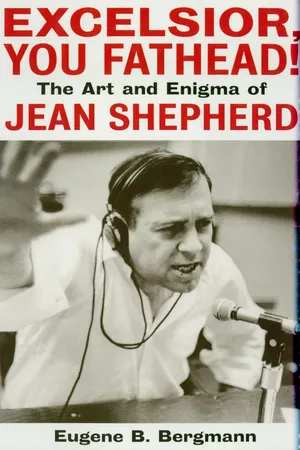
Jean Shepherd (1921-1999), master humorist, is best known for his creation A Christmas Story, the popular movie about the child who wants a BB gun for Christmas and nearly shoots his eye out.
What else did Shepherd do? He is considered by many to be the Mark Twain and James Thurber of his day. For many thousands of fans, for decades, "Shep" talked on the radio late at night, keeping them up way past their bedtimes. He entertained without a script, improvising like a jazz musician, on any and every subject you can imagine. He invented and remains the master of talk radio.
Shepherd perpetrated one of the great literary hoaxes of all time, promoting a nonexistent book and author, and then brought the book into existence. He wrote 23 short stories for Playboy, four times winning their humor of the year award, and also interviewed The Beatles for the magazine. He authored several popular books of humor and satire, created several television series and acted in several plays. He is the model for the character played by Jason Robards in the play and movie A Thousand Clowns, as well as the inspiration for the Shel Silverstein song made famous by Johnny Cash, "A Boy Named Sue."
Readers will learn the significance of innumerable Shepherd words and phrases, such as "Excelsior, you fathead " and observe his constant confrontations with the America he loved. They will get to know and understand this multitalented genius by peeking behind the wall he built for himself – a wall to hide a different and less agreeable persona. Through interviews with his friends, co-workers and creative associates, such as musician David Amram, cartoonist and playwright Jules Feiffer, publisher and broadcaster Paul Krassner, and author Norman Mailer, the book explains a complex and unique genius of our time.
"Shepherd pretty much invented talk radio ... What I got of him was a wonder at the world one man could create. I am as awed now by his achievement as I was then."
– Richard Corliss, Time magazine online
What else did Shepherd do? He is considered by many to be the Mark Twain and James Thurber of his day. For many thousands of fans, for decades, "Shep" talked on the radio late at night, keeping them up way past their bedtimes. He entertained without a script, improvising like a jazz musician, on any and every subject you can imagine. He invented and remains the master of talk radio.
Shepherd perpetrated one of the great literary hoaxes of all time, promoting a nonexistent book and author, and then brought the book into existence. He wrote 23 short stories for Playboy, four times winning their humor of the year award, and also interviewed The Beatles for the magazine. He authored several popular books of humor and satire, created several television series and acted in several plays. He is the model for the character played by Jason Robards in the play and movie A Thousand Clowns, as well as the inspiration for the Shel Silverstein song made famous by Johnny Cash, "A Boy Named Sue."
Readers will learn the significance of innumerable Shepherd words and phrases, such as "Excelsior, you fathead " and observe his constant confrontations with the America he loved. They will get to know and understand this multitalented genius by peeking behind the wall he built for himself – a wall to hide a different and less agreeable persona. Through interviews with his friends, co-workers and creative associates, such as musician David Amram, cartoonist and playwright Jules Feiffer, publisher and broadcaster Paul Krassner, and author Norman Mailer, the book explains a complex and unique genius of our time.
"Shepherd pretty much invented talk radio ... What I got of him was a wonder at the world one man could create. I am as awed now by his achievement as I was then."
– Richard Corliss, Time magazine online
Frequently asked questions
Yes, you can cancel anytime from the Subscription tab in your account settings on the Perlego website. Your subscription will stay active until the end of your current billing period. Learn how to cancel your subscription.
No, books cannot be downloaded as external files, such as PDFs, for use outside of Perlego. However, you can download books within the Perlego app for offline reading on mobile or tablet. Learn more here.
Perlego offers two plans: Essential and Complete
- Essential is ideal for learners and professionals who enjoy exploring a wide range of subjects. Access the Essential Library with 800,000+ trusted titles and best-sellers across business, personal growth, and the humanities. Includes unlimited reading time and Standard Read Aloud voice.
- Complete: Perfect for advanced learners and researchers needing full, unrestricted access. Unlock 1.4M+ books across hundreds of subjects, including academic and specialized titles. The Complete Plan also includes advanced features like Premium Read Aloud and Research Assistant.
We are an online textbook subscription service, where you can get access to an entire online library for less than the price of a single book per month. With over 1 million books across 1000+ topics, we’ve got you covered! Learn more here.
Look out for the read-aloud symbol on your next book to see if you can listen to it. The read-aloud tool reads text aloud for you, highlighting the text as it is being read. You can pause it, speed it up and slow it down. Learn more here.
Yes! You can use the Perlego app on both iOS or Android devices to read anytime, anywhere — even offline. Perfect for commutes or when you’re on the go.
Please note we cannot support devices running on iOS 13 and Android 7 or earlier. Learn more about using the app.
Yes, you can access Excelsior, You Fathead! by Eugene B. Bergmann in PDF and/or ePUB format. We have over one million books available in our catalogue for you to explore.
Information
eBook ISBN
9781476848822Edition
1Table of contents
- Part I
- Part II
- Part III
- Part IV
- Part V
- Part VI
- Part VII