Inventing the American Guitar is the first book to describe the early history of American guitar design in detail. It tells the story of how a European instrument was transformed into one with all of the design and construction features that define the iconic American flat-top guitar. This transformation happened within a mere 20 years, a remarkably brief period.
The person who dominates this history is C. F. Martin Sr., America's first major guitar maker and the founder of the Martin Guitar Company, which continues to produce outstanding flat-top guitars today. After emigrating from his native Saxony to New York in 1833, Martin quickly established a guitar making business, producing instruments modeled after those of his mentor, Johann Stauffer of Vienna. By the time he moved his family and business to rural Pennsylvania in 1839, Martin had absorbed and integrated the influence of Spanish guitars he had seen and heard in New York. In Pennsylvania, he evolved further, inventing a uniquely American guitar that was fully developed before the outbreak of the Civil War.
Inventing the American Guitar traces Martin's evolution as a craftsman and entrepreneur and explores the influences and experiments that led to his creation of the American guitar that is recognized and played around the world today.
To learn more about the history of the Martin guitar, click here to view the video and article from BBC, How Martin Guitars Became an 'American Stratavarius'.
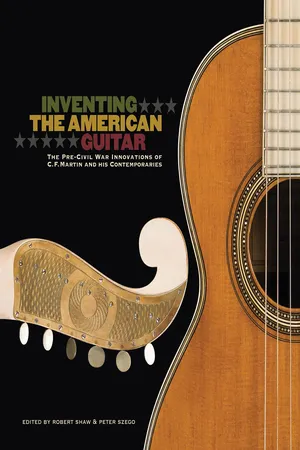
eBook - ePub
Inventing the American Guitar
The Pre-Civil War Innovations of C.F. Martin and His Contemporaries
- English
- ePUB (mobile friendly)
- Available on iOS & Android
eBook - ePub
Inventing the American Guitar
The Pre-Civil War Innovations of C.F. Martin and His Contemporaries
About this book
Information
Subtopic
Guitar MusicTable of contents
- Foreword
- Preface
- PART I AUSTRO-GERMAN STYLE
- PART II SPANISH STYLE
- PART III AMERICAN STYLE
- Timeline: 1833–Present
- Acknowledgments
- Notes
- Glossary
- Bibliography
- Contributors
- Illustration Credits
Trusted by 375,005 students
Access to over 1.5 million titles for a fair monthly price.
Study more efficiently using our study tools.
Frequently asked questions
Yes, you can cancel anytime from the Subscription tab in your account settings on the Perlego website. Your subscription will stay active until the end of your current billing period. Learn how to cancel your subscription
No, books cannot be downloaded as external files, such as PDFs, for use outside of Perlego. However, you can download books within the Perlego app for offline reading on mobile or tablet. Learn how to download books offline
Perlego offers two plans: Essential and Complete
- Essential is ideal for learners and professionals who enjoy exploring a wide range of subjects. Access the Essential Library with 800,000+ trusted titles and best-sellers across business, personal growth, and the humanities. Includes unlimited reading time and Standard Read Aloud voice.
- Complete: Perfect for advanced learners and researchers needing full, unrestricted access. Unlock 1.5M+ books across hundreds of subjects, including academic and specialized titles. The Complete Plan also includes advanced features like Premium Read Aloud and Research Assistant.
We are an online textbook subscription service, where you can get access to an entire online library for less than the price of a single book per month. With over 1.5 million books across 990+ topics, we’ve got you covered! Learn about our mission
Look out for the read-aloud symbol on your next book to see if you can listen to it. The read-aloud tool reads text aloud for you, highlighting the text as it is being read. You can pause it, speed it up and slow it down. Learn more about Read Aloud
Yes! You can use the Perlego app on both iOS and Android devices to read anytime, anywhere — even offline. Perfect for commutes or when you’re on the go.
Please note we cannot support devices running on iOS 13 and Android 7 or earlier. Learn more about using the app
Please note we cannot support devices running on iOS 13 and Android 7 or earlier. Learn more about using the app
Yes, you can access Inventing the American Guitar by James Westbrook,Arian Sheets,Richard Johnston in PDF and/or ePUB format, as well as other popular books in Media & Performing Arts & Guitar Music. We have over 1.5 million books available in our catalogue for you to explore.