For much of the last 25 years, NATO has focused on crisis managementin places such as Kosovo and Afghanistan,resulting in major changes to alliance strategy, resourcing,force structure, and training. Re-embracing collective defense —which lies at the heart of the Treaty of Washington's Article 5 commitment— is no easy feat, and not something NATO can do through rhetoric and official pronouncements. Nonetheless,this shift is vitally necessary if the alliance is to remain the bulwark of Western defense and security. Russia's illegal annexation of Crimea and its invasion of Ukraine have fundamentally upended the security environment in Europe, thrusting NATO into the spotlight as the primary collective defense tool most European states rely upon to ensure their security.
Collective defense is one of the alliance's threecore missions, along with crisis management and cooperative security. It is defined in Article 5, the most well-known and arguably most important part of NATO's founding treaty, which states: "The Parties agree that an armed attack against one or more of them in Europe or North America shall be considered an attack against them all." Although all three missions are vital to the interests of NATO's many member states, collective defense has become first among equals once again. However,three very significant hurdles stand in the way of the alliance and its member states as they attempt to re-embrace collective defense. These loosely correspond to an ends-waysmeans construct. First is the alliance's strategy toward Russia. Is Russia an adversary,a partner,neither,or both? How should strategy and policies change to place the alliance and its members on more solid ground when it comes to managing Russia? Second are the ongoing disputes over resourcing and burden-sharing. In recent years, it has become commonplace for American leaders to publicly berate European allies in an effort to garner more contributions to the common defense. How might the alliance better measure and more equitably share security burdens? Third is the alliance's readiness to fulfill its objectives. Many allies have announced or are implementing increases in defense spending. However, governments of European NATO member states are strongly incentivized by domestic politics to favor acquisition of military hardware or spending on personnel salaries and benefits,usually at the expense of readiness. The result is that NATO military forces risk quickly becoming hollow in a way that is often underappreciated, which will prevent the alliance from fulfilling the collective defense promise inherent in Article 5. The book examines all such questions to assess NATO's return to collective defense and offer a roadmap for overcoming those challenges in both the short and long-term.
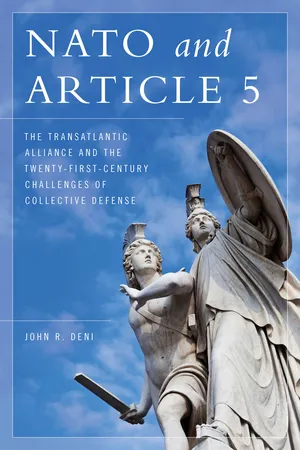
eBook - ePub
NATO and Article 5
The Transatlantic Alliance and the Twenty-First-Century Challenges of Collective Defense
- English
- ePUB (mobile friendly)
- Available on iOS & Android
eBook - ePub
NATO and Article 5
The Transatlantic Alliance and the Twenty-First-Century Challenges of Collective Defense
About this book
Information
Table of contents
- Preface and Acknowledgments
- 1 Introduction
- 2 From Collective Defense to Collective Security and Back Again
- 3 NATO’s Russia Problem—Getting the Ends Right
- 4 Defense Spending and Burden-Sharing: Finding Means to Defend
- 5 NATO’s Collective Defense Ways: Shortchanging Readiness?
- 6 The Way Ahead: Prescriptions for NATO Collective Defense
- Bibliography
- Index
- About the Author
Trusted by 375,005 students
Access to over 1.5 million titles for a fair monthly price.
Study more efficiently using our study tools.
Frequently asked questions
Yes, you can cancel anytime from the Subscription tab in your account settings on the Perlego website. Your subscription will stay active until the end of your current billing period. Learn how to cancel your subscription
No, books cannot be downloaded as external files, such as PDFs, for use outside of Perlego. However, you can download books within the Perlego app for offline reading on mobile or tablet. Learn how to download books offline
Perlego offers two plans: Essential and Complete
- Essential is ideal for learners and professionals who enjoy exploring a wide range of subjects. Access the Essential Library with 800,000+ trusted titles and best-sellers across business, personal growth, and the humanities. Includes unlimited reading time and Standard Read Aloud voice.
- Complete: Perfect for advanced learners and researchers needing full, unrestricted access. Unlock 1.5M+ books across hundreds of subjects, including academic and specialized titles. The Complete Plan also includes advanced features like Premium Read Aloud and Research Assistant.
We are an online textbook subscription service, where you can get access to an entire online library for less than the price of a single book per month. With over 1.5 million books across 990+ topics, we’ve got you covered! Learn about our mission
Look out for the read-aloud symbol on your next book to see if you can listen to it. The read-aloud tool reads text aloud for you, highlighting the text as it is being read. You can pause it, speed it up and slow it down. Learn more about Read Aloud
Yes! You can use the Perlego app on both iOS and Android devices to read anytime, anywhere — even offline. Perfect for commutes or when you’re on the go.
Please note we cannot support devices running on iOS 13 and Android 7 or earlier. Learn more about using the app
Please note we cannot support devices running on iOS 13 and Android 7 or earlier. Learn more about using the app
Yes, you can access NATO and Article 5 by John R. Deni in PDF and/or ePUB format, as well as other popular books in Politics & International Relations & National Security. We have over 1.5 million books available in our catalogue for you to explore.