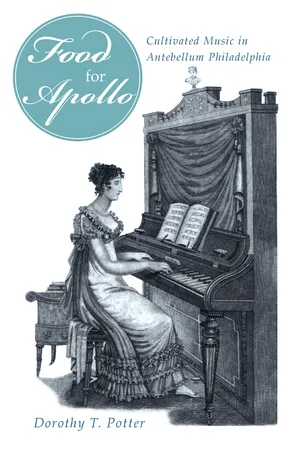
Food for Apollo by Dorothy Potter, describes and evaluates the growth and scope of cultivated music in Philadelphia, from the early eighteenth-century to the advent of the Civil War. In many works dealing with American culture, discussion of music's influence is limited to a few significant performances or persons, or ignored altogether. The study of music's role in cultural history is fairly recent, compared to literature, art, and architecture. Whether vernacular or based on European models, a more thorough understanding of music should include attention to related subjects. This book examines concert and theatre performances, music publishing, pre-1861 manufacture of pianos, and British and American literature which promoted music, informing readers about individuals such as Wolfgang Amadeus Mozart, whose works and fame generated interest on both sides of the Atlantic.
Though initially hindered by the Society of Friends' opposition to entertainments of all sorts, numbers of non-Quakers supported dancing, concerts, and drama by the 1740s; this interest accelerated after the Revolution, with the building of some of America's earliest theatres, and over time, Musical Fund Hall, the Academy of Music, and other venues. Emigrant musicians, notably Alexander Reinagle, introduced new works by contemporary Europeans such as Franz Joseph Haydn, Mozart, C.P. E. Bach, and many others, in concerts blended with favorite tunes, like the "President's March." Later in the nineteenth century, Philadelphia's noted African-American composer and band leader Francis Johnson, continued the tradition of mixing classical and vernacular works in his popular promenade concerts. As they advertised and shipped their music to an ever-growing market, post-Revolutionary emigrant music publishers, including Benjamin Carr and his family, George Willig, and George Blake, created successful businesses that influenced American taste far beyond Philadelphia.
- English
- ePUB (mobile friendly)
- Available on iOS & Android
eBook - ePub
About this book
Information
Table of contents
- Acknowledgments
- Introduction
- 1 Philadelphia’s Musical Beginnings, 1700–1786
- 2 From City Tavern to Musical Fund Society Hall: Philadelphia’s Music in Transition, 1786–1831
- 3 Cultivated Music Adapts and Thrives, 1831–1861
- 4 Music for the Masses: Publishers and Piano Makers, 1786–1861
- 5 Historians, Critics, and Romantics: Mozart in Literature, 1803–1861
- Appendix
- Notes
- Bibliography
Trusted by 375,005 students
Access to over 1.5 million titles for a fair monthly price.
Study more efficiently using our study tools.
Frequently asked questions
Yes, you can cancel anytime from the Subscription tab in your account settings on the Perlego website. Your subscription will stay active until the end of your current billing period. Learn how to cancel your subscription
No, books cannot be downloaded as external files, such as PDFs, for use outside of Perlego. However, you can download books within the Perlego app for offline reading on mobile or tablet. Learn how to download books offline
Perlego offers two plans: Essential and Complete
- Essential is ideal for learners and professionals who enjoy exploring a wide range of subjects. Access the Essential Library with 800,000+ trusted titles and best-sellers across business, personal growth, and the humanities. Includes unlimited reading time and Standard Read Aloud voice.
- Complete: Perfect for advanced learners and researchers needing full, unrestricted access. Unlock 1.5M+ books across hundreds of subjects, including academic and specialized titles. The Complete Plan also includes advanced features like Premium Read Aloud and Research Assistant.
We are an online textbook subscription service, where you can get access to an entire online library for less than the price of a single book per month. With over 1.5 million books across 990+ topics, we’ve got you covered! Learn about our mission
Look out for the read-aloud symbol on your next book to see if you can listen to it. The read-aloud tool reads text aloud for you, highlighting the text as it is being read. You can pause it, speed it up and slow it down. Learn more about Read Aloud
Yes! You can use the Perlego app on both iOS and Android devices to read anytime, anywhere — even offline. Perfect for commutes or when you’re on the go.
Please note we cannot support devices running on iOS 13 and Android 7 or earlier. Learn more about using the app
Please note we cannot support devices running on iOS 13 and Android 7 or earlier. Learn more about using the app
Yes, you can access 'Food for Apollo' by Dorothy T. Potter in PDF and/or ePUB format, as well as other popular books in History & Social History. We have over 1.5 million books available in our catalogue for you to explore.