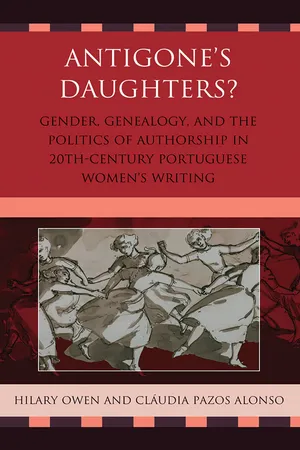
Antigone's Daughters? provides the first detailed discussion in English of six well-known Portuguese women writers, working across a wide range of genres: Florbela Espanca (1894-1930), Irene Lisboa (1892-1958), Agustina Bessa Luís, (1923- ), Natália Correia (1923-93), Hélia Correia (1949 -) and Lídia Jorge (1946 - ). Together they cover the span of the 20th century and afford historical insights into the complex gender politics of achieving institutional acceptance and validation in the Portuguese national canon at different points in the 20th century.
Although a patrilinear evolutionary model visibly structures national literary history in Portugal to the present day, women writers and critics have not generally sought to replace this with a matrilinear feminist counter-history. The unifying metaphor that the authors adopt here for the purpose of discussing Portuguese women's ambivalent response to female genealogy is the classical figure of Antigone, who paradoxically sacrifices her own genealogical continuity in the name of defending family and kinship, while resisting the patriarchal pragmatics of state-building. Should women writers, faced with the absence of a female tradition, posit a woman-centred place outside the jurisdiction of male genealogy, however strategically essentialist that place may be, or should they primarily eschew fixed sexual identity to act as unnameable saboteurs, undoing the law of patriarchal tradition from within?
eBook - ePub
Antigone's Daughters?
Gender, Genealogy and the Politics of Authorship in 20th-Century Portuguese Women's Writing
- English
- ePUB (mobile friendly)
- Available on iOS & Android
eBook - ePub
Antigone's Daughters?
Gender, Genealogy and the Politics of Authorship in 20th-Century Portuguese Women's Writing
About this book
Information
Table of contents
- Acknowledgments
- Introduction
- 1. Florbela Espanca and Female Genius: Alone of All Her Sex?
- 2. Irene Lisboa: Minding the Gender Gap
- 3. The Case of the Missing Body: Allegories of Authorship in Agustina Bessa Luís
- 4. Matriarchal Precedents: Thus Spoke Natália Correia
- 5. Giving Up Whose Ghost in the Works of Hélia Correia?
- 6. Sexual/Textual Re-Visions in Lídia Jorge
- Conclusion
- Notes
- Bibliography
Trusted by 375,005 students
Access to over 1.5 million titles for a fair monthly price.
Study more efficiently using our study tools.
Frequently asked questions
Yes, you can cancel anytime from the Subscription tab in your account settings on the Perlego website. Your subscription will stay active until the end of your current billing period. Learn how to cancel your subscription
No, books cannot be downloaded as external files, such as PDFs, for use outside of Perlego. However, you can download books within the Perlego app for offline reading on mobile or tablet. Learn how to download books offline
Perlego offers two plans: Essential and Complete
- Essential is ideal for learners and professionals who enjoy exploring a wide range of subjects. Access the Essential Library with 800,000+ trusted titles and best-sellers across business, personal growth, and the humanities. Includes unlimited reading time and Standard Read Aloud voice.
- Complete: Perfect for advanced learners and researchers needing full, unrestricted access. Unlock 1.5M+ books across hundreds of subjects, including academic and specialized titles. The Complete Plan also includes advanced features like Premium Read Aloud and Research Assistant.
We are an online textbook subscription service, where you can get access to an entire online library for less than the price of a single book per month. With over 1.5 million books across 990+ topics, we’ve got you covered! Learn about our mission
Look out for the read-aloud symbol on your next book to see if you can listen to it. The read-aloud tool reads text aloud for you, highlighting the text as it is being read. You can pause it, speed it up and slow it down. Learn more about Read Aloud
Yes! You can use the Perlego app on both iOS and Android devices to read anytime, anywhere — even offline. Perfect for commutes or when you’re on the go.
Please note we cannot support devices running on iOS 13 and Android 7 or earlier. Learn more about using the app
Please note we cannot support devices running on iOS 13 and Android 7 or earlier. Learn more about using the app
Yes, you can access Antigone's Daughters? by Hilary Owen,Cláudia Pazos Alonso in PDF and/or ePUB format, as well as other popular books in Literature & European Literary Criticism. We have over 1.5 million books available in our catalogue for you to explore.