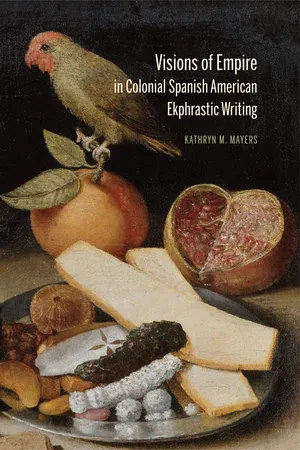
The process of shaping and asserting cultural identity in viceregal Spanish America occurred as much through the medium of pictures as through the medium of writing. Focused on writing that references visual texts (ekphrasis), Visions of Empire in Colonial Spanish American Ekphrastic Writing examines the way words about pictures in the writing of three Spanish American Creoles-Hernando Domínguez Camargo, Juan de Espinosa Medrano, and Sor Juana Inés de la Cruz-negotiate the challenges that confronted the American-born ruling elite in Spanish America during the contentious transitional period between the Conquest and Independence.
In Spanish America, pictures have long served as a crucial medium for cultural communication. In vast rural and urban regions where print culture is not deeply rooted and being "cultured" is not synonymous with being "literate," visual texts ranging from pre-Hispanic pictographic codices to Baroque architectural surfaces to postmodern painted murals have played an essential role in shaping and asserting cultural identity. During the viceregal era, texts that referenced such visual texts proliferated in Latin America, particularly among Creole elites, who found themselves trapped in an ambiguous political and social position between Spain and America. At the level of content, Creole ekphrases bear little obvious connection to categories of social privilege. On the level of form, however, these ekphrases engage conventions of representation that reveal the social contingencies of the poetic gaze. They refract the visual object through an ideologically-charged language that invokes differentials of race, class, gender, sexuality, nationality, and position within the colonial power structure.
Visions of Empire brings recent scholarship on visuality and ekphrasis to bear on twenty-first-century reexaminations of criollismo to explore how cultural productions of the Spanish American Creole elite exercised relations of power, mediated social differences, and presented symbolic organizations of social space. Focusing on the way Creole adaptations of Gongoran ekphrases placed the Creoles in a position of epistemological, economic, or moral authority over peninsular Spaniards and Amerindian and casta majorities around them, this book illustrates how Creole words about pictures propose alternate visions of empire, symbolically reordering Spain's empire in the Americas around the figure of the Creole.
- English
- ePUB (mobile friendly)
- Available on iOS & Android
eBook - ePub
Visions of Empire in Colonial Spanish American Ekphrastic Writing
About this book
Information
Table of contents
- Acknowledgments
- Introduction
- A Note on Translations
- Chapter 1: Picturing Power
- Chapter 2: Imag(in)ing Empire
- Chapter 3: Pictures of Plenty
- Chapter 4: Icons of Identities
- Chapter 5: Portraits of Privilege
- Conclusion
- Bibliography
- About the Author
Trusted by 375,005 students
Access to over 1.5 million titles for a fair monthly price.
Study more efficiently using our study tools.
Frequently asked questions
Yes, you can cancel anytime from the Subscription tab in your account settings on the Perlego website. Your subscription will stay active until the end of your current billing period. Learn how to cancel your subscription
No, books cannot be downloaded as external files, such as PDFs, for use outside of Perlego. However, you can download books within the Perlego app for offline reading on mobile or tablet. Learn how to download books offline
Perlego offers two plans: Essential and Complete
- Essential is ideal for learners and professionals who enjoy exploring a wide range of subjects. Access the Essential Library with 800,000+ trusted titles and best-sellers across business, personal growth, and the humanities. Includes unlimited reading time and Standard Read Aloud voice.
- Complete: Perfect for advanced learners and researchers needing full, unrestricted access. Unlock 1.5M+ books across hundreds of subjects, including academic and specialized titles. The Complete Plan also includes advanced features like Premium Read Aloud and Research Assistant.
We are an online textbook subscription service, where you can get access to an entire online library for less than the price of a single book per month. With over 1.5 million books across 990+ topics, we’ve got you covered! Learn about our mission
Look out for the read-aloud symbol on your next book to see if you can listen to it. The read-aloud tool reads text aloud for you, highlighting the text as it is being read. You can pause it, speed it up and slow it down. Learn more about Read Aloud
Yes! You can use the Perlego app on both iOS and Android devices to read anytime, anywhere — even offline. Perfect for commutes or when you’re on the go.
Please note we cannot support devices running on iOS 13 and Android 7 or earlier. Learn more about using the app
Please note we cannot support devices running on iOS 13 and Android 7 or earlier. Learn more about using the app
Yes, you can access Visions of Empire in Colonial Spanish American Ekphrastic Writing by Kathryn M Mayers in PDF and/or ePUB format, as well as other popular books in History & European History. We have over 1.5 million books available in our catalogue for you to explore.