Does fiction do more than just represent space? Can our experiences with fictional storytelling be in themselves spatial? In Constructing Spain: The Re-imagination of Space and Place in Fiction and Film, Nathan Richardson explores relations between cultural representation and spatial transformation across fifty years of Spanish culture. Beginning in 1953, the year Spanish space was officially reopened to Western thought and capital, and culminating in 2003, the year of Aznar's unpopular involvement of his country in the second Iraq War, Richardson traces in popular and critically acclaimed fiction and film an evolution in Spanish storytelling that, while initially representative in nature, increasingly engages its audience in spatial practices that go beyond mere perception or conception of local material geographies.
In original readings of films by Luis Berlanga, Luis Buñuel, Alex de la Iglesia, Alejandro Amenábar, and Julio Medem, and novels by Juan Goytisolo, Antonio Muñoz Molina, and Javier Marías, Richardson shows this formal evolution as a necessary response to developments, restorations, and transformations of local landscapes that resulted during these years from various human migrations, tourist-invasions, urban development plans, resurgent nationalisms, and finally globalization. As these changes occur, Richardson traces a shift in the works studied from mere representation of spatial change toward actual engagement with shifting physical and social geographies, as they inch ever closer toward the production of an actual spatial experience for their audiences. In the final chapters of this book, Richardson offers in-depth and highly original readings of the storytelling projects of Medem and Marías in particular, showing how these two artists invite readers to not only reconceive hegemonic notions of space and place, but to practice alternative notions of being-in-place. In these final readings, Constructing Spain, points to the newest developments in contemporary Spanish narrative and film, a rise of new grammars of creation to challenge the ongoing capital-driven creative destruction of globalized Spanish geography.
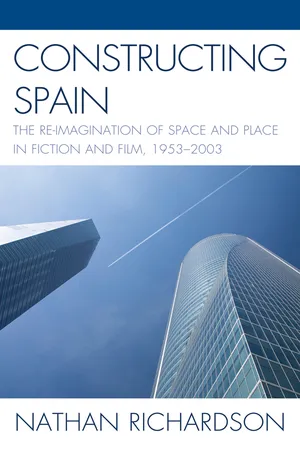
eBook - ePub
Constructing Spain
The Re-imagination of Space and Place in Fiction and Film, 1953–2003
- English
- ePUB (mobile friendly)
- Available on iOS & Android
eBook - ePub
Constructing Spain
The Re-imagination of Space and Place in Fiction and Film, 1953–2003
About this book
Information
Subtopic
Film & VideoTable of contents
- Preface
- Chapter 1: Spanish Territories, Global Geographies
- Chapter 2: The Construction of Space and Place in Franco’s Spain (1953–1970)
- Chapter 3: Building Beyond Spain
- Chapter 4: Sacred Spain
- Chapter 5: The World Will Be Redonda, or the Dark Back of Community
- Chapter 6: Preserving the House While Pursuing the World
- Chapter 7: Spanish Grammars of Creation
- Bibliography
Trusted by 375,005 students
Access to over 1.5 million titles for a fair monthly price.
Study more efficiently using our study tools.
Frequently asked questions
Yes, you can cancel anytime from the Subscription tab in your account settings on the Perlego website. Your subscription will stay active until the end of your current billing period. Learn how to cancel your subscription
No, books cannot be downloaded as external files, such as PDFs, for use outside of Perlego. However, you can download books within the Perlego app for offline reading on mobile or tablet. Learn how to download books offline
Perlego offers two plans: Essential and Complete
- Essential is ideal for learners and professionals who enjoy exploring a wide range of subjects. Access the Essential Library with 800,000+ trusted titles and best-sellers across business, personal growth, and the humanities. Includes unlimited reading time and Standard Read Aloud voice.
- Complete: Perfect for advanced learners and researchers needing full, unrestricted access. Unlock 1.5M+ books across hundreds of subjects, including academic and specialized titles. The Complete Plan also includes advanced features like Premium Read Aloud and Research Assistant.
We are an online textbook subscription service, where you can get access to an entire online library for less than the price of a single book per month. With over 1.5 million books across 990+ topics, we’ve got you covered! Learn about our mission
Look out for the read-aloud symbol on your next book to see if you can listen to it. The read-aloud tool reads text aloud for you, highlighting the text as it is being read. You can pause it, speed it up and slow it down. Learn more about Read Aloud
Yes! You can use the Perlego app on both iOS and Android devices to read anytime, anywhere — even offline. Perfect for commutes or when you’re on the go.
Please note we cannot support devices running on iOS 13 and Android 7 or earlier. Learn more about using the app
Please note we cannot support devices running on iOS 13 and Android 7 or earlier. Learn more about using the app
Yes, you can access Constructing Spain by Nathan Richardson in PDF and/or ePUB format, as well as other popular books in Media & Performing Arts & Film & Video. We have over 1.5 million books available in our catalogue for you to explore.