Afro-Cuban Identity in Post-Revolutionary Novel and Film examines the changing discourse on race as portrayed in Cuban novels and films produced after 1959. Andrea Easley Morris analyzes the artists' participation in and questioning of the revolutionary government's revision of national identity to include the unique experience and contributions of Cuban men and women of African descent. While the Cuban revolution brought sweeping changes that vastly improved the material condition of many Afro-Cubans, at the time overrepresented among Cuba's poor and marginalized, the government's official position was that racial inequities had been resolved as early as 1962. Although a more open dialogue on race was cut short, the work of several novelists and film directors from the late 1960s and 70s expresses the need to explore what was gained and lost by Afro-Cubans in the early years of the revolution, among them Manuel Granados, Miguel Barnet, Nivaria Tejera, Sara Gómez, César Leante, Tomás Gutiérrez Alea, Sergio Giral, and Manuel Cofiño.
Their works participate in the process of redefining Cuban national identity that took place after the revolution and, more specifically, they explore the place of Afro-Cuban identity within a broader notion of revolutionary "Cubanness." This occurs through an emphasis on Afro-Cuban cultural practices that have constituted forms of resistance to colonial and neo-colonial oppression. This book examines the identity conflicts portrayed in these works and takes into account the artists' negotiation of their own status within the revolutionary context by looking at the narrative strategies used to address racial issues within the constraints placed on cultural production in Cuba after 1962.
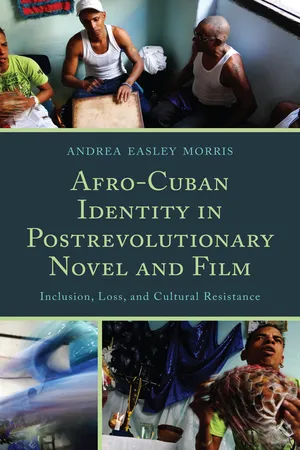
eBook - ePub
Afro-Cuban Identity in Post-Revolutionary Novel and Film
Inclusion, Loss, and Cultural Resistance
- English
- ePUB (mobile friendly)
- Available on iOS & Android
eBook - ePub
Afro-Cuban Identity in Post-Revolutionary Novel and Film
Inclusion, Loss, and Cultural Resistance
About this book
Information
Table of contents
- Acknowledgments
- Introduction: Creative Difference(s)
- 1 Contradictory Approaches to Race, from Independence to Revolution
- Part I: Representing Difference in Colonial and Republican Settings
- 3 Performing the Mulata Rumbera
- 4 Fragmented Cubanness by Way of Détour
- Part II: Postrevolutionary Identities in Conflict
- 6 Race, Place, and Marginality
- Conclusion
- Epilogue: The 1980s and Beyond
- Bibliography
- Index
Trusted by 375,005 students
Access to over 1.5 million titles for a fair monthly price.
Study more efficiently using our study tools.
Frequently asked questions
Yes, you can cancel anytime from the Subscription tab in your account settings on the Perlego website. Your subscription will stay active until the end of your current billing period. Learn how to cancel your subscription
No, books cannot be downloaded as external files, such as PDFs, for use outside of Perlego. However, you can download books within the Perlego app for offline reading on mobile or tablet. Learn how to download books offline
Perlego offers two plans: Essential and Complete
- Essential is ideal for learners and professionals who enjoy exploring a wide range of subjects. Access the Essential Library with 800,000+ trusted titles and best-sellers across business, personal growth, and the humanities. Includes unlimited reading time and Standard Read Aloud voice.
- Complete: Perfect for advanced learners and researchers needing full, unrestricted access. Unlock 1.5M+ books across hundreds of subjects, including academic and specialized titles. The Complete Plan also includes advanced features like Premium Read Aloud and Research Assistant.
We are an online textbook subscription service, where you can get access to an entire online library for less than the price of a single book per month. With over 1.5 million books across 990+ topics, we’ve got you covered! Learn about our mission
Look out for the read-aloud symbol on your next book to see if you can listen to it. The read-aloud tool reads text aloud for you, highlighting the text as it is being read. You can pause it, speed it up and slow it down. Learn more about Read Aloud
Yes! You can use the Perlego app on both iOS and Android devices to read anytime, anywhere — even offline. Perfect for commutes or when you’re on the go.
Please note we cannot support devices running on iOS 13 and Android 7 or earlier. Learn more about using the app
Please note we cannot support devices running on iOS 13 and Android 7 or earlier. Learn more about using the app
Yes, you can access Afro-Cuban Identity in Post-Revolutionary Novel and Film by Andrea Easley Morris in PDF and/or ePUB format, as well as other popular books in Literature & 20th Century History. We have over 1.5 million books available in our catalogue for you to explore.