- English
- ePUB (mobile friendly)
- Available on iOS & Android
eBook - ePub
About this book
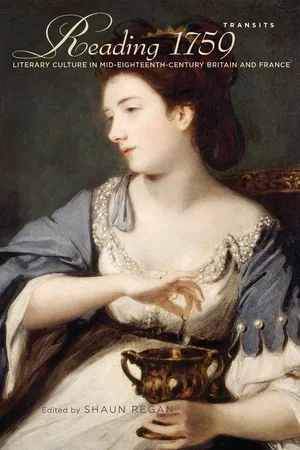
Reading 1759 investigates the literary culture of a remarkable year in British and French history, writing, and ideas. Familiar to many as the British "year of victories" during the Seven Years' War, 1759 was also an important year in the histories of fiction, philosophy, ethics, and aesthetics. Reading 1759 is the first book to examine together the range of works written and published during this crucial year. Offering broad coverage of the year's work in writing, these essays examine key works by Johnson, Voltaire, Sterne, Adam Smith, Edward Young, Sarah Fielding, and Christopher Smart, along with such group projects as the Encyclopédie and the literary review journals of the mid-eighteenth century. Organized around a cluster of key topics, the volume reflects the concerns most important to writers themselves in 1759. This was a year of the new and the modern, as writers addressed current issues of empire and ethical conduct, forged new forms of creative expression, and grappled with the nature of originality itself. Texts written and published in 1759 confronted the history of Western colonialism, the problem of prostitution in a civilized society, and the limitations of linguistic expression. Philosophical issues were also important in 1759, not least the thorny question of causation; while, in France, state censorship challenged the Encyclopédie, the central Enlightenment project. Taking into its purview such texts and intellectual developments, Reading 1759 puts the literary culture of this singular, and singularly important, year on the scholarly map. In the process, the volume also provides a self-reflective contribution to the growing body of "annualized" studies that focus on the literary output of specific years.
Information
Table of contents
- Contents
- Acknowledgements
- Introduction
- Part I: Writing Empire
- Chapter 1: “What mankind has lost and gained”: Johnson, Rasselas, and Colonialism
- Chapter 2: Voltaire’s Candide as a Global Text: War, Slavery, and Leadership
- Part II: Sentimental Ethics, Luxurious Sexualities
- Chapter 3: Adam Smith’s The Theory of Moral Sentiments in 1759: Spectatorship, Duty, and Social Improvement
- Chapter 4: “On the soft beds of luxury most kingdoms have expired”: 1759 and the Lives of Prostitutes
- Part III: Authorship and Aesthetics
- Chapter 5: Young, Goldsmith, Johnson, and the Idea of the Author in 1759
- Chapter 6: Towards a New Language: Sublime Aesthetics in Smart’s Jubilate Agno
- Part IV: Enlightenment and Its Discontents
- Chapter 7: The Encyclopédie in 1759: Crisis and Continuation
- Chapter 8: Lost Cause: Hume, Causation, and Rasselas
- Part V: Originality and Appropriation
- Chapter 9: Eccentricity, Originality, and the Novel: Tristram Shandy, volumes 1 and 2
- Chapter 10: Shakespeare’s “Propriety” and the Mid-Eighteenth-Century Novel: Sarah Fielding’s The History of the Countess of Dellwyn
- Part VI: Conclusion: Reading 1759
- Chapter 11: Writers, Reviewers, and the Culture of Reading
- Bibliography
- Contributors
Trusted by 375,005 students
Access to over 1.5 million titles for a fair monthly price.
Study more efficiently using our study tools.
Frequently asked questions
Yes, you can cancel anytime from the Subscription tab in your account settings on the Perlego website. Your subscription will stay active until the end of your current billing period. Learn how to cancel your subscription
No, books cannot be downloaded as external files, such as PDFs, for use outside of Perlego. However, you can download books within the Perlego app for offline reading on mobile or tablet. Learn how to download books offline
Perlego offers two plans: Essential and Complete
- Essential is ideal for learners and professionals who enjoy exploring a wide range of subjects. Access the Essential Library with 800,000+ trusted titles and best-sellers across business, personal growth, and the humanities. Includes unlimited reading time and Standard Read Aloud voice.
- Complete: Perfect for advanced learners and researchers needing full, unrestricted access. Unlock 1.5M+ books across hundreds of subjects, including academic and specialized titles. The Complete Plan also includes advanced features like Premium Read Aloud and Research Assistant.
We are an online textbook subscription service, where you can get access to an entire online library for less than the price of a single book per month. With over 1.5 million books across 990+ topics, we’ve got you covered! Learn about our mission
Look out for the read-aloud symbol on your next book to see if you can listen to it. The read-aloud tool reads text aloud for you, highlighting the text as it is being read. You can pause it, speed it up and slow it down. Learn more about Read Aloud
Yes! You can use the Perlego app on both iOS and Android devices to read anytime, anywhere — even offline. Perfect for commutes or when you’re on the go.
Please note we cannot support devices running on iOS 13 and Android 7 or earlier. Learn more about using the app
Please note we cannot support devices running on iOS 13 and Android 7 or earlier. Learn more about using the app
Yes, you can access Reading 1759 by Shaun Regan in PDF and/or ePUB format, as well as other popular books in Literature & European History. We have over 1.5 million books available in our catalogue for you to explore.